Global Gas Chromatography Market Poised for Resilient Growth, Projected to Scale Significant Heights by 2036
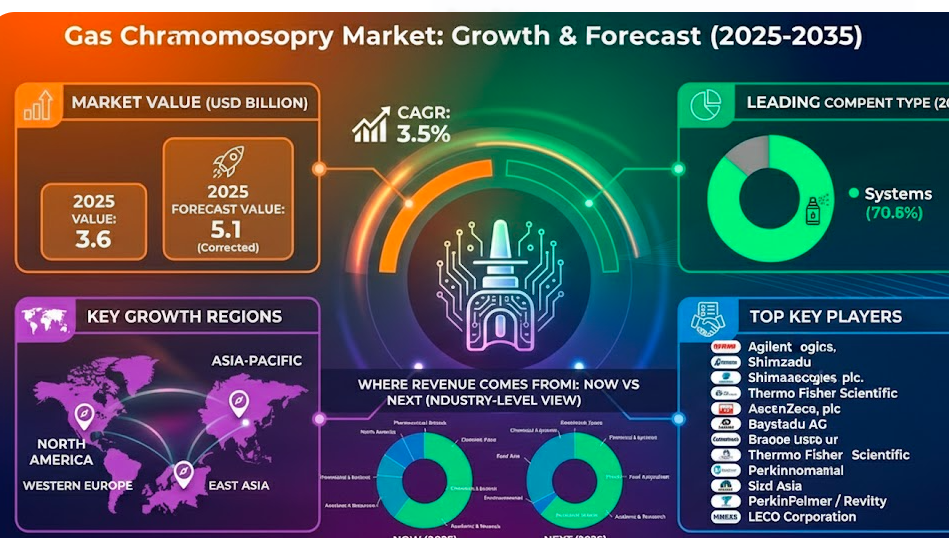
The global gas chromatography (GC) market has entered a transformative era, driven by a surge in pharmaceutical R&D, stringent environmental mandates, and a revolution in smart analytical instrumentation. Following a pivotal milestone in early 2026, where market valuations climbed to approximately $3.07 billion, new industry intelligence projects a robust growth trajectory extending through 2036.
According to the latest strategic outlook, the gas chromatography sector is expanding at a compound annual growth rate (CAGR) of 6.7%. This momentum is fueled by the critical need for high-precision analytical testing in drug discovery, food safety, and industrial sustainability.
Key Market Fundamentals: Who, What, and Why
The resurgence of the GC market is anchored by several critical pillars that define the current industrial landscape:
-
Who is driving the market: Pharmaceutical and biotechnology companies currently lead the demand, accounting for roughly 31% of global revenue. Major industry players—including Agilent Technologies, Thermo Fisher Scientific, Shimadzu Corporation, and PerkinElmer—are reporting high demand for platforms that integrate AI-driven diagnostics.
-
What is evolving: The industry is shifting from traditional, high-maintenance hardware to modular and portable GC systems. These smart instruments feature onboard sensors that predict component failure and monitor column health in real-time, effectively transitioning GC from a specialty tool to a seamless industrial utility.
-
Where growth is concentrated: While North America remains the dominant force with over 39% market share, the Asia-Pacific region has emerged as the fastest-growing frontier. Rapid industrialization and the localization of pharmaceutical manufacturing in India and China are expected to sustain double-digit growth rates in specific sub-sectors.
-
Why it matters: As global regulatory bodies like the FDA and EMA tighten standards for impurity profiling and residual solvent analysis, GC remains the gold standard for separating and identifying volatile substances at parts-per-trillion (ppt) levels.
Data-Backed Insights: 2026–2036 Forecast
The 2026–2036 forecast period highlights a market that is not only growing in size but also in technical sophistication.
| Metric | 2026 Estimate | 2036 Projection |
| Market Valuation | $3.07 Billion | ~$6.0+ Billion |
| Primary Growth Driver | Pharmaceutical R&D | Lab Sustainability/AI Integration |
| Fastest Growing Region | Asia-Pacific | Asia-Pacific & LAMEA |
| Leading Segment | Accessories & Consumables | Accessories & Smart Software |
The 2026 laboratory environment is no longer just about generating data; it’s about generating actionable intelligence, states a leading industry analyst. The shift toward automated, modular systems means that GC is becoming a ‘plug-and-play’ necessity for quality control.
Strategic Trends Shaping the Next Decade
As the market moves toward 2036, three primary trends are expected to dominate the strategic landscape:
1. The Rise of Green Chromatography
Sustainability has moved from a corporate goal to a technical requirement. Labs are increasingly transitioning from helium—which faces supply constraints—to hydrogen-based carrier gas alternatives. Manufacturers are responding by designing energy-efficient oven technologies that reduce power consumption and carbon footprints.
2. AI and Cloud-Enabled Analytics
Modern gas chromatographs are now frequently paired with cloud-connected platforms. This allows pharmaceutical and biopharmaceutical laboratories with multi-site operations to maintain standardized methods and centralized visibility, ensuring consistent compliance across different geographic locations.
3. Micro-Gas Chromatography (µ-GC)
The demand for real-time, on-site analysis in the oil and gas and environmental sectors has accelerated the development of Micro-GC systems. These compact devices integrate columns and detectors onto silicon platforms, enabling rapid analysis for applications like natural gas energy content testing and carbon capture monitoring.
Industry Outlook and Investor Relevance
For investors and market professionals, the gas chromatography market represents a stable, high-value sector with significant recurring revenue. The Accessories and Consumables segment—including high-resolution columns and RFID-enabled valves—continues to account for the largest revenue share (approx. 55%), providing a resilient financial foundation even during broader economic fluctuations.
As the industry looks toward 2036, the integration of Gas Chromatography-Mass Spectrometry (GC-MS) as a plug-and-play diagnostic tool will likely redefine clinical forensics, environmental monitoring, and the production of complex biopharmaceuticals.
Browse Full Report : https://www.factmr.com/report/193/gas-chromatography-market
About Fact.MR
Fact.MR is a global market research and consulting firm, trusted by Fortune 500 companies and emerging businesses for reliable insights and strategic intelligence. With a presence across the U.S., UK, India, and Dubai, we deliver data-driven research and tailored consulting solutions across 30+ industries and 1,000+ markets. Backed by deep expertise and advanced analytics, Fact.MR helps organizations uncover opportunities, reduce risks, and make informed decisions for sustainable growth.