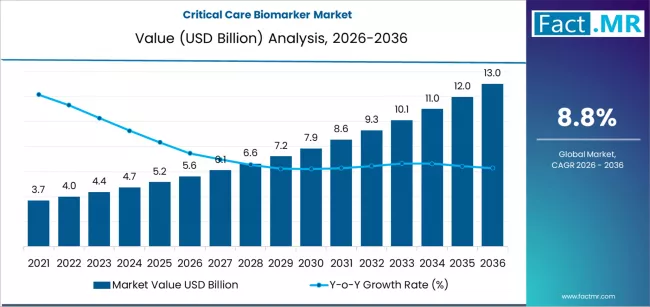
The global critical care biomarker market is entering a phase of rapid clinical industrialization, with its valuation projected to grow from USD 0.8 billion in 2026 to USD 1.8 billion by 2036. According to a specialized industry analysis, this represents a robust compound annual growth rate (CAGR) of 8.5%, signaling a transformative shift in the management of life-threatening conditions.
As Intensive Care Units (ICUs) face increasing pressure to improve patient outcomes while reducing hospital stays, the demand for high-sensitivity biomarkers has evolved from a supplemental diagnostic tool to a cornerstone of emergency medicine. These molecular indicators are now essential for the early detection of sepsis, acute kidney injury (AKI), and myocardial infarction, allowing clinicians to initiate life-saving interventions hours before clinical symptoms fully manifest.
Summary Table: Critical Care Biomarker Market Outlook
| Metric | Details |
| Market Value (2026E) | USD 0.8 Billion |
| Forecast Value (2036F) | USD 1.8 Billion |
| Projected CAGR (2026-2036) | 8.5% |
| Leading Category | Cardiometabolic Biomarkers (42.5% Share) |
| Primary End-User | Hospitals & ICU Centers (65%+ Share) |
| Highest Growth Market | India (10.2% CAGR) |
Request for Sample Report | Customize Report – https://www.factmr.com/connectus/sample?flag=S&rep_id=13602
Core Market Dynamics: Answering the Strategic ‘Who,’ ‘What,’ and ‘Why’
Critical care biomarkers are biological molecules—such as proteins, enzymes, or hormones—measured in blood or urine to evaluate organ function and disease progression in acutely ill patients.
-
Who is leading the sector? Industry titans including Roche Diagnostics, Abbott Laboratories, Thermo Fisher Scientific, Siemens Healthineers, and Danaher Corporation are at the forefront, developing high-throughput assays and point-of-care (POC) testing kits.2
-
What is the dominant biomarker category? Cardiometabolic Biomarkers command a significant 42.5% market share. Troponin and Natriuretic Peptides remain the gold standard for rapid cardiac assessment, though Procalcitonin (PCT) for sepsis monitoring is the fastest-growing sub-segment.
-
Where is growth most accelerated? India is emerging as the fastest-growing market with a 10.2% CAGR, fueled by a massive expansion in private critical care infrastructure. China follows with a 9.5% CAGR, supported by national initiatives to modernize emergency response networks.
-
Why is the technology shifting? The market is moving toward Multiplex Testing. Instead of testing for single indicators, clinicians are adopting panels that can simultaneously screen for inflammation, cardiac stress, and renal failure from a single patient sample.
Sector Insights: Hospitals and Emergency Departments Drive Volume
The Hospitals and Critical Care Centers segment remains the primary end-user, projected to hold over 65% of the market share by 2026. However, the Emergency Medical Services (EMS) segment is seeing rapid adoption of handheld biomarker readers, enabling “pre-hospital” diagnostics that can streamline the triage process before a patient even reaches the ER.
“The integration of biomarkers into critical care is a paradigm shift from reactive to proactive medicine,” the analysis states. “In the case of sepsis—where every hour of delayed treatment increases mortality by nearly 8%—biomarkers like Procalcitonin provide the diagnostic velocity required to save lives. We are seeing a major trend where biomarkers are no longer just ‘confirming’ a diagnosis; they are ‘predicting’ complications like multi-organ failure before they occur.”
Key Market Trends and Strategic Outlook
1. Optimization through Point-of-Care (POC) Integration
One of the most significant absolute dollar opportunities lies in Handheld Biosensors. There is a surge in demand for portable devices that provide lab-quality results at the bedside in under 15 minutes. This trend is particularly dominant in North America, which currently holds a 35% global market share, as facilities focus on reducing “time-to-decision” metrics.
2. The Rise of Acute Kidney Injury (AKI) Biomarkers
While cardiac markers are established, the market is seeing an influx of specialized markers like NGAL (Neutrophil Gelatinase-Associated Lipocalin) and KIM-1. These markers allow for the detection of kidney stress up to 48 hours earlier than traditional creatinine tests, creating a high-value niche in the post-operative care segment.
3. Regulatory and Digital Health Tailwinds
In the United States (7.2% CAGR) and Germany (6.8% CAGR), growth is supported by the adoption of AI-driven diagnostic algorithms. Modern biomarker platforms are increasingly integrated with Electronic Health Records (EHR), allowing AI to track biomarker trends and alert ICU staff to deteriorating patient status in real-time.
Investment Perspective: A High-Stakes Diagnostic Pillar
The critical care biomarker market represents a robust opportunity for biotechnology firms and medical device manufacturers. As global populations age and the prevalence of chronic diseases leads to higher ICU admission rates, the demand for high-precision diagnostic tools—capable of guiding complex clinical decisions in high-pressure environments—is expected to remain a primary growth engine through 2036.
Browse Full Report: https://www.factmr.com/report/critical-care-biomarker-market