Bio-inspired robotics is emerging as one of the most fascinating advancements in modern technology, drawing inspiration from biological systems to design highly efficient and adaptable machines. By mimicking the movement, behavior, and structural features of living organisms, these robots are capable of performing complex tasks in dynamic and unpredictable environments. From robotic arms modeled after human anatomy to drones inspired by birds and insects, bio-inspired robotics is transforming industries and redefining the boundaries of automation. As the demand for intelligent, flexible, and energy-efficient robotic systems continues to grow, this market is gaining significant momentum.
Market Overview
The bio-inspired robotics market focuses on the development of robotic systems that replicate biological processes and mechanisms. These robots are designed to achieve enhanced mobility, flexibility, and efficiency compared to traditional robotic systems. By leveraging principles from biology, physics, and engineering, bio-inspired robots can navigate complex terrains, adapt to environmental changes, and perform tasks that were previously difficult or impossible for conventional robots.
Advancements in artificial intelligence, sensor technologies, and material science are playing a crucial role in driving the adoption of bio-inspired robotics. Soft robotics, for instance, uses flexible materials that mimic the elasticity of biological tissues, enabling safer interaction with humans and delicate objects. Similarly, swarm robotics—modeled after the collective behavior of insects—allows multiple robots to work together efficiently to accomplish large-scale tasks.
The increasing need for automation in sectors such as defense, healthcare, agriculture, and logistics is further accelerating market growth. Bio-inspired robots offer unique advantages, including improved adaptability, reduced energy consumption, and enhanced operational efficiency, making them an attractive solution for a wide range of applications.
Regional Insights
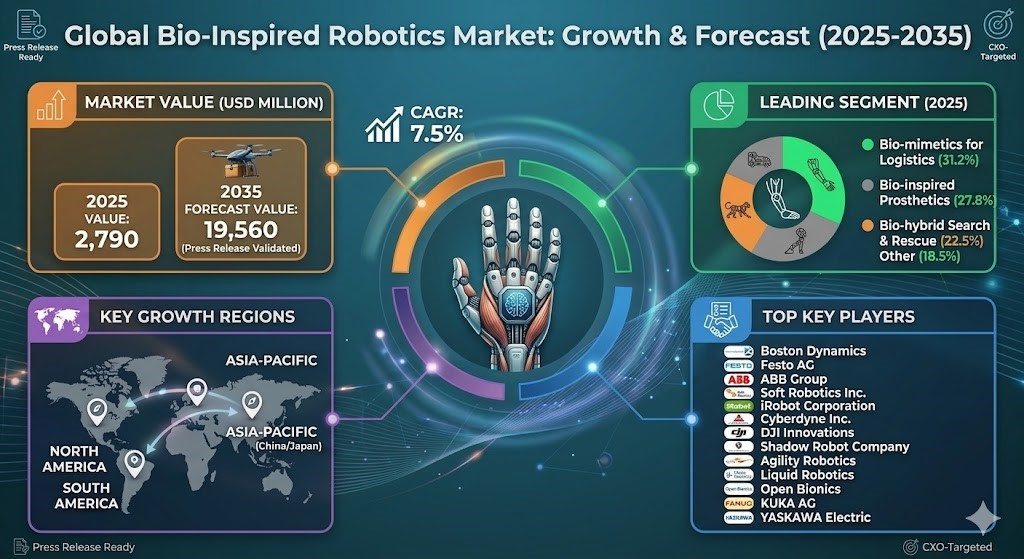
North America holds a prominent position in the bio-inspired robotics market, driven by strong investments in research and development and the presence of leading technology companies and academic institutions. The region is at the forefront of innovation, particularly in defense and healthcare applications.
Europe is also witnessing steady growth, supported by government initiatives and funding for advanced robotics research. Countries such as Germany, the United Kingdom, and Switzerland are actively exploring bio-inspired technologies for industrial automation and environmental monitoring.
The Asia-Pacific region is emerging as a significant growth hub, fueled by rapid industrialization and increasing adoption of robotics in manufacturing and agriculture. Countries like China, Japan, and South Korea are investing heavily in robotics innovation, creating new opportunities for bio-inspired solutions.
Meanwhile, other regions, including Latin America and the Middle East & Africa, are gradually adopting bio-inspired robotics, primarily in sectors such as agriculture, mining, and infrastructure development, where adaptability and efficiency are critical.
Key Trends & Forecast
The bio-inspired robotics market is evolving rapidly, with several key trends shaping its future. One of the most notable trends is the growing adoption of soft robotics, which enables machines to perform delicate tasks with precision and safety. These robots are particularly useful in healthcare and food processing applications, where handling sensitive materials is essential.
Another significant trend is the integration of artificial intelligence and machine learning, allowing bio-inspired robots to learn from their environment and improve their performance over time. This capability enhances decision-making and enables robots to operate autonomously in complex scenarios.
Miniaturization is also gaining traction, with researchers developing small-scale robots inspired by insects and microorganisms. These micro-robots have potential applications in medical procedures, environmental monitoring, and search-and-rescue operations.
Energy efficiency is a key focus area, with bio-inspired designs helping reduce power consumption by mimicking natural movement patterns. For example, robotic fish and underwater drones inspired by marine life can move more efficiently in water compared to traditional propulsion systems.
Looking ahead, the market is expected to witness continuous innovation as interdisciplinary research brings together biology, engineering, and data science. The growing emphasis on sustainable and efficient technologies will further drive the adoption of bio-inspired robotics across industries.
Applications & End-Use Outlook
Bio-inspired robotics is being utilized across a diverse range of industries, offering innovative solutions to complex challenges.
In the defense sector, these robots are used for surveillance, reconnaissance, and search-and-rescue missions. Their ability to navigate difficult terrains and operate in hazardous environments makes them highly valuable for military applications.
The healthcare industry is leveraging bio-inspired robotics for surgical procedures, rehabilitation, and drug delivery systems. Robots inspired by human anatomy and biological processes are improving precision and patient outcomes.
In agriculture, bio-inspired robots are being used for tasks such as crop monitoring, planting, and harvesting. These robots can adapt to varying environmental conditions, helping farmers improve productivity and reduce resource consumption.
The logistics and warehousing sector is also adopting swarm robotics to optimize operations. By mimicking the collective behavior of ants and bees, these systems can efficiently manage inventory and streamline distribution processes.
Environmental monitoring is another key application area, with bio-inspired robots being used to study ecosystems, track wildlife, and monitor pollution levels. Their ability to blend into natural environments makes them ideal for such tasks.
Additionally, industries such as construction, mining, and aerospace are exploring the use of bio-inspired robotics to enhance efficiency and safety in challenging conditions.
Conclusion
The bio-inspired robotics market represents a convergence of nature and technology, offering innovative solutions that push the boundaries of what machines can achieve. By learning from biological systems, engineers are developing robots that are more adaptable, efficient, and capable of handling complex tasks.
As industries continue to embrace automation and seek sustainable solutions, the demand for bio-inspired robotics is expected to grow significantly. Ongoing advancements in artificial intelligence, materials science, and sensor technologies will further expand the capabilities of these systems.
Organizations that invest in bio-inspired robotics stand to gain a competitive edge by leveraging cutting-edge technology to improve efficiency, reduce costs, and enhance performance. As this field continues to evolve, it will play a crucial role in shaping the future of robotics and intelligent automation.
Browse Full Report – https://www.factmr.com/report/bio-inspired-robotics-market