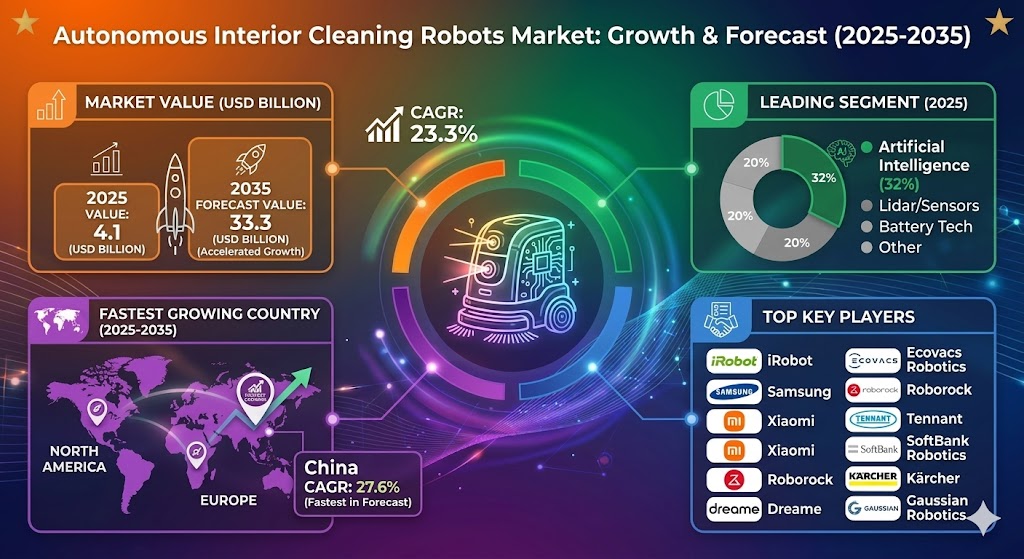
As automation continues to transform everyday tasks, the autonomous interior cleaning robots market is witnessing rapid growth across residential, commercial, and industrial sectors. These robots are designed to perform cleaning tasks independently, using advanced technologies such as artificial intelligence, sensors, and machine learning. With increasing demand for hygiene, efficiency, and labor optimization, autonomous cleaning robots are becoming an essential part of modern facility management. Their ability to deliver consistent and efficient cleaning while reducing human intervention is driving their adoption worldwide.
Market Overview:
Autonomous interior cleaning robots are intelligent machines capable of navigating indoor spaces and performing tasks such as vacuuming, mopping, scrubbing, and disinfecting without direct human control. These systems use a combination of sensors, cameras, and mapping technologies to understand their surroundings, avoid obstacles, and optimize cleaning routes.
The market is expanding due to the growing need for automated solutions that enhance productivity and reduce operational costs. Businesses and households alike are turning to these robots to maintain cleanliness while minimizing manual effort. In addition, the integration of smart features such as remote control, scheduling, and real-time monitoring is making these devices more user-friendly and efficient.
Manufacturers are continuously innovating to improve navigation accuracy, battery life, and cleaning performance. The development of compact, lightweight, and multi-functional robots is further enhancing their appeal across various applications. As technology evolves, these robots are becoming more capable of handling complex environments and diverse cleaning requirements.
Regional Insights:
North America remains a leading market for autonomous interior cleaning robots, driven by high adoption of smart home technologies and strong demand from commercial sectors such as healthcare and hospitality. The region’s focus on automation and innovation is supporting market growth.
Europe is also experiencing significant adoption, particularly in countries emphasizing cleanliness, sustainability, and advanced facility management practices. The demand for energy-efficient and environmentally friendly cleaning solutions is encouraging the use of autonomous robots.
The Asia-Pacific region is emerging as a major growth hub, fueled by rapid urbanization, increasing disposable income, and growing awareness of smart home technologies. The expansion of commercial spaces such as malls, airports, and office buildings is further driving demand for automated cleaning solutions in the region.
Key Trends & Forecast:
- Increasing integration of artificial intelligence and machine learning for improved navigation and decision-making.
- Growing demand for contactless and hygienic cleaning solutions, especially in high-traffic environments.
- Development of multi-functional robots capable of performing various cleaning tasks in a single device.
- Rising adoption of IoT-enabled devices with remote monitoring and control capabilities.
These trends are shaping the future of the market, making autonomous cleaning robots more efficient, intelligent, and adaptable to different environments.
Applications & End-Use Outlook:
Autonomous interior cleaning robots are widely used across multiple sectors, each benefiting from their efficiency and reliability. In the residential sector, these robots are commonly used for routine cleaning tasks, offering convenience and time savings for homeowners. Their ability to operate autonomously and adapt to different floor types makes them a popular choice for modern households.
In the commercial sector, businesses such as offices, retail stores, hotels, and hospitals rely on autonomous cleaning robots to maintain high standards of cleanliness. These robots help reduce labor costs while ensuring consistent cleaning performance, particularly in large and high-traffic areas.
The industrial sector also utilizes these robots for cleaning warehouses, manufacturing facilities, and other large spaces. Their ability to operate continuously and handle demanding environments makes them valuable in maintaining operational efficiency.
Healthcare facilities represent a significant application area, where maintaining hygiene is critical. Autonomous cleaning robots equipped with disinfection capabilities are being used to reduce the risk of infections and ensure a safe environment for patients and staff.
Additionally, public infrastructure such as airports, railway stations, and shopping centers are increasingly adopting these robots to manage cleaning operations efficiently. The growing emphasis on cleanliness and safety in public spaces is further driving market demand.
Conclusion:
The autonomous interior cleaning robots market is transforming the way cleaning tasks are performed, offering innovative solutions that combine efficiency, convenience, and advanced technology. As demand for automation and hygiene continues to rise, these robots are becoming an integral part of modern living and facility management.
With ongoing advancements in artificial intelligence, connectivity, and robotics, the market is expected to witness sustained growth in the coming years. Organizations and consumers that adopt these smart cleaning solutions can benefit from improved efficiency, reduced costs, and enhanced cleanliness standards. Access to comprehensive market insights can help stakeholders identify opportunities and make informed decisions in this rapidly evolving market.
Browse Full Report – https://www.factmr.com/report/autonomous-interior-cleaning-robots-market