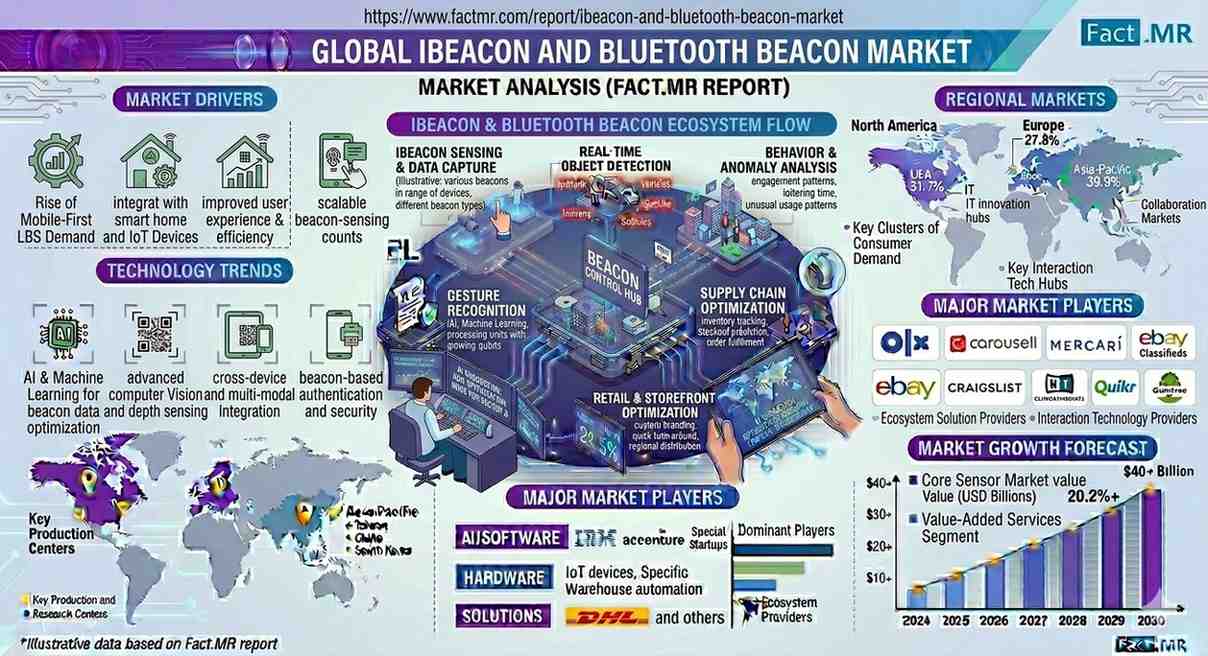
The global landscape for proximity-based communication is undergoing a structural transformation, shifting from simple “push notifications” to integrated location intelligence. According to a comprehensive strategic report by Fact.MR, the iBeacon and Bluetooth beacon market is valued at USD 43.9 Billion in 2026 and is projected to soar to USD 287.4 Billion by 2036, expanding at a remarkable 27.5% CAGR.
The transition is being fueled by the convergence of Bluetooth Low Energy (BLE) hardware with advanced AI analytics, enabling enterprises to bridge the gap between physical environments and digital consumer behavior.
Executive Summary: Key Market Metrics
| Metric | Details |
| Market Valuation (2026E) | USD 43.9 Billion |
| Projected Value (2036F) | USD 287.4 Billion |
| Global CAGR (2026–2036) | 27.5% |
| Dominant Component | Hardware (60% Market Share) |
| Leading Protocol | iBeacon (55% Market Share) |
Segmental Analysis & Technology Drivers
- Hardware: The Infrastructure Backbone
Accounting for 60% of the market share in 2026, hardware remains the primary revenue driver. The massive deployment of beacon transmitters across retail stores, airports, and smart factories is essential for creating the “signal grid” required for indoor positioning.
- iBeacon vs. Open Protocols
The iBeacon protocol holds 55% of the market, benefiting from deep integration with the iOS ecosystem. However, open standards like Eddystone are gaining ground in industrial R&D and manufacturing sectors where cross-platform flexibility is paramount for workforce tracking and equipment monitoring.
- The Shift to “Location Intelligence”
The market is pivoting from basic proximity marketing toward complex asset tracking. Advanced beacon systems are now being integrated into IoT infrastructure to support:
- Indoor Navigation: Real-time wayfinding in massive transport hubs (Airports/Train Stations).
- Workforce Safety: Monitoring personnel in high-risk industrial zones.
- Retail Analytics: Mapping “dwell times” and heatmaps to optimize store layouts.
Regional Outlook: Asia-Pacific and North America at the Forefront
- India (10.1% CAGR): The world’s fastest-growing market, supported by the Smart Cities Mission and rapid retail digitization. Proximity platforms like Gimbal are aggressively expanding partnerships to tap into India’s 900+ million mobile user base.
- China (9.8% CAGR): Driven by massive smart city initiatives from the Ministry of Housing, where beacons are used for public infrastructure and smart transportation.
- United States (9.2% CAGR): A mature innovation hub where Apple Inc. and Estimote are focusing on high-accuracy indoor positioning (sub-1 meter) to meet FCC standards for emergency services and retail precision.
- Japan (8.9% CAGR): Growth is aligned with the “Society 5.0” initiative, focusing on using beacons for senior care monitoring and smart infrastructure maintenance.
Supply Chain & Competitive Landscape
The market is moderately fragmented, characterized by a mix of ecosystem owners and specialized hardware innovators.
Key Industry Players:
- Ecosystem Leaders: Apple Inc., Aruba Networks (HPE), Sony Group Corporation.
- Platform Specialists: Estimote, Inc., Kontakt.io, Inc., Gimbal, Inc.
- Hardware Innovators: Radius Networks, BlueCats, Sensoro, Jaalee Technology.
Supply Chain Dynamics: Buyers (retailers/facility operators) are increasingly adopting multi-vendor strategies to ensure system flexibility. Competitive advantage is shifting from the device itself to the device management software—the ability to manage thousands of “headless” beacons remotely (battery life, signal strength, firmware updates) is the new industry benchmark.
Strategic Takeaways for Decision-Makers
- Prioritize Scalability: Invest in beacon platforms that offer unified management of hardware and high-fidelity analytics to ensure long-term ROI.
- Privacy by Design: With increasing global scrutiny on location tracking, developers must prioritize “opt-in” transparency and data anonymization to maintain consumer trust.
- Infrastructure Synergy: Beacons should not be viewed in isolation; integrate them with existing Wi-Fi and 5G networks to enhance indoor positioning accuracy.
Future Outlook & Risks
The market faces a critical restraint in privacy regulation compliance (GDPR, India’s DPDP Act), which may increase software overhead. However, the opportunity in Industrial IoT (IIoT) and Healthcare—where tracking high-value assets and patient movement can save lives and costs—represents an untapped multibillion-dollar frontier.
Browse Full Report –
https://www.factmr.com/report/ibeacon-and-bluetooth-beacon-market