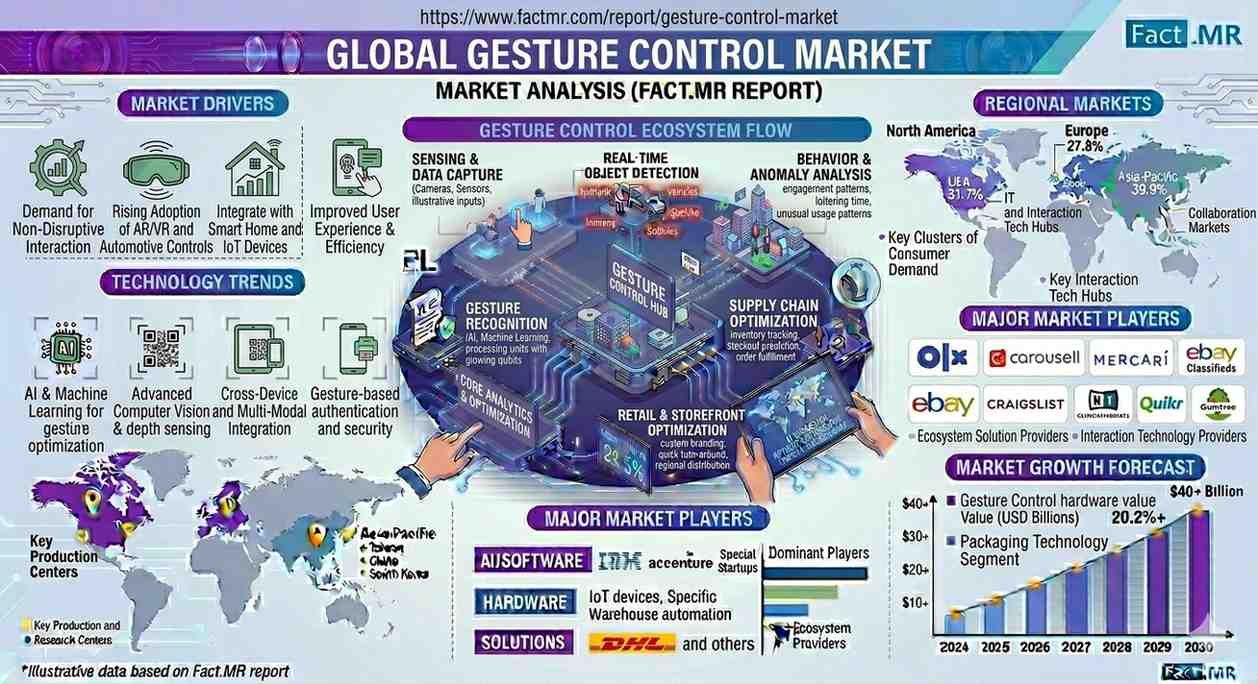
The traditional touch interface is facing a structural decline as “Touchless Interaction” becomes the new standard for the digital age. According to a comprehensive strategic report by Fact.MR, the global gesture control market is valued at USD 31.2 Billion in 2026 and is projected to soar to USD 112.4 Billion by 2036.
The research identifies a “Natural UI” revolution, where high-precision 3D sensing and AI-driven motion tracking are replacing physical buttons in automotive cockpits, surgical suites, and the rapidly expanding Metaverse.
Executive Summary: Key Market Metrics
| Metric | Details |
| Market Valuation (2026E) | USD 31.2 Billion |
| Projected Value (2036F) | USD 112.4 Billion |
| Forecasted CAGR | 13.5% |
| Dominant Dimension | 3D Gesture Control (65% Share) |
| Primary Application | Consumer Electronics (38% Share) |
Segmental Analysis & Technology Trends
- 3D Gesture Systems: Capturing Depth and Intent
Accounting for 65% of the market share in 2026, 3D systems have become the gold standard for accuracy. Unlike 2D predecessors, 3D sensors—led by Intel RealSense and NVIDIA AI Vision—utilize depth-sensing to interpret complex hand and body movements in real-time, reducing latency and “false positives” in safety-critical environments.
- Wearable-Based Input: The AR/VR Catalyst
Wearable-based gesture control holds a 30% share, driven by the integration of hand-tracking in premium headsets like Apple Vision Pro. As of 2025, Ultraleap has expanded its controller-free haptic feedback, allowing users to “feel” digital objects, further cementing wearables as the primary interface for immersive enterprise simulations.
- Automotive & Healthcare: Mission-Critical Adoption
- Automotive: OEMs are integrating 3D gesture interfaces into infotainment systems to reduce driver distraction.
- Healthcare: Post-pandemic hygiene mandates have turned gesture control into a necessity for sterile operating rooms, where surgeons navigate 3D medical imaging without physical contact.
Regional Outlook: Asia-Pacific Outpaces Global Growth
- India (10.5% CAGR): The fastest-growing market globally. Demand is anchored by a massive smartphone user base and government-backed “Digital India” initiatives that promote touchless public kiosks and smart city infrastructure.
- China (10.2% CAGR): A manufacturing powerhouse for gesture-enabled IoT. Domestic giants like Tencent and Huawei are embedding gesture sensors into the smart home ecosystem at an aggressive scale.
- United States (9.5% CAGR): The epicenter of AI-gesture R&D. Growth is led by the defense and healthcare sectors, where advanced HMI (Human-Machine Interface) is a top procurement priority.
- Germany (8.9% CAGR): Driven by “Industry 4.0” and luxury automotive leaders (BMW, Mercedes-Benz) who have made gesture control a standard feature in high-end vehicle cockpits.
Supply Chain & Competitive Landscape
The market is shifting from “Hardware-Only” to “Software-Defined” interaction.
Key Industry Players:
- Ecosystem Leaders: Apple Inc., Intel Corporation, NVIDIA.
- Precision Specialists: Ultraleap, gestigon GmbH (Valeo), PointGrab.
- Niche Innovators: Logbar, Nimble VR (Meta), 4tiitoo GmbH.
Competitive Dynamics: Supply chain dominance is currently held by firms that control the Silicon-to-Software stack. While sensor manufacturers (like Sony or Infineon) provide the raw data, the value-add—and the higher margins—lie in the AI algorithms that translate skeletal tracking into actionable commands.
Actionable Insights & Investment Risks
Investment Opportunities
- Haptic-Gesture Integration: Combining mid-air haptics with 3D gestures to provide tactile feedback is the next frontier for high-end consumer tech.
- Nearshoring Sensor Production: Given the geopolitical sensitivity of high-end CMOS sensors, building regional “Sensing Hubs” in North America and Europe is a strategic priority.
Critical Risks
- Privacy Concerns: Constant “always-on” camera monitoring for gesture detection faces increasing scrutiny under the EU AI Act.
- Ergonomic Fatigue: Poorly designed gesture interfaces can lead to “Gorilla Arm” syndrome (user fatigue), potentially limiting long-term adoption in workspace environments.
Browse Full Report –
https://www.factmr.com/report/gesture-control-market