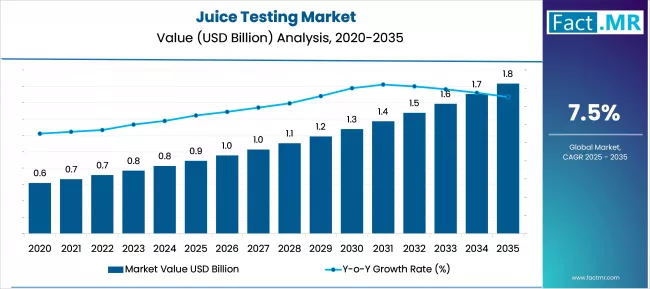
The global juice testing market is projected to grow from USD 672.4 million in 2024 to approximately USD 1,224.2 million by 2034. This steady expansion represents a compound annual growth rate (CAGR) of 6.2% over the ten-year forecast period. The market is primarily driven by rigorous international food safety regulations and a surge in consumer demand for “clean label” and authentic fruit juice products.
Quick Stats:
-
Market size 2024? USD 672.4 million.
-
Market size 2034? USD 1,224.2 million.
-
CAGR? 6.2% (2024–2034).
-
Leading testing type? Authenticity testing is the fastest-growing segment due to the rise in high-value “not-from-concentrate” (NFC) juices.
-
Leading target contaminant? Microbiological testing holds the largest share to ensure the absence of pathogens like E. coli and Salmonella.
-
Leading technology? Chromatography (HPLC and GC) and Mass Spectrometry are the dominant technologies for precision testing.
-
Key growth regions? Europe (largest market), North America, and East Asia (fastest-growing).
-
Top companies? Eurofins Scientific, SGS SA, Intertek Group plc, Bureau Veritas, ALS Limited, and TÜV SÜD.
Get Access of Report Sample: https://www.factmr.com/connectus/sample?flag=S&rep_id=11059
Market Momentum (YoY Path)
The juice testing market is witnessing consistent year-over-year growth. Valued at USD 672.4 million in 2024, the market is expected to reach USD 714.1 million by 2025. As global trade in tropical and exotic juices expands, the demand for third-party testing services is projected to climb steadily through 2029, reaching approximately USD 905.8 million, before hitting the USD 1.22 billion mark by 2034.
Why the Market is Growing
Growth is fueled by a global crackdown on food fraud and adulteration. The juice industry frequently faces issues with the addition of unauthorized sugars, water, or cheaper juices to premium products. To maintain consumer trust and comply with standards like those set by the FDA (USA) and EFSA (Europe), manufacturers are investing heavily in authenticity and purity testing. Furthermore, the trend toward “cold-pressed” and “raw” juices—which do not undergo traditional pasteurization—has significantly increased the requirement for rapid microbiological safety testing.
Segment Spotlight
1. Testing Type: Authenticity and Purity
Authenticity testing is a critical segment. It involves isotope analysis and sugar profiling to verify that a juice labeled “100% Orange” has not been diluted or blended with other fruit juices. This is particularly vital for the premium and organic juice sectors where price premiums are high.
2. Target: Contaminants and Residues
While microbiological testing is the baseline, pesticide residue testing is seeing a surge. As consumer awareness regarding chemical exposure grows, testing for multi-residue pesticides in imported fruit pulps has become a standard requirement for major retail brands.
3. Regional Focus: Europe’s Leadership
Europe currently dominates the juice testing market, supported by the AIJN (European Fruit Juice Association) standards and a sophisticated consumer base that demands high transparency. Meanwhile, East Asia is the fastest-growing region, driven by the rapid expansion of the beverage industry in China and a growing middle class focusing on health and wellness.
Drivers, Opportunities, Trends, and Challenges
Drivers: The primary drivers are the tightening of global food safety laws and the shift toward healthy lifestyles. The increase in international juice trade also necessitates standardized testing to meet the export requirements of different nations.
Opportunities: There is a significant opportunity in the development of on-site rapid testing kits. These allow manufacturers to perform preliminary safety checks at the point of harvest or during initial processing, reducing the time and cost associated with sending samples to central laboratories.
Trends: A key trend is the integration of Blockchain and AI in testing data. By linking laboratory results to a blockchain, juice brands can provide a “traceability certificate” to consumers via QR codes, proving the product’s origin and safety.
Challenges: The high cost of advanced analytical equipment like NMR (Nuclear Magnetic Resonance) spectroscopy can be a barrier for smaller labs. Additionally, the increasing complexity of “designer” adulterants requires continuous R&D to keep testing methods effective.
Country Growth Outlook (CAGR)
| Country | Projected CAGR (2024-2034) |
| China | 7.4% |
| India | 6.9% |
| USA | 5.5% |
| Germany | 4.8% |
Competitive Landscape
The market is highly consolidated among a few global testing giants like Eurofins and SGS. These companies are pursuing aggressive acquisition strategies to broaden their regional footprints and technical capabilities. A major focus for these players is the development of “multi-parameter” testing, which allows for the simultaneous detection of sugars, acids, and contaminants in a single run, significantly increasing lab throughput.\
Browse Full Report : https://www.factmr.com/report/juice-testing-market
About Fact.MR
Fact.MR is a global market research and consulting firm, trusted by Fortune 500 companies and emerging businesses for reliable insights and strategic intelligence. With a presence across the U.S., UK, India, and Dubai, we deliver data-driven research and tailored consulting solutions across 30+ industries and 1,000+ markets. Backed by deep expertise and advanced analytics, Fact.MR helps organizations uncover opportunities, reduce risks, and make informed decisions for sustainable growth.