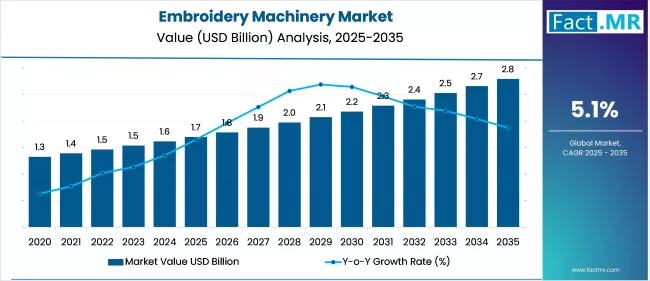
The global embroidery machinery market is projected to grow from USD 1.80 billion in 2024 to approximately USD 3.02 billion by 2034. This expansion represents an absolute increase of USD 1.22 billion over the forecast period, with the market set to expand at a compound annual growth rate (CAGR) of 5.3% between 2024 and 2034.
The market is being propelled by a transition from traditional manual techniques to automated, high-speed computer-controlled systems that meet the growing consumer demand for personalized and high-fashion apparel.
Get Access of Report Sample: https://www.factmr.com/connectus/sample?flag=S&rep_id=2015
Quick Stats:
-
Market size 2024? USD 1.80 billion.
-
Market size 2034? USD 3.02 billion.
-
CAGR? 5.3% (2024–2034).
-
Leading product segment? Multi-head embroidery machines dominate the market due to their high production efficiency in industrial settings.
-
Leading application? Apparel and Fashion remain the primary end-use industries, followed by home textiles.
-
Key growth regions? East Asia (specifically China and Japan), South Asia (India), and North America.
-
Top companies? Tajima Industries Ltd., Barudan Co. Ltd., Brother Industries Ltd., ZSK Stickmaschinen GmbH, Melco International, and Bernina International AG.
Market Momentum (YoY Path)
The embroidery machinery market is maintaining a steady upward trajectory. Valued at USD 1.80 billion in 2024, the market is expected to witness consistent annual gains as textile hubs in Asia and South America modernize their manufacturing floors. By 2029, the market valuation is expected to reach USD 2.32 billion, eventually climbing to USD 3.02 billion by 2034. This represents a total growth of approximately 1.7X across the decade.
Why the Market is Growing
The primary growth driver is the “Fast Fashion” phenomenon and the rising trend of mass customization. Consumers are increasingly seeking personalized logos, intricate designs, and embroidered patterns on everyday apparel and sportswear. To meet this demand, manufacturers are investing in advanced embroidery machines that offer multi-needle configurations, automatic thread trimming, and high-speed operation. Furthermore, the integration of AI and cloud-based design software is making it easier for small businesses to enter the custom apparel market.
Segment Spotlight
1. Machine Type: Multi-Head Machines
Multi-head embroidery machines are the leading segment, favored by large-scale garment exporters. These machines allow for the simultaneous embroidery of the same design on multiple garments, significantly reducing labor costs and production time. They are essential for meeting the volume requirements of global retail brands.
2. Technology: Computer-Controlled Systems
The shift toward computerized embroidery machinery is absolute. Modern machines now feature large touch-screen interfaces, USB connectivity, and wireless networking. This technology allows for the precise reproduction of complex digital designs, which was previously impossible with manual or semi-automatic systems.
3. Regional Leader: East Asia
East Asia is the powerhouse of the embroidery machinery market, driven by China’s massive textile manufacturing base. India is also a critical growth hub, where a rich heritage of traditional embroidery is being augmented by industrial automation to cater to both domestic and export fashion markets.
Drivers, Opportunities, Trends, and Challenges
Drivers: The surge in e-commerce platforms offering custom-designed apparel is a major driver. Additionally, the recovery of the global hospitality and sports sectors has increased the demand for embroidered uniforms and branded team-wear.
Opportunities: There is a significant opportunity in the development of hybrid machines that combine embroidery with laser cutting or digital printing. Such “all-in-one” decorative systems allow manufacturers to create unique, multi-textured garments that command premium prices.
Trends: A key trend is the adoption of compact/portable professional machines. These smaller-footprint units allow boutique designers and “home-preneurs” to produce industrial-quality embroidery in limited spaces, fueling the “maker movement” globally.
Challenges: High initial investment costs for premium multi-head machines can be a barrier for small-scale enterprises. Additionally, the market faces competition from alternative garment decoration techniques like high-definition screen printing and direct-to-garment (DTG) printing.
Country Growth Outlook (CAGR)
| Country | Projected CAGR (2024-2034) |
| India | 6.5% |
| China | 5.8% |
| USA | 4.2% |
| Germany | 3.5% |
Competitive Landscape
The market is highly competitive and dominated by Japanese and German engineering. Companies like Tajima and Barudan are the gold standard for industrial durability, while Brother and Bernina lead the consumer and boutique professional segments. Market players are currently focused on “Industry 4.0” features, such as remote machine monitoring and predictive maintenance, to help factory owners maximize uptime.
Browse Full Report : https://www.factmr.com/report/2015/embroidery-machinery-market
About Fact.MR
Fact.MR is a global market research and consulting firm, trusted by Fortune 500 companies and emerging businesses for reliable insights and strategic intelligence. With a presence across the U.S., UK, India, and Dubai, we deliver data-driven research and tailored consulting solutions across 30+ industries and 1,000+ markets. Backed by deep expertise and advanced analytics, Fact.MR helps organizations uncover opportunities, reduce risks, and make informed decisions for sustainable growth.