As technology continues to evolve, the demand for responsive and intuitive user experiences has grown significantly. One component quietly enabling this transformation is the vibration motor. Widely used across consumer electronics, automotive systems, healthcare devices, and industrial equipment, vibration motors provide tactile feedback that enhances functionality, safety, and user interaction. Once limited to simple alert mechanisms, these compact motors have become essential in designing smarter and more interactive products.
Introduction to Vibration Motors
Vibration motors are compact devices engineered to generate mechanical oscillations. These vibrations serve multiple purposes, from notifying users through silent alerts to enabling haptic feedback in advanced touch interfaces. Their small size, energy efficiency, and adaptability make them ideal for integration into modern electronic systems.
The growing adoption of smartphones, wearable technology, and connected devices has significantly expanded the role of vibration motors. Consumers increasingly expect devices that communicate through touch, whether it is a subtle notification on a smartwatch or immersive feedback in a gaming controller. As a result, manufacturers are investing in refined motor technologies that deliver precise and customizable vibration patterns.
Market Overview
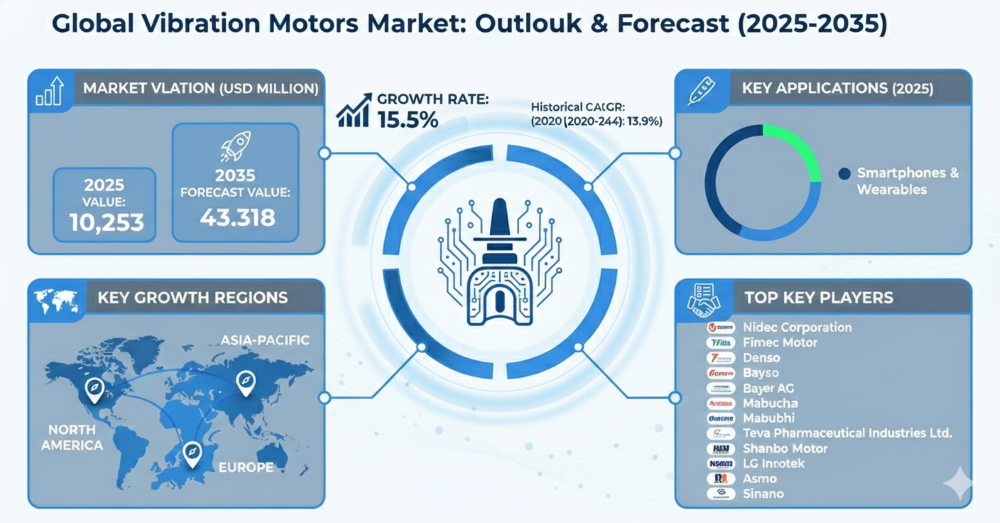
The vibration motors market is experiencing steady expansion as industries recognize the value of tactile communication. These motors are no longer confined to mobile phones; they now support applications ranging from automotive alert systems to medical monitoring devices.
Advancements in miniaturization have made it possible to incorporate vibration motors into slimmer and lighter devices without compromising performance. At the same time, improvements in durability and power efficiency are helping manufacturers meet the expectations of consumers who prioritize reliability and longer battery life.
Two widely recognized motor types dominate the market: eccentric rotating mass (ERM) motors and linear resonant actuators (LRA). ERM motors are known for their simplicity and cost-effectiveness, making them suitable for high-volume electronics. LRAs, on the other hand, offer faster response times and more refined feedback, making them ideal for premium devices that require sophisticated haptic experiences.
Key Growth Drivers
Rising Demand for Consumer Electronics
The proliferation of smartphones, tablets, wearables, and gaming devices remains a major driver for the vibration motors market. Haptic feedback has become a standard feature in touch-enabled devices, improving usability while creating a more engaging interface. As device manufacturers continue to compete on user experience, high-performance vibration motors are becoming a design priority.
Expansion of Wearable Technology
Fitness trackers, smartwatches, and health-monitoring devices rely heavily on vibration alerts to deliver notifications discreetly. These silent cues are particularly valuable in professional or social settings where audible alerts may be disruptive. With wearable adoption accelerating worldwide, the need for compact yet powerful vibration motors is expected to grow.
Automotive Safety and Comfort
Modern vehicles increasingly incorporate vibration-based warning systems. Steering wheels, seats, and driver-assistance technologies use tactile signals to alert drivers about lane departures, collision risks, or navigation prompts. Such features enhance road safety by providing immediate, non-visual feedback that allows drivers to keep their focus on the road.
Industrial and Medical Applications
Beyond consumer markets, vibration motors are finding roles in industrial automation and healthcare equipment. In medical devices, they support patient alerts and diagnostic tools, while industrial machinery uses controlled vibrations for monitoring processes and detecting faults. This diversification is strengthening the market’s long-term growth potential.
Emerging Trends Shaping the Market
One of the most notable trends is the shift toward advanced haptic technologies. Users now expect feedback that feels natural and responsive rather than abrupt or mechanical. This has encouraged manufacturers to develop motors capable of delivering nuanced vibration patterns that simulate textures, clicks, and resistance.
Another important trend is the integration of vibration motors into augmented and virtual reality systems. Immersive environments rely heavily on tactile cues to create realistic experiences, and high-precision motors are critical to achieving that level of engagement.
Energy efficiency is also gaining attention. As portable devices strive for longer battery life, component manufacturers are designing motors that consume less power while maintaining strong performance. Sustainable manufacturing practices and environmentally responsible materials are gradually influencing product development as well.
Regional Insights
The vibration motors market demonstrates strong global presence, with Asia-Pacific emerging as a significant manufacturing hub. The region benefits from a robust electronics production ecosystem and a rapidly expanding consumer base eager to adopt new technologies. Countries known for large-scale electronics manufacturing continue to drive innovation and supply chain efficiency.
North America remains an important market due to its early adoption of advanced technologies and high demand for premium devices. Meanwhile, Europe emphasizes quality, safety standards, and automotive innovation, contributing to steady demand for sophisticated vibration solutions.
Emerging economies are also showing promising growth as digital transformation accelerates and access to smart devices improves. Increasing urbanization and rising disposable incomes are expected to further support market expansion in these regions.
Challenges Facing the Industry
Despite its positive outlook, the vibration motors market faces several challenges. Designing motors that balance compact size with powerful output requires advanced engineering, which can raise production costs. Price sensitivity in competitive consumer electronics markets often pressures manufacturers to deliver high quality at lower costs.
Supply chain disruptions and fluctuations in raw material availability can also impact production timelines. Additionally, as devices become thinner, integrating vibration motors without affecting overall design or battery capacity presents a technical challenge.
Competition from alternative feedback technologies is another factor to consider. While vibration remains highly effective, manufacturers continuously explore new ways to enhance tactile interaction, pushing motor developers to innovate consistently.
Future Outlook
The future of the vibration motors market appears promising as the world becomes increasingly connected and experience-driven. Haptic technology is expected to move beyond simple alerts toward deeply immersive interactions that redefine how users engage with devices.
As artificial intelligence, smart ecosystems, and next-generation mobility solutions advance, vibration motors will continue to support intuitive communication between humans and machines. Their role in safety systems, medical technologies, and interactive electronics ensures they will remain a vital component across industries.
In an era where touch is becoming as important as sight and sound in digital experiences, vibration motors are quietly shaping the way people interact with technology. With ongoing innovation and expanding applications, this market is set to remain a cornerstone of modern device engineering for years to come.
Browse Full Report – https://www.factmr.com/report/318/vibration-motors-market