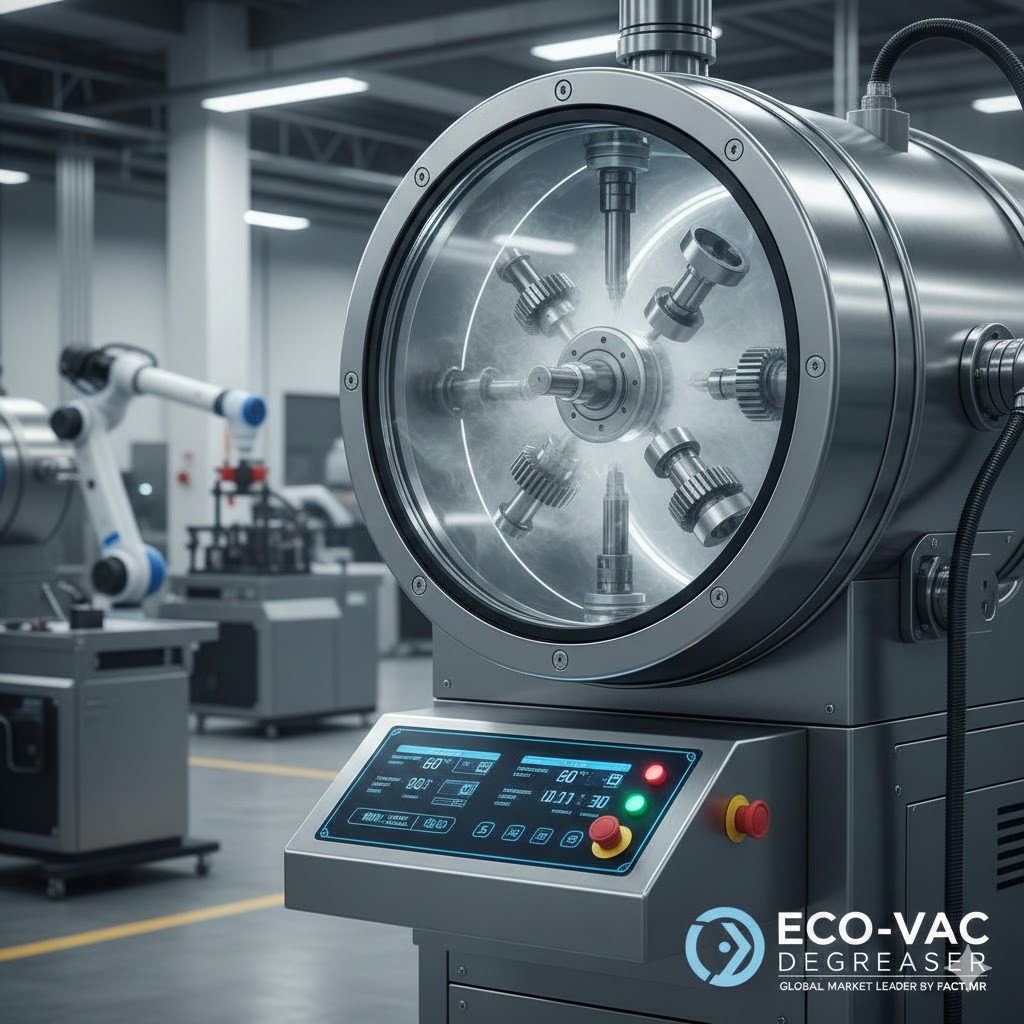
The global Vacuum Degreaser Market is evolving rapidly as manufacturing industries worldwide adopt advanced cleaning technologies to improve product quality, regulatory compliance, and operational efficiency. Defined by stringent cleaning requirements in sectors such as automotive, aerospace, semiconductors, and industrial machining, vacuum degreasers offer superior contaminant removal, reduced solvent usage, and enhanced surface preparation. This market landscape provides a comprehensive look at the market’s projected trajectory through 2036, with a deep dive into competitive positioning, pricing dynamics, and regional growth hotspots.
📈 Market Overview & Growth Forecast
In 2023, the global vacuum degreaser market was valued at approximately USD 1,047.0 million. By 2033, it is projected to expand to USD 1,771.6 million, reflecting a CAGR of ~5.4% between 2023 and 2033. Extending this trend suggests continued growth toward ~USD 2.1–2.3 billion by 2036, driven by escalating industrial cleaning needs and technology adoption.
Vacuum degreasers eliminate contaminants and residual oils from metal and mechanical parts during manufacturing. Operating under vacuum conditions allows solvents to evaporate at lower temperatures compared with traditional methods, reducing energy use and improving overall cleaning efficiency. This performance advantage underpins market expansion.
🧠 Strategic Benchmarking: Competitive Landscape
🔎 Key Market Players
The market features both global and regional players that emphasize product innovation, service differentiation, and geographic reach. Leading companies include:
-
Baron Blakeslee
-
Ecoclean Machines Private Limited
-
Emerson Electric Co.
-
HEMO GmbH
-
IHI Corporation
-
Koyo Thermo Systems Co. Ltd.
-
Ultronix Inc.
These firms focus on next‑generation vacuum degreasers that integrate automation, lower solvent consumption, and industry‑specific cleaning protocols. Partnerships and regional distribution agreements are common competitive strategies to accelerate adoption across target industries.
🪙 Pricing Trends & Market Dynamics
📊 Pricing Dynamics
Pricing in the vacuum degreaser market reflects the complexity of custom configurations, capacity variations, and automation levels. High initial capital investment is a notable barrier for mass adoption.
Vacuum degreasers are significantly more expensive than conventional degreasing systems due to complex engineering, performance efficiency, and solvent recovery features. Automated and high‑capacity units command premium pricing, while smaller and semi‑automatic systems are positioned for mid‑tier commercial customers.
As operators pursue lean manufacturing and sustainability, the total cost of ownership (TCO) — including energy savings, reduced solvent usage, and labor efficiencies — becomes a key pricing justification for advanced vacuum degreasers.
⚙️ Market Drivers
The market is primarily driven by:
-
Industrial Growth: Expansion of automotive, aerospace, electronics, and semiconductor manufacturing fuels demand.
-
Regulatory Pressures: Stringent environmental standards and workplace safety norms push manufacturers toward vacuum systems with eco‑friendly solvent use and emissions control.
-
Quality Standards: Adoption of CGMP and other cleaning protocols heightens preference for precise, residue‑free cleaning.
⚠️ Market Restraints
Despite strong growth drivers, certain constraints persist:
-
High Upfront Costs: Capital intensity limits adoption by cost‑sensitive small and medium enterprises.
-
Technological Compliance: Manufacturers face regulatory compliance challenges that can slow product launches and implementation.
-
Environmental Concerns: Some solvent‑based systems pose flammability and toxicity risks, requiring strict handling and disposal protocols.
🗺️ Regional Hotspots & Growth Dynamics
🌏 North America
A mature industrial base and strong R&D ecosystem make North America a key revenue contributor. The region’s demand is driven by automotive and aerospace sectors, as well as semiconductor fabrication facilities requiring precision cleaning. Advanced regulatory landscapes further foster adoption of cleaner technologies.
🌍 Europe
Europe holds a leading market share and demonstrates robust growth due to stringent environmental policies and advanced manufacturing frameworks. Countries such as Germany, the United Kingdom, and France lead in both adoption and technology innovation. Renewable manufacturing agendas and sustainable industry practices are accelerating the shift toward vacuum degreasers over conventional degreasers.
🌏 Asia Pacific
Asia Pacific is projected as the fastest-growing regional market through the mid-2030s. Robust industrialization in China, India, Japan, and South Korea, expanding automotive assembly, electronics fabrication, and heavy manufacturing facilities offer fertile ground for vacuum degreaser deployment. Market momentum is supported by cost-competitive manufacturing and increasing investments in smart factories.
🇱🇷 Latin America & Middle East & Africa
-
Latin America is exhibiting strong CAGR potential through the mid-2030s due to rising industrial quality standards and manufacturing upgrades across Brazil, Mexico, and Argentina.
-
Middle East & Africa is forecasted to deliver solid growth with investments in sustainable manufacturing and cleaner processes in key industrial hubs.
🏁 Sectoral Adoption Trends
Across end‑use industries, adoption trends vary:
-
Automotive: Largest segment, owing to rigorous cleaning protocols before assembly, painting, and final quality checks.
-
Aerospace: High demand for precision cleaning to ensure structural integrity and performance.
-
Semiconductors & Electronics: Precision surface cleaning for chips and circuit components.
-
Industrial Machining & Medical: Consistent adoption for enhanced maintenance and sterilization.
These sectors collectively account for a significant share of global demand, with the automotive and aerospace verticals leading volume adoption and diversification into specialized cleaning protocols.
Browse Full Report : https://www.factmr.com/report/2533/vacuum-degreaser-market
📌 Outlook Through 2036
The vacuum degreaser market is set for continued expansion through 2036, driven by:
-
Digital manufacturing and smart factory integration accelerating automation adoption.
-
Sustainability imperatives steering demand toward energy-efficient, low emissions systems.
-
Emerging markets in Asia Pacific and Latin America creating new growth frontiers.
As pricing structures evolve to highlight TCO advantages and regulatory landscapes tighten, vacuum degreasers will increasingly become a core investment for quality-centric industrial manufacturers.