The scissor lift rental market is rapidly evolving as construction, maintenance, and industrial sectors increasingly demand flexible, safe, and cost-effective aerial access solutions. The global shift toward project-based equipment needs and the growing preference for rental over ownership have accelerated market expansion. Industry participants are expanding their fleets and enhancing service capabilities to meet diverse operational requirements across sectors.
Market Dynamics and Growth Trajectory
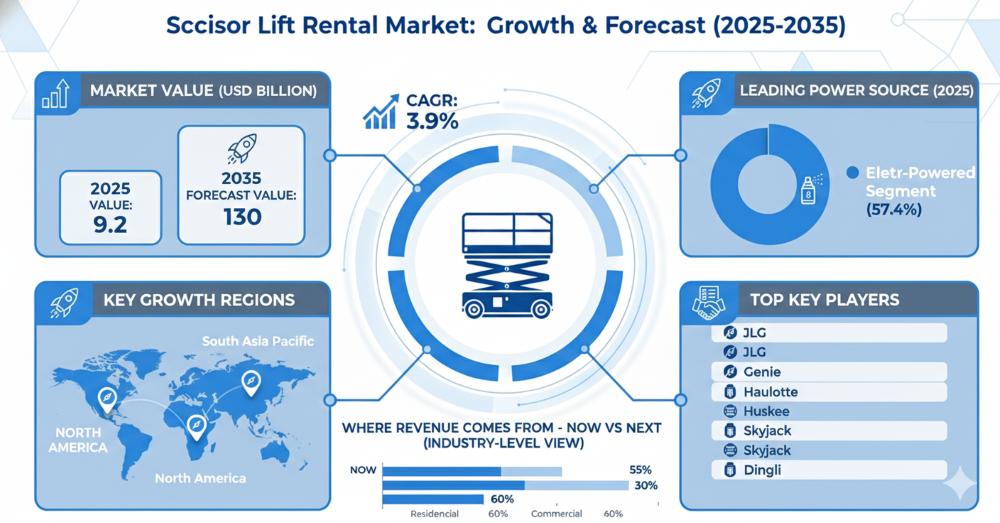
The scissor lift rental market is expected to witness steady expansion over the coming decade, supported by rising infrastructure projects, commercial development, and industrial modernization. Scissor lifts are specialized aerial work platforms designed to provide vertical lifting support for workers and materials, making them indispensable for tasks that require safe elevation.
These platforms are widely utilized across construction sites, warehouses, manufacturing facilities, and commercial buildings. Unlike fixed access systems, scissor lifts offer mobility and adaptability, allowing operators to reposition equipment easily based on project needs. This flexibility plays a crucial role in driving rental adoption, particularly among contractors aiming to maintain operational efficiency without committing to long-term capital investments.
Rental Preference: Cost Efficiency and Operational Flexibility
A major factor fueling the scissor lift rental market is the financial advantage associated with renting equipment rather than purchasing it outright. Ownership often involves substantial upfront costs, ongoing maintenance, storage considerations, and equipment depreciation. Rental models eliminate many of these concerns, enabling businesses to allocate resources more strategically.
Rental agreements frequently include maintenance and servicing, ensuring that equipment remains in optimal working condition. This arrangement reduces downtime risks while allowing companies to focus on project execution rather than equipment management.
Additionally, rental solutions provide scalability. Organizations can increase equipment availability during peak construction periods and scale back once projects conclude. This approach helps minimize idle assets and supports efficient budget management, particularly for firms handling multiple short-term assignments.
Technology and Adoption Trends
Technological innovation continues to reshape the scissor lift rental landscape. One notable trend is the increasing adoption of electric scissor lifts, which are gaining popularity due to their quiet operation, reduced emissions, and suitability for indoor environments. As sustainability becomes a priority across industries, electrically powered equipment aligns with environmental goals while meeting regulatory standards.
Digital transformation is also influencing rental operations. Advanced fleet management technologies — including telematics, sensor-based diagnostics, and predictive maintenance tools — allow rental providers to monitor equipment performance in real time. These systems enhance safety, improve utilization rates, and help prevent unexpected breakdowns.
Automation and data analytics are further enabling rental companies to optimize inventory planning and respond quickly to changing customer demands. As smart construction practices gain traction, technologically enhanced lifting solutions are expected to become a competitive differentiator.
End-Use Segments and Applications
The construction industry remains the primary driver of scissor lift rental demand. Projects ranging from residential developments to large commercial complexes require elevated access for electrical work, structural installations, painting, facade maintenance, and HVAC system setup. Compared with traditional ladders or scaffolding, scissor lifts provide greater stability and worker safety, contributing to improved productivity on job sites.
The maintenance sector also represents a significant opportunity. Facilities such as airports, shopping centers, factories, and distribution hubs rely on scissor lifts for lighting repairs, inspections, equipment servicing, and signage installation. Because these tasks occur periodically rather than continuously, renting becomes a practical and economical solution.
Warehouse and logistics operations are emerging as another important application area. With the expansion of e-commerce and large distribution networks, businesses increasingly require efficient access to high storage areas. Scissor lifts support inventory handling, shelving installation, and facility upkeep, strengthening their role in modern supply chain infrastructure.
Furthermore, specialized industries such as event management and entertainment utilize scissor lifts for stage construction, lighting adjustments, and audiovisual system placement. This broad applicability highlights the versatility of rental equipment across diverse operational settings.
Regional Market Insights
From a regional perspective, developed economies continue to demonstrate strong adoption due to established construction activity and mature equipment rental ecosystems. Meanwhile, rapidly urbanizing regions are creating new growth avenues as governments and private investors channel funds into infrastructure development, transportation networks, and commercial real estate.
Industrial expansion, population growth, and smart city initiatives are further contributing to increased demand for aerial work platforms. As safety regulations become more stringent worldwide, organizations are turning to reliable lifting solutions that support compliance while improving worker protection.
Challenges and Market Opportunities
Despite its promising outlook, the scissor lift rental market faces several challenges. Fleet expansion requires significant capital investment, and managing large equipment inventories can be operationally complex. Providers must balance availability with utilization to maintain profitability.
Competition is also intensifying as new entrants explore the rental business model. To remain competitive, companies are focusing on service differentiation through value-added offerings such as operator training, rapid delivery, safety certifications, and customized rental packages.
At the same time, these challenges create opportunities for innovation. The growing emphasis on sustainability is encouraging the adoption of energy-efficient equipment, while digital platforms are simplifying booking processes and enhancing customer experience. Partnerships, mergers, and strategic expansions are expected to shape the competitive landscape in the years ahead.
Conclusion
The scissor lift rental market is positioned for consistent growth as industries prioritize safety, efficiency, and flexible asset utilization. Rental solutions provide a practical alternative to equipment ownership, allowing organizations to adapt quickly to evolving project requirements while controlling operational costs.
With technological advancements improving equipment performance and sustainability shaping purchasing decisions, rental providers are well placed to support modern construction and industrial workflows. As infrastructure development accelerates and businesses continue to seek agile operational models, the scissor lift rental market is set to remain a critical enabler of elevated work access across the global economy.
Browse Full Report – https://www.factmr.com/report/scissor-lift-rental-market