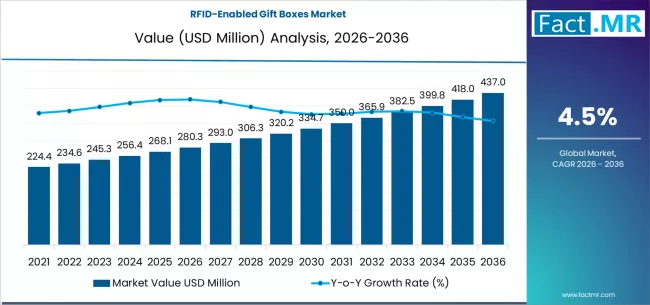
The global RFID-Enabled Gift Boxes Market is poised for significant expansion through 2036 as retailers, brand owners, and luxury product manufacturers increasingly adopt smart packaging technologies to enhance customer experience, drive anti-counterfeiting, improve supply chain visibility, and support post-purchase engagement. RFID-enabled gift boxes integrate radio-frequency identification (RFID) tags and readers into traditional gift packaging — enabling seamless tracking, interactive marketing, inventory management, and authentication features that elevate both operational efficiency and consumer satisfaction.
As e-commerce and omnichannel retailing accelerate, brands are seeking packaging solutions that not only protect products but also extend digital connectivity and traceability across the product journey. RFID integration in gift boxes offers real-time visibility, reduces shrinkage, supports efficient fulfillment, and creates personalized experiences for consumers — making them attractive for luxury goods, seasonal gifting, corporate gifting, electronics, and high-end lifestyle products.
Market Outlook (2026–2036)
-
Estimated Market Value in 2026: USD 4.7 billion
-
Projected Market Value in 2036: USD 12.8 billion
-
Forecast CAGR (2026–2036): ~10.5%
-
Leading Technology: Integrated Passive RFID Tags
-
Primary End Users: Luxury Retailers, e-Commerce Platforms, Corporate Gifting Services
-
Key Drivers: Growth in smart packaging adoption, demand for anti-counterfeiting, expansion of omnichannel retail
The anticipated growth reflects greater emphasis by brands on interactive, secure, and traceable packaging solutions that enhance both back-end operations and customer touchpoints.
To access the complete data tables and in-depth insights, request a Discount On The Report here: https://www.factmr.com/connectus/sample?flag=S&rep_id=12762
Market Overview
RFID-enabled gift boxes embed RFID technology — including tags, chips, and occasionally integrated antennas — within packaging structures to provide wireless identification and data exchange capabilities. These systems allow stakeholders to scan, verify, and track products throughout the supply chain without direct line of sight, enabling swift inventory counts, anti-theft measures, and streamlined logistics.
From a consumer perspective, RFID-enabled packaging can support personalized experiences such as product authentication, unlock digital content, and enable loyalty or interactive features via NFC (near-field communication) compatibility. For luxury brands, seasonal gift assortments, and premium offerings, the technology helps maintain brand integrity, reduce fraud, and foster repeat engagement.
Key Market Drivers
1. Rising Demand for Smart Packaging Solutions
With the global increase in e-commerce, omnichannel retailing, and connected consumer touchpoints, smart packaging is transitioning from novelty to necessity. RFID-enabled solutions provide actionable data, enhance customer experience, and support supply chain efficiency.
2. Growth in Luxury and Gifting Segments
Premium products, luxury gift assortments, and high-end seasonal gift boxes often carry higher risk of counterfeiting and returns. RFID technology helps brands authenticate products, manage inventory, and deliver premium customer experiences — strengthening brand trust and loyalty.
3. Anti-Counterfeiting and Brand Protection Needs
Counterfeiting remains a major challenge for many industries. RFID-enabled gift boxes provide secure, tamper-evident packaging that bolsters brand protection initiatives and enables verification at multiple points across distribution channels.
4. Enhanced Supply Chain Visibility and Inventory Control
RFID systems enable faster inventory audits, automated data capture, and improved accuracy in order fulfillment. Brands and logistics partners benefit from lower shrinkage, reduced stockouts, and better demand forecasting.
5. Consumer Engagement and Digital Integration
RFID-based technologies can bridge physical packaging with digital experiences — supporting NFC-enabled storytelling, interactive unboxing, and personalized post-purchase engagement that deepen customer relationships.
Market Segmentation Insights
By Technology Type:
-
Passive RFID Tags: Low-cost, high-reliability tags widely used for inventory tracking and authentication.
-
Active RFID Solutions: Battery-assisted tags for real-time tracking and longer read ranges.
-
NFC-Enabled RFID Systems: Support consumer interaction and mobile engagement.
-
Hybrid RFID/Sensor Integrations: Combine environmental sensing with identification for condition monitoring.
By End Use Sector:
-
Luxury Goods and High-End Retail: Perfumes, watches, jewelry, and fashion gift boxes.
-
Seasonal and Holiday Gifting: Premium packaging for festive occasions and special events.
-
Corporate and Promotional Gifts: Branded packages for employee recognition and B2B gifting.
-
Consumer Electronics and Premium Devices: High-value electronics with enhanced authentication.
-
Personalized Custom Gift Services: Tailored packaging with interactive digital features.
By Distribution Channel:
-
Direct Brand and Retail Store Sales
-
E-Commerce Platforms and Online Marketplaces
-
Specialty Packaging Suppliers
-
Corporate Procurement and Gifting Services
Regional Demand Dynamics
North America is expected to lead the market due to strong technology adoption, high consumer spending on premium goods and gifting, and advanced retail infrastructure that supports smart packaging ecosystems. Brands in this region are among the earliest adopters of RFID for both operational and customer engagement purposes.
Europe represents a key regional market, supported by established luxury goods sectors, stringent brand protection laws, and high consumer expectations for quality and authenticity. RFID-enabled gift boxes are increasingly integrated into premium retail experiences and high-value product deliveries.
Asia Pacific is projected to exhibit the fastest growth, driven by expanding luxury retail markets, rapid growth of e-commerce, and rising adoption of smart technologies in packaging and logistics. Countries with large digital consumer bases and tech-savvy populations are accelerating market uptake.
Emerging demand is also visible in Latin America and Middle East & Africa, where growing retail sectors and increased focus on anti-counterfeiting are encouraging adoption of advanced packaging solutions.
Competitive Landscape
The RFID-enabled gift boxes market is moderately competitive, with participation from RFID technology providers, smart packaging innovators, luxury packaging manufacturers, and brand technology integrators. Key strategies among leading players include development of integrated hardware and software solutions, custom design services for premium brands, and partnerships with retail and logistics stakeholders to deliver end-to-end smart packaging ecosystems.
Innovation focuses on reducing tag costs, improving read reliability, enhancing integration with mobile and cloud platforms, and expanding user-centric features such as mobile authentication and digital content triggers. Competitive differentiation is also shaped by regional service networks and support offerings that assist brands in deploying RFID solutions at scale.
Future Outlook
The RFID-Enabled Gift Boxes Market is expected to maintain robust growth through 2036 as brands invest in differentiated packaging that supports operational efficiency, customer engagement, and brand protection. Continued innovation in RFID technology, coupled with expanding digital retail ecosystems, will create new opportunities for smart packaging across industries.
As consumer expectations for seamless, interactive, and secure purchasing experiences rise, RFID-enabled gift boxes will become integral components of modern retail strategies — transforming how products are tracked, authenticated, and personalized from warehouse to doorstep.
Browse Full Report: https://www.factmr.com/report/rfid-enabled-gift-boxes-market