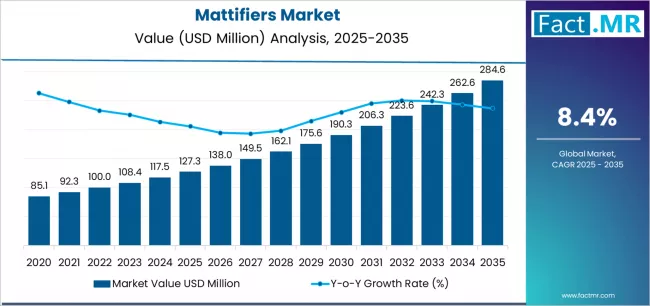
The global mattifiers market is entering a high-growth phase, fueled by rising demand for advanced cosmetic formulations, premium personal care products, and high-performance industrial coatings. According to a new analysis by Fact.MR, the market is valued at USD 127.3 million in 2025 and is projected to reach USD 284.6 million by 2035, expanding at a robust CAGR of 8.4% over the forecast period.
This near 2.2X market expansion reflects increasing adoption of mattifying agents across cosmetics, skincare, coatings, inks, and specialty manufacturing, as brands and industries prioritize surface aesthetics, oil control, and smooth texture performance.
The mattifiers market stands at the forefront of a transformative decade, redefining cosmetic formulation technologies and surface-smoothing solutions worldwide.
Browse Full Report: https://www.factmr.com/report/mattifiers-market
Strategic Market Drivers
Booming Cosmetics & Personal Care Industry
Mattifiers are essential ingredients in modern cosmetics, enabling:
- Shine reduction and oil control
- Smooth, soft-focus skin appearance
- Improved sensory feel and texture consistency
Rising consumer demand for matte-finish foundations, primers, lip products, sunscreens, and skincare formulations is significantly accelerating market growth, especially in premium and dermatologist-backed brands.
Shift Toward Clean Beauty & Advanced Formulations
The global move toward clean-label, non-toxic, and skin-friendly ingredients is driving innovation in mattifiers based on:
- Silica
- Polymers
- Starch-based and mineral mattifiers
Formulators are increasingly adopting lightweight, breathable, and non-comedogenic mattifiers, supporting long-wear performance without compromising skin health.
Expanding Applications in Industrial Coatings & Inks
Beyond cosmetics, mattifiers play a crucial role in:
- Industrial and architectural coatings
- Wood finishes and furniture coatings
- Printing inks and packaging solutions
The demand for scratch resistance, glare reduction, and surface uniformity in coatings is propelling mattifier usage across construction, automotive, and consumer goods industries.
Rising Demand for Premium Aesthetic Finishes
Luxury packaging, electronics coatings, and specialty plastics increasingly require controlled gloss and tactile finishes, boosting mattifier adoption in high-end manufacturing systems.
Regional Growth Highlights
North America: Innovation-Led Cosmetic Formulation
North America remains a strong market due to:
- High demand for premium cosmetics and skincare
- Presence of leading beauty brands and formulation labs
- Strong focus on clean beauty and dermatologically tested products
The U.S. continues to lead innovation in silica-based and polymer mattifiers.
Europe: Sustainability & Regulatory Compliance
Europe’s stringent cosmetic regulations and sustainability focus are driving demand for eco-friendly and bio-based mattifiers. Countries such as France, Germany, Italy, and the U.K. are key contributors, supported by strong luxury cosmetics and industrial coatings sectors.
East Asia: Beauty Trends & Manufacturing Strength
East Asia—led by South Korea, Japan, and China—is witnessing rapid growth due to:
- K-beauty and J-beauty formulation trends
- High consumer preference for matte and soft-focus finishes
- Large-scale cosmetics and coatings manufacturing capacity
Emerging Markets: Rising Disposable Income & Urbanization
Markets such as India, Southeast Asia, Latin America, and the Middle East are experiencing increased mattifier demand driven by:
- Expanding middle-class population
- Rising cosmetic consumption
- Growth in construction and industrial coatings
Market Segmentation Insights
By Product Type
- Silica-Based Mattifiers – Dominant due to superior oil absorption and smooth texture
- Polymer Mattifiers – Growing use in long-wear cosmetic formulations
- Wax & Starch-Based Mattifiers – Increasing adoption in natural and clean-label products
By Application
- Cosmetics & Personal Care – Largest and fastest-growing segment
- Industrial Coatings – Strong demand for matte and satin finishes
- Inks & Printing – Enhanced surface control and glare reduction
- Plastics & Specialty Manufacturing – Premium tactile and visual finishes
By End User
- Cosmetic & Skincare Manufacturers
- Paints & Coatings Companies
- Printing & Packaging Firms
- Specialty Chemical Producers
Challenges Impacting Market Growth
High Formulation Costs
Advanced mattifiers, especially specialty silica and polymer-based variants, increase formulation costs, limiting adoption among budget cosmetic brands.
Performance Balancing in Formulations
Achieving the right balance between matte effect, skin feel, durability, and transparency remains a technical challenge for formulators.
Regulatory Compliance
Strict cosmetic and chemical regulations require extensive testing and compliance, increasing time-to-market for new mattifier products.
Competitive Landscape
The mattifiers market is moderately fragmented, with key players focusing on:
- Advanced surface-modification technologies
- Bio-based and sustainable mattifier solutions
- Customizable particle size and texture performance
Key Companies Profiled
- Evonik Industries AG
- Wacker Chemie AG
- Nouryon
- Imerys
- Solvay S.A.
- BYK (Altana Group)
- PQ Corporation
- Grace Materials Technologies
Recent Developments
- 2024: Launch of next-generation silica mattifiers for lightweight, breathable cosmetic formulations
- 2023: Increased adoption of bio-based mattifiers aligned with clean beauty trends
- 2022: Expansion of mattifier use in industrial coatings to meet premium finish requirements
Future Outlook: A Decade of Surface & Texture Innovation
The next ten years will redefine mattifier technologies, driven by:
- Growth in premium and clean-label cosmetics
- Rising demand for matte, soft-focus skin finishes
- Expansion of industrial and architectural coatings
- Innovation in bio-based and multifunctional mattifiers
As brands and manufacturers prioritize aesthetics, performance, and sustainability, the global mattifiers market is well-positioned for sustained, high-growth expansion through 2035.