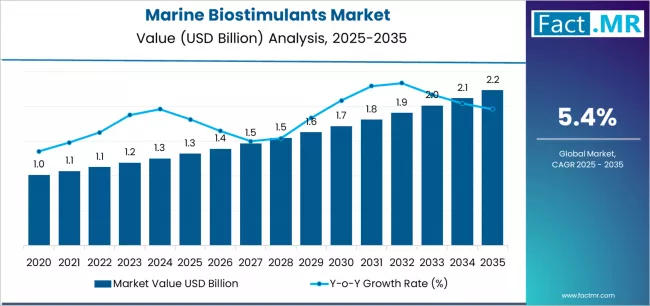
As the global agriculture sector increasingly turns to sustainable and environmentally friendly practices, the market for marine biostimulants has emerged as a critical growth area. Marine biostimulants — largely derived from seaweed, marine proteins, and other ocean-based materials — offer a natural alternative to conventional synthetic fertilizers, supporting plant health, nutrient uptake, stress resistance, and yield enhancement. With rising awareness among farmers, agribusinesses, and regulators about sustainable farming, natural inputs, and organic agriculture, marine biostimulants are gaining wide acceptance across the world.
Market Overview
The global marine biostimulants market is currently witnessing solid growth, underpinned by rising demand for eco-friendly crop enhancement solutions, growing emphasis on soil health and sustainable agriculture, and increasing adoption of organic farming practices. This growth reflects a shift in agricultural strategy: from reliance on chemical fertilizers and agrochemicals toward biologically derived, renewable inputs that support long-term soil health and environmental sustainability. Marine biostimulants, with their complex mix of bioactive compounds — such as polysaccharides, amino acids, and micronutrients — have become integral to modern crop-management regimes seeking to balance productivity with ecological stewardship.
Key Ingredients and Product Types
Within the marine biostimulants category, seaweed extracts dominate the market. Seaweed-based products are widely regarded as the most effective ingredient type because they naturally contain plant growth regulators, micronutrients, and complex bioactive molecules that enhance nutrient absorption, encourage root and shoot development, and improve plant resilience under stress.
Beyond seaweed extracts, other ingredient types include fish protein hydrolysates, chitosan and marine polysaccharides, and other marine-derived compounds. These variants expand the functional scope of biostimulants, enabling tailored applications for different crops, soil types, and farming systems.
End-Use Applications
Marine biostimulants are applied across a wide range of crop categories, but large-scale row crops and cereals represent the largest end-use segment. The extent and scale of grain and cereal cultivation worldwide make them a prime target for yield optimization and input efficiency strategies — precisely where marine biostimulants fit.
Beyond staple crops, other significant applications include fruits and vegetables, turf and ornamentals, and specialty crops. In horticulture and controlled-environment agriculture (greenhouses, high-value fruit/vegetable farms), marine biostimulants contribute to improved fruit setting, better quality and shelf-life, and stress tolerance, making them attractive for growers focused on premium produce.
Modes of Application
Among the various application methods, foliar treatment — spraying biostimulant solutions directly onto plant leaves — remains the most widely used globally. Foliar application allows for rapid absorption, timely responses to nutrient deficiencies or stress conditions, and efficient use of inputs, especially in large-scale farming operations.
Soil treatment and seed treatment are also employed, though to a lesser extent. Seed treatment with marine biostimulants helps improve early germination, seedling vigor, and stress resilience from the very beginning of the crop cycle, while soil treatment can enhance soil microbiome activity and long-term fertility — valuable especially in regions embracing regenerative agriculture.
Market Growth Drivers
A number of converging factors are fueling the growth of the marine biostimulants market globally:
- Sustainable agriculture and organic farming: As governments, consumers, and agribusinesses prioritize sustainability, the demand for natural, non-chemical crop inputs has surged. Marine biostimulants align well with organic certification requirements and environmental stewardship goals, making them increasingly attractive.
- Need for improved soil and crop resilience: With climate change, unpredictable weather, soil degradation, and water scarcity becoming more common, farmers seek solutions to maintain yield and crop health. Marine biostimulants help improve stress tolerance, nutrient use efficiency, and overall plant vigor — factors that support resilient agriculture.
- Technological advances in extraction and formulation: Innovations in marine extraction processes — including more concentrated seaweed extracts, improved fish-protein hydrolysates, and advanced polysaccharide-based formulations — have enhanced the effectiveness and consistency of biostimulant products, encouraging adoption.
- Expansion in global markets and distribution networks: As awareness spreads and regulatory frameworks evolve, distribution networks are expanding, especially in emerging markets. This increases accessibility for farmers and agribusinesses worldwide, enabling wider adoption beyond early-adopter regions.
Regional Dynamics and Market Opportunities
Geographically, while Europe currently holds a substantial share of demand — reflecting established organic farming infrastructure and stringent environmental standards — other regions are witnessing rapid growth, especially in the Asia-Pacific. Rapid agricultural expansion, growing interest in sustainable farming, and increasing adoption of advanced agricultural inputs in countries like India and China are driving market expansion in these regions.
This geographic spread offers interesting opportunities. In emerging economies, there is strong potential for deploying seaweed-based and marine-derived biostimulants across both staple crop farming and high-value horticulture. As farming communities become more aware of sustainable inputs and as distribution networks improve, demand could accelerate significantly, particularly in areas where soil health, yield stability, and input efficiency are critical.
Challenges & Market Constraints
Despite the promising outlook, the marine biostimulants market also faces a few challenges. Awareness among farmers — especially in traditional agricultural regions — remains uneven. In some markets, the benefits of biostimulants over conventional fertilizers are not yet fully understood, which can hinder adoption.
Additionally, cost pressures can be a factor, particularly for commodity crop producers operating on thin margins. The price premium of biostimulants compared to standard chemical fertilizers may restrict their uptake in price-sensitive markets or among smallholder farmers.
Regulatory uncertainty in certain regions also poses a hurdle; while some places have robust frameworks supporting biostimulants (e.g., under fertilizer or organic-input regulations), others lack clear classification or approval pathways — complicating market penetration and cross-border trade.
Outlook & Future Trends
Looking ahead, the marine biostimulants market is poised for steady and sustained growth. As sustainable agriculture continues to gain traction globally, biostimulants are likely to move from niche or supplementary inputs to mainstream agricultural practice. Advances in extraction and formulation technologies will further improve product efficacy, consistency, and cost-effectiveness — making them more accessible to a broader range of farmers.
Moreover, the integration of these products into comprehensive farming systems — combining biostimulants with precision agriculture, soil-microbiome management, and data-driven agronomy — could significantly enhance outcomes in yield, quality, and sustainability. This is especially relevant in regions facing soil degradation, water scarcity, or climate-related stress conditions.
As regulatory frameworks evolve — especially in regions transitioning toward organic certification and sustainable agriculture standards — marine biostimulants may also see increased acceptance among large agribusinesses, governmental agricultural programs, and smallholder farmers alike. This could result in broader distribution, more competitive pricing, and greater penetration into staple-crop segments as well as specialty and horticultural farming.
Conclusion
The market for marine biostimulants represents a promising intersection of agriculture, sustainability, and innovation. As global agriculture grapples with the twin challenges of feeding a growing population and preserving environmental health, marine-derived biostimulants offer a viable solution — boosting crop yields, enhancing nutrient uptake, improving stress tolerance, and aligning with sustainable farming practices.
With increasing awareness, improving technologies, and expanding regulatory and distribution frameworks, marine biostimulants are likely to play an increasingly central role in the future of agriculture worldwide. For farmers, agribusinesses, and stakeholders looking to adopt sustainable and high-performance crop-input strategies, now is an opportune time to explore the potential of marine biostimulants as part of a modern, responsible agricultural portfolio.
Browse Full Report – https://www.factmr.com/report/marine-biostimulants-market