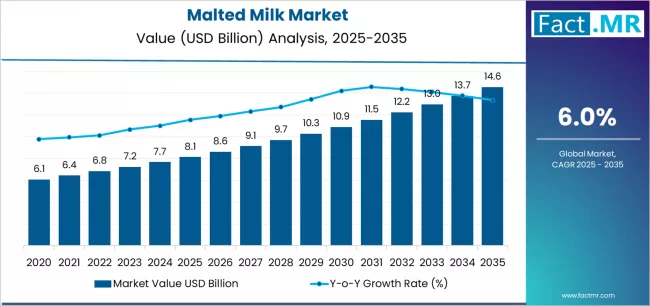
The global malted milk market is evolving from a traditional heritage beverage into a versatile functional ingredient, projected to grow from a valuation of USD 10.3 billion in 2026 to approximately USD 17.8 billion by 2036. This reflects a compound annual growth rate (CAGR) of 5.6% over the ten-year forecast period. The market is being revitalized by the “clean label” movement, the expansion of artisanal bakery sectors, and a surge in demand for fortified, shelf-stable nutritional supplements in emerging economies.
Get Access of Report Sample: https://www.factmr.com/connectus/sample?flag=S&rep_id=11642
Quick Stats:
- Market size 2026? USD 10.3 billion.
- Market size 2036? USD 17.8 billion.
- CAGR? 5.6% (2026–2036).
- Leading Source? Wheat-based malted milk holds the largest share (approx. 64%).
- Fastest Growing Source? Barley is witnessing a higher growth rate due to its premium flavor profile.
- Dominant Form? Powdered malted milk accounts for over 80% of the market share.
- Top Companies? Nestlé S.A., Unilever (Horlicks), Associated British Foods (Ovaltine), GlaxoSmithKline PLC, Abbott Laboratories, and Muntons plc.
Market Momentum (YoY Path)
The malted milk market is undergoing a transition from a standalone “bedtime drink” to a key component in the broader “active nutrition” space. Valued at USD 10.3 billion in 2026, the industry is expected to reach USD 12.2 billion by 2029 as manufacturers introduce low-sugar and high-protein variants to cater to health-conscious adults. As the application of malt extract expands further into the premium confectionery and dairy-alternative sectors, the valuation is projected to hit USD 14.6 billion by 2032, eventually reaching USD 17.8 billion by 2036.
Why the Market is Growing
Growth is primarily fueled by the Rising Demand for Functional Beverages and Expansion in the Food Processing Industry. Modern consumers view malted milk as a natural source of essential vitamins (B6, B12), minerals (Calcium, Magnesium), and dietary fiber. Furthermore, its Unique Flavor Profile and Texture Enhancement properties make it a staple in the bakery and confectionery sectors, where it is used to provide a “creamy mouthfeel” and natural sweetness. In Developing Regions, malted milk is heavily promoted through school nutrition programs and government-led initiatives to combat micronutrient deficiencies, providing a stable foundation for long-term volume growth.
Segment Spotlight
- Source: Wheat vs. Barley vs. Others
Wheat remains the dominant source due to its cost-effectiveness and widespread availability. However, Barley-based products are gaining ground in the premium segment, favored for their authentic malty aroma and “heritage” positioning. Emerging sources like Oats and Rye are being explored for niche, gluten-reduced formulations.
- End-Use: Beverages vs. Bakery & Confectionery
While Beverages remain the primary application, the Bakery & Confectionery segment is the fastest-growing. Malted milk powder is increasingly used in “bite-sized” snacks, artisanal cookies, and premium chocolate fillings to differentiate products with a nostalgic yet sophisticated flavor.
- Regional Focus: Asia-Pacific’s Market Dominance
Asia-Pacific currently holds the largest market share (approx. 37%), with India being the single largest revenue contributor globally. The deep-rooted cultural consumption of malt-based drinks in India and China, combined with rising disposable incomes, ensures this region remains the primary growth engine. Europe is also a key player, focusing on high-value organic and “clean label” malted milk ingredients.
Drivers, Opportunities, Trends, and Challenges
- Drivers: Increasing health consciousness, growth in e-commerce sales channels, and the “premiumization” of the global dairy industry.
- Opportunities: Plant-based Malted Drinks. There is a massive opportunity to develop malted milk alternatives using almond, oat, or soy bases to cater to the vegan and lactose-intolerant population.
- Trends: The rise of Ready-to-Drink (RTD) liquid formats for on-the-go consumption and the integration of Probiotics into malted milk powders to support gut health.
- Challenges: Volatile Raw Material Prices. Fluctuations in wheat and barley yields due to climate change can impact manufacturer margins. Additionally, the High Sugar Content in traditional formulations is a concern for some health-conscious consumer groups.
Country Growth Outlook (CAGR 2026-2036)
| Country | Projected CAGR |
| India | 6.5% |
| China | 6.0% |
| UK | 5.4% |
| USA | 5.1% |
| Germany | 4.8% |
Competitive Landscape
The market is characterized by Intense Brand Loyalty and Continuous Product Reformulation.
- Strategic Repositioning: Major players like Nestlé and Unilever are repositioning their heritage brands (Milo, Horlicks) as “Performance and Growth” supplements for children and “Energy and Immunity” drinks for adults.
- B2B Partnerships: Companies like Muntons and Briess Malt & Ingredients are focusing on the industrial B2B market, providing specialized malted milk powders for large-scale cookie and snack manufacturers.
- Innovation in Packaging: Competition is focusing on Sustainable Packaging Solutions, with a shift from metal tins to high-barrier recyclable pouches and FSC-certified cartons to reduce environmental impact.
- Local Champions: In regions like India, domestic players (e.g., Amul, Bournvita) are competing aggressively with multinationals by leveraging extensive rural distribution networks and localized flavor profiles.
Browse Full Report : https://www.factmr.com/report/malted-milk-market
About Fact.MR
Fact.MR is a global market research and consulting firm, trusted by Fortune 500 companies and emerging businesses for reliable insights and strategic intelligence. With a presence across the U.S., UK, India, and Dubai, we deliver data-driven research and tailored consulting solutions across 30+ industries and 1,000+ markets. Backed by deep expertise and advanced analytics, Fact.MR helps organizations uncover opportunities, reduce risks, and make informed decisions for sustainable growth.