As industries and homeowners increasingly prioritize flexibility and cost efficiency, the log splitter rental market is gaining momentum within the broader equipment rental landscape. Rather than investing in expensive machinery that may only be used occasionally, many users are turning to rental services for convenient access to high-performance wood processing tools. This shift reflects evolving consumer preferences toward shared resources, reduced maintenance responsibilities, and smarter financial planning.
The rising popularity of outdoor heating solutions, landscaping projects, and property maintenance activities is further supporting demand for rental log splitters. Whether for residential firewood preparation or commercial land clearing, rental services provide an accessible and practical solution for short-term equipment needs.
Market Overview
The log splitter rental market caters to a diverse customer base that includes homeowners, contractors, landscaping companies, and tree service providers. Rental companies typically maintain fleets featuring various splitter types such as gas-powered, electric, and hydraulic machines, allowing customers to select equipment based on workload, mobility requirements, and operational preferences.
Unlike ownership, renting eliminates concerns related to storage, servicing, and long-term depreciation. This makes the rental model especially appealing to seasonal users who require equipment only during specific times of the year. Additionally, rental providers often ensure that machinery is well-maintained and ready for use, which reduces downtime and improves productivity for end-users.
The increasing acceptance of the rental economy is also playing a critical role in market expansion. Businesses and individuals alike are recognizing that renting equipment can free up capital for other investments while still delivering the performance needed for demanding tasks.
Market Dynamics and Growth Drivers
Seasonal Demand from Residential Users
One of the primary drivers of the log splitter rental market is seasonal demand. In regions where firewood is commonly used for heating, homeowners often rent log splitters during the fall and early winter months to prepare wood efficiently. Renting allows them to complete large tasks quickly without committing to equipment that may sit idle for most of the year.
Cost Efficiency and Financial Flexibility
Purchasing heavy-duty equipment can be a significant financial burden, particularly for individuals or small businesses with limited budgets. Rentals provide an economical alternative by converting large capital expenditures into manageable operational costs. Users pay only for the time they need the equipment, making rentals a financially sound choice for short-term projects.
Growing Commercial Applications
Commercial sectors are increasingly integrating rental equipment into their workflows. Tree removal services, construction crews, and landscaping professionals frequently encounter wood processing requirements but may not need a log splitter on a daily basis. Renting enables these businesses to scale their equipment usage according to project demands without overinvesting in machinery.
Advancements in Equipment Technology
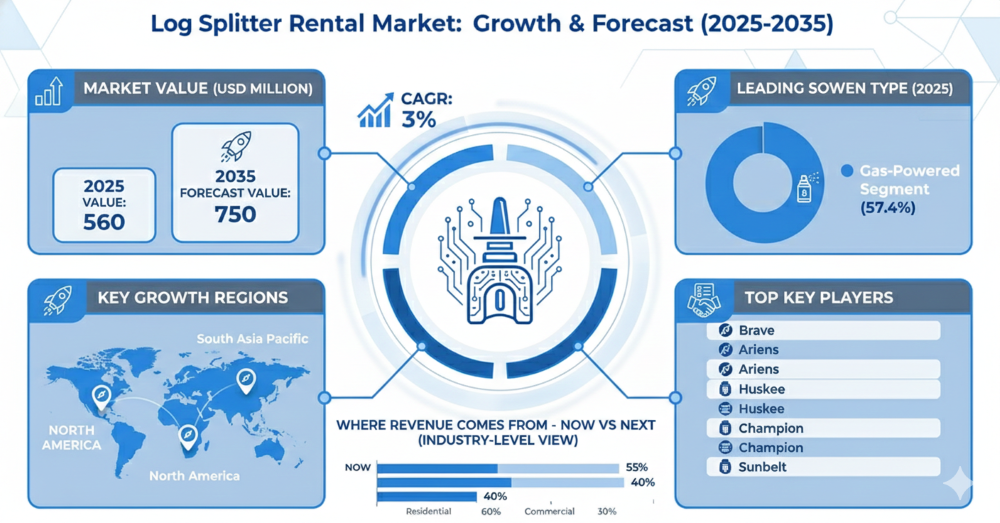
Technological improvements are enhancing the performance, safety, and usability of modern log splitters. Electric models are becoming more attractive due to their quieter operation and reduced emissions, while gas-powered machines continue to dominate where higher power output is necessary. Hydraulic splitters are particularly valued for heavy-duty applications that require consistent force and efficiency.
Regional Insights
North America
North America represents a mature market with widespread awareness of equipment rental services. A strong do-it-yourself culture, combined with extensive rental networks, supports steady demand among both homeowners and professional contractors.
Europe
Europe benefits from well-established rental infrastructures and a growing emphasis on cost optimization. Many businesses prefer renting equipment to maintain operational agility, while homeowners increasingly rely on rental providers for property maintenance tools.
Asia-Pacific
The Asia-Pacific region is emerging as a promising market due to expanding construction activities and rising urban development. Increased awareness of rental services, along with improving affordability, is encouraging adoption across both residential and commercial sectors.
Overall, global demand continues to grow as more users recognize the practical advantages of renting over owning.
Key Market Trends
Digital Transformation in Rental Services
Online booking platforms are transforming the equipment rental experience. Customers can now browse available models, compare specifications, check availability, and schedule rentals with ease. This digital shift enhances transparency and convenience while helping rental providers streamline operations.
Rising Focus on Sustainability
Environmental considerations are influencing equipment preferences. Electric and battery-powered log splitters are gaining traction among environmentally conscious users seeking cleaner alternatives. Rental companies are responding by expanding their fleets to include eco-friendly options that align with sustainability goals.
Value-Added Services Enhancing Customer Experience
Rental providers are increasingly offering services such as delivery, pickup, equipment demonstrations, and safety guidance. These additions improve user confidence and ensure efficient equipment handling, which can encourage repeat business and long-term customer relationships.
Safety and Ergonomic Improvements
Modern log splitters are being designed with enhanced safety features, including improved stability, automatic return systems, and user-friendly controls. These innovations help reduce the risk of injury and make the equipment more accessible to less experienced operators.
Segmentation and Equipment Types
The log splitter rental market can be broadly categorized based on power source, capacity, and user profile.
By Power Source:
Gas-powered splitters remain widely used due to their mobility and ability to handle tough logs. Electric models are increasingly preferred for residential applications because they are easier to operate and require less maintenance. Hydraulic splitters serve high-volume commercial operations where efficiency is critical.
By Capacity:
Lower-capacity machines are typically sufficient for household tasks, while mid-range and high-capacity splitters are designed for professional workloads involving larger logs and continuous usage.
By End User:
Residential customers drive demand during peak seasonal periods, whereas commercial users contribute to steady, year-round rental activity. Together, these segments create a balanced demand structure for rental providers.
Conclusion
The log splitter rental market is steadily establishing itself as an essential component of the equipment rental industry. Driven by the need for flexibility, cost savings, and operational convenience, more users are opting to rent rather than purchase heavy machinery. Technological advancements, digital rental platforms, and expanding service offerings are further strengthening market appeal.
As industries and households continue to prioritize efficiency and financial prudence, the demand for rental log splitters is expected to remain strong. Providers that focus on diverse equipment fleets, customer-centric services, and sustainable solutions will be well-positioned to capitalize on emerging opportunities in this evolving market.
Browse Full Report – https://www.factmr.com/report/log-splitter-rental-market