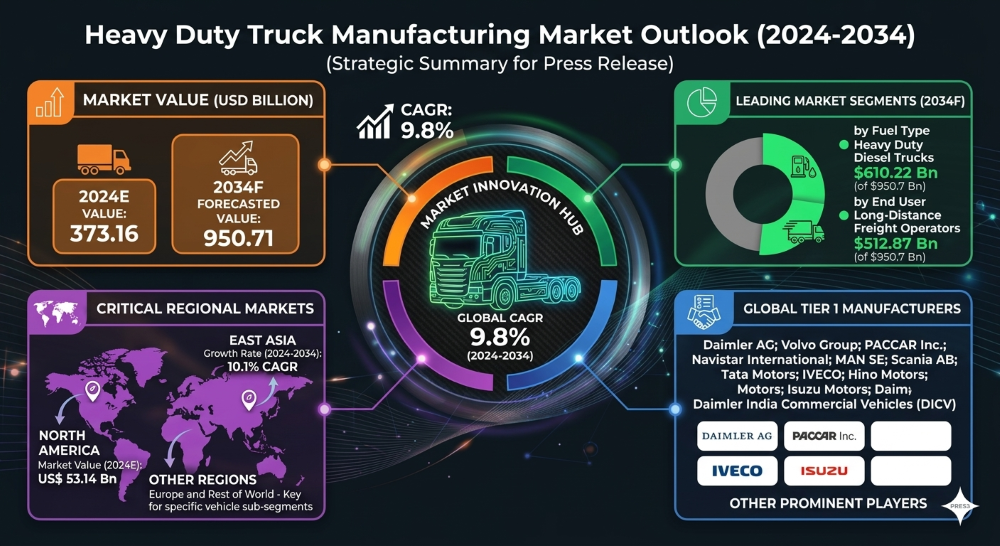
The heavy-duty truck manufacturing market plays a crucial role in supporting global trade, logistics, and large-scale transportation activities. As industries expand and supply chains become increasingly complex, the demand for high-capacity transportation vehicles continues to rise. Heavy-duty trucks are essential for long-distance freight movement, construction operations, mining activities, and infrastructure development. The market is experiencing steady growth as manufacturers focus on improving vehicle efficiency, durability, and sustainability while meeting evolving regulatory standards and technological advancements.
Market Overview:
Heavy-duty trucks are large commercial vehicles designed to transport heavy loads across long distances and challenging terrains. These trucks typically include tractor-trailers, dump trucks, tankers, and other specialized vehicles used across various industrial sectors. They are built with powerful engines, reinforced chassis structures, and advanced suspension systems to handle demanding transportation tasks.
The growth of the heavy-duty truck manufacturing market is closely linked to the expansion of global logistics networks, the development of infrastructure projects, and increasing industrial activities. As e-commerce continues to grow and supply chains expand globally, transportation companies are investing in advanced heavy-duty trucks that can deliver improved fuel efficiency and operational reliability.
Technological advancements are also reshaping the industry. Modern heavy-duty trucks incorporate advanced telematics systems, improved aerodynamics, and digital fleet management solutions that help operators monitor vehicle performance, optimize routes, and reduce operational costs. These innovations are helping fleet operators improve productivity while maintaining safety and regulatory compliance.
Regional Insights:
The heavy-duty truck manufacturing market is expanding across several key regions, each influenced by unique economic and industrial factors.
North America represents a significant market for heavy-duty trucks due to the strong presence of large logistics networks and well-developed transportation infrastructure. The region continues to adopt advanced trucking technologies, including connected vehicles and improved engine efficiency solutions. Manufacturers are also focusing on reducing emissions and enhancing fuel economy to meet environmental regulations.
Europe is another major market, driven by strict emission standards and the increasing focus on sustainable transportation. Governments and automotive manufacturers in the region are encouraging the development of cleaner and more efficient commercial vehicles. This has led to increased research and development efforts aimed at producing alternative fuel trucks, including electric and hydrogen-powered heavy-duty vehicles.
The Asia-Pacific region is emerging as one of the fastest-growing markets for heavy-duty truck manufacturing. Rapid industrialization, expanding infrastructure projects, and the growth of manufacturing industries are driving strong demand for heavy transport vehicles. Countries such as China and India are witnessing significant growth in freight transportation and construction activities, which is boosting the demand for heavy-duty trucks across the region.
Key Trends & Forecast:
Several key trends are shaping the future of the heavy-duty truck manufacturing market.
One major trend is the development of alternative fuel technologies. As governments around the world implement stricter environmental regulations, manufacturers are exploring cleaner energy solutions such as electric trucks, hybrid powertrains, and hydrogen fuel cell technology. These innovations are designed to reduce greenhouse gas emissions and improve energy efficiency.
Another important trend is the increasing integration of digital technologies into heavy-duty trucks. Telematics systems, advanced driver assistance systems, and predictive maintenance technologies are becoming standard features in modern trucks. These technologies help fleet operators track vehicle performance, monitor fuel consumption, and enhance driver safety.
Autonomous driving technology is also gaining attention in the heavy-duty truck industry. Manufacturers and technology companies are investing in research to develop semi-autonomous and fully autonomous trucks that can improve logistics efficiency and reduce human error. While large-scale deployment is still evolving, these innovations have the potential to transform long-haul transportation in the future.
Additionally, manufacturers are focusing on lightweight materials and improved vehicle design to enhance fuel efficiency and load capacity. Advanced manufacturing techniques and innovative materials are helping reduce vehicle weight while maintaining strength and durability.
Applications & End-Use Outlook:
Heavy-duty trucks are widely used across various industries that require the transportation of large quantities of goods and materials. The logistics and freight transportation sector represents the largest application segment, as these trucks are essential for moving goods between manufacturing facilities, warehouses, distribution centers, and retail locations.
The construction industry is another major user of heavy-duty trucks. Vehicles such as dump trucks and cement mixers are vital for transporting construction materials, including sand, gravel, and concrete, to project sites. As infrastructure development continues to expand globally, the demand for specialized construction trucks is expected to grow.
Mining operations also rely heavily on high-capacity trucks to transport minerals, ores, and raw materials across mining sites and processing facilities. These trucks are designed to operate in challenging environments and carry extremely heavy loads, making them essential for large-scale mining activities.
Other sectors, including agriculture, energy, and waste management, also depend on heavy-duty trucks for transporting bulk materials and equipment. As these industries continue to expand, the demand for reliable and efficient transportation vehicles is expected to increase.
Conclusion:
The heavy-duty truck manufacturing market remains a fundamental component of the global transportation and logistics ecosystem. With industries increasingly relying on efficient freight movement and large-scale material transportation, the demand for durable and technologically advanced trucks continues to grow.
Manufacturers are responding to these evolving demands by investing in innovation, sustainability, and digital technologies. From alternative fuel engines to connected fleet management systems, modern heavy-duty trucks are becoming more efficient, environmentally friendly, and technologically advanced.
As global trade expands and infrastructure development accelerates, the heavy-duty truck manufacturing market is expected to witness continued growth. Companies that focus on innovation, efficiency, and sustainability will be well positioned to meet the future demands of the transportation industry while supporting the evolving needs of global supply chains.
Browse Full Report – https://www.factmr.com/report/heavy-duty-truck-manufacturing-market