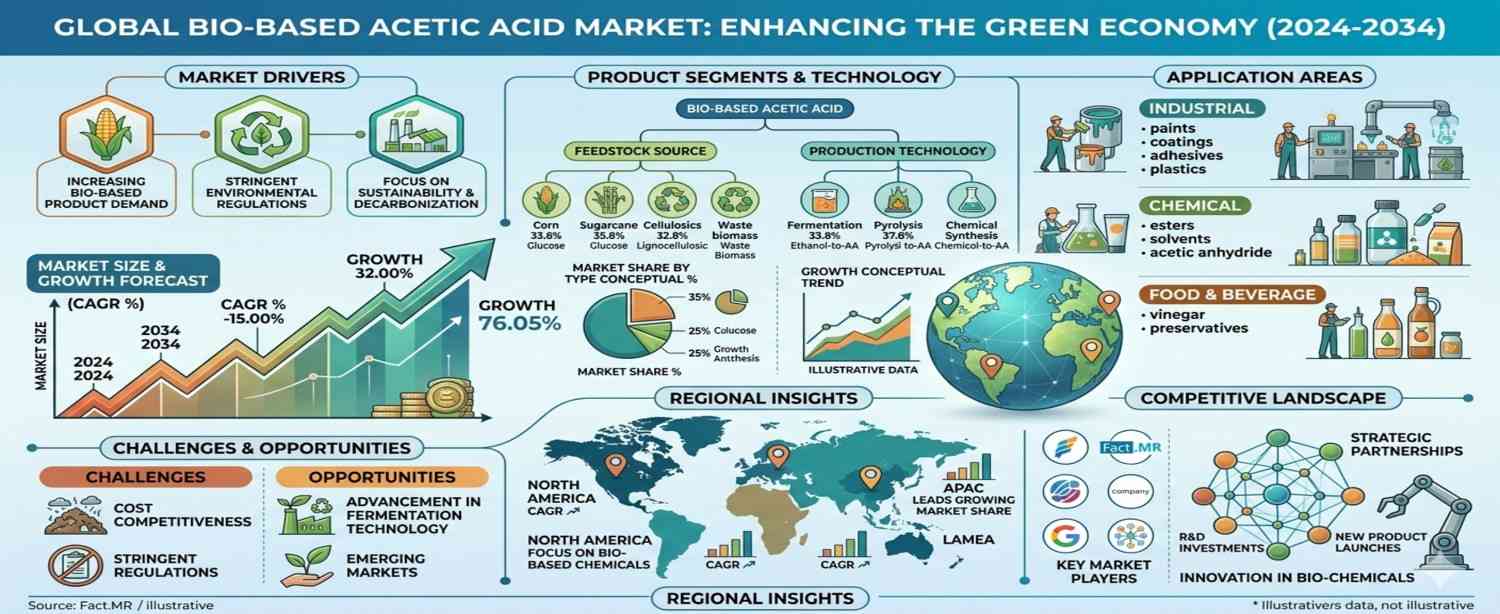
The global chemical industry is reaching a pivotal decarbonization milestone. As industrial giants pivot from petrochemical dependence to circular economy models, bio-based acetic acid has emerged as a cornerstone of the “Green Chemistry” movement. New market intelligence reveals the sector is valued at USD 1.4 billion in 2025 and is projected to skyrocket to USD 3.8 billion by 2035—a massive 10.5% CAGR that signals a permanent shift in industrial manufacturing.
For decision-makers in the pharmaceutical, food processing, and chemical sectors, this 2.71X expansion represents more than just growth—it is a regulatory and economic mandate for sustainable supply chains.
Quick Stats: The Decadal Outlook (2025–2035)
| Metric | Value / Detail |
| Market Value (2025E) | USD 1.4 Billion |
| Forecast Value (2035F) | USD 3.8 Billion |
| Absolute Growth | USD 2.4 Billion (171.4% increase) |
| Leading Production Source | Biomass Fermentation (61% Market Share) |
| Primary Demand Driver | Food & Beverage (42% Application Share) |
| Top Growth Region | USA (11.2% CAGR) |
Market Dynamics: Why the Surge is Accelerating
The transition is being fueled by a combination of “push” (regulatory) and “pull” (innovation) factors. Between 2030 and 2035 alone, the market will add USD 1.5 billion in value, representing 62.5% of the total decade-long expansion.
- The Fermentation Dominance: Biomass fermentation currently commands 61% of the market. Chemical engineers are increasingly favoring this method for its feedstock flexibility and proven ability to drastically reduce carbon footprints while maintaining cost-competitiveness.
- The Pharmaceutical Mandate: High-purity bio-based acetic acid is becoming essential for pharmaceutical manufacturing. As ESG investing influences the medical supply chain, companies like LanzaTech and Afyren are scaling biotechnology to meet stringent purity requirements.
- Circular Economy & Waste-to-Chemicals: A major trend is the shift toward agricultural residue and waste valorization. This allows manufacturers to bypass the “food vs. fuel” debate by converting waste into high-value chemical building blocks.
Industrial and Consumer Segment Leadership
- Industrial End Use (64% Share): This segment remains the backbone of the market. Manufacturers in chemical processing and sustainable packaging are prioritizing bio-based acetic acid to meet Scope 3 emissions reporting and renewable content targets.
- Food & Beverage (42% Share): As the primary application driver, the food industry utilizes bio-based grades for preservation and processing due to their exceptional safety profiles and “certified green” credentials.
Regional Powerhouses: A Global Heatmap
The market’s acceleration varies by region, with the West and East Asia leading the charge through specific industrial strengths:
| Country | CAGR (2025-2035) | Primary Growth Driver |
| USA | 11.2% | Biotechnology infrastructure & Pharma clusters |
| Mexico | 10.7% | Abundant agricultural waste & North American trade |
| Germany | 10.3% | Innovation leadership & Circular economy focus |
| France | 10.1% | Biorefinery development & Sustainable initiatives |
| South Korea | 9.8% | Advanced bioprocessing & Tech-led manufacturing |
Browse Full Report –
https://www.factmr.com/report/1189/bio-based-acetic-acid-market