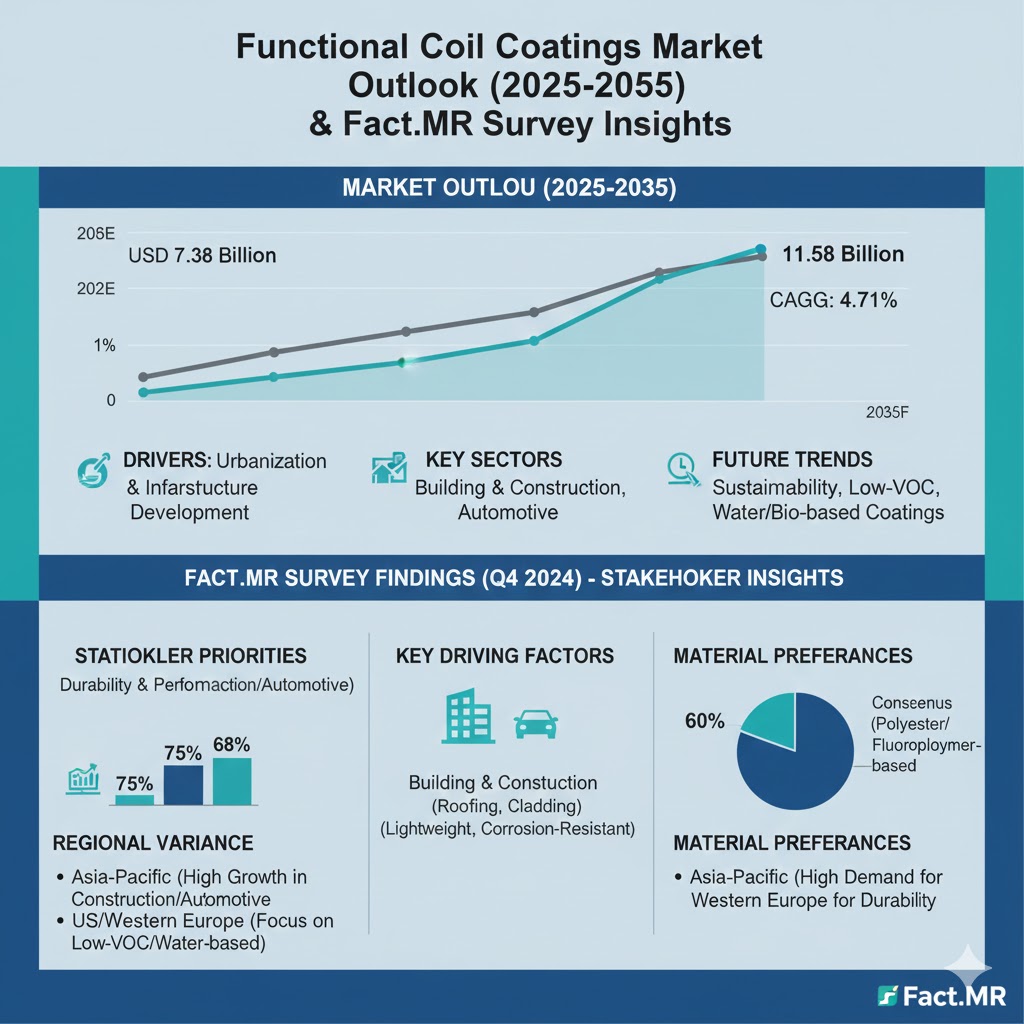
The global Functional Coil Coatings market is poised for significant growth over the next decade, with strong drivers in innovation, sustainability, and strategic positioning. The market is projected to grow from an estimated USD 7.38 billion in 2025 to USD 11.58 billion by 2035, representing a compound annual growth rate (CAGR) of 4.71%.
This growth trajectory is fueled by rising demand across key end-use sectors such as construction, automotive, industrial manufacturing, and appliances, where performance and sustainability are increasingly critical.
Market Drivers: Performance and Sustainability
1. Regulatory and Environmental Pressures
Environmental compliance has become a major growth driver, with 84% of industry participants ranking VOC and hazardous emissions control as critical. The push toward low-VOC, water-based, and bio-based coatings is reshaping production, with sustainable formulations now accounting for approximately 40% of total market demand, up from 28% in 2020.
This shift represents a 42.8% increase in adoption of eco-friendly coatings over the last five years, reflecting the combined effect of regulatory enforcement and consumer demand for sustainable building materials.
2. Rising Demand for High-Performance Coatings
End users increasingly require multifunctional coatings that deliver:
-
Corrosion resistance (demand growing at 5.2% CAGR)
-
Thermal stability (4.8% CAGR)
-
Energy efficiency and reflective properties (4.5% CAGR)
-
Smart functionalities such as self-cleaning and antimicrobial features (projected to increase by 6.1% CAGR)
The smart coatings segment, currently representing 12% of total revenue, is expected to nearly double by 2035, driven by industrial and healthcare applications.
3. End-Use Industry Growth
-
Construction: Accounts for 38% of market revenue, fueled by urbanization and energy-efficient building mandates. Growth in this segment is projected at 4.9% CAGR.
-
Automotive: Represents 27% of revenue, with EV adoption boosting demand for lightweight, corrosion-resistant coil coatings. The EV-related coatings market is expected to grow at 6.2% CAGR through 2035.
-
Industrial Manufacturing and Appliances: Together comprise 35% of the market, with durability and aesthetic requirements driving adoption of advanced coatings at 4.4% CAGR.
Regional Insights
-
Asia-Pacific: Leading market share at 45% in 2025, expected to reach 48% by 2035, driven by China and India. Rapid urbanization and industrial expansion are contributing to a 5.0% regional CAGR.
-
Europe: Accounts for 25% of market revenue, with water-based and bio-based coatings adoption rising from 32% in 2020 to 46% in 2025. Stringent regulations continue to favor eco-friendly solutions.
-
North America: Contributes 20% of revenue, with a CAGR of 4.3%, supported by high regulatory compliance and smart technology integration.
-
Rest of World: Holds 10% of the market, growing at 3.8% CAGR, largely in emerging regions where adoption is increasing steadily.
Innovation Trends
Sustainable and Eco-Friendly Formulations
-
Water-based and bio-based coatings currently occupy 40% of the total market, projected to grow to 60% by 2035.
-
Low-VOC coatings are growing at 5.5% CAGR, becoming a standard in regulatory-driven markets.
Smart and Functional Coatings
-
The smart coatings segment is expected to expand from USD 0.88 billion in 2025 to USD 1.72 billion by 2035, reflecting a 6.1% CAGR.
-
Key functionalities include self-healing, anti-microbial, anti-fingerprint, and self-cleaning properties.
Customized Solutions
-
Demand for substrate-specific and application-specific coatings is growing, representing 28% of total market revenue in 2025, expected to reach 35% by 2035.
Advanced Materials and Supply Chain Innovations
-
Nanotechnology and polymer-matrix enhancements are projected to account for 15% of product innovations by 2035, improving adhesion, durability, and resistance to extreme environments.
Challenges
-
Raw Material Volatility: Specialty resins and pigments have fluctuated by ±12% annually, affecting pricing and margins.
-
Adoption Gaps: Emerging markets show 20–30% lower adoption rates for sustainable and smart coatings compared to mature markets.
-
Regulatory Complexity: Compliance costs represent 3–5% of total production costs for global manufacturers, requiring strategic localization.
Competitive Landscape
The market is fragmented but led by major global players:
-
AkzoNobel, PPG Industries, BASF, Sherwin-Williams, Henkel AG & Co. KGaA
Collectively, these leaders hold ~45% of the global market share, leveraging R&D and strategic acquisitions. Smaller regional players are increasing their presence in high-growth emerging markets, accounting for ~20% of market revenue, while niche manufacturers focus on specialized applications and smart coatings.
Browse Full Report : https://www.factmr.com/report/4460/functional-coil-coatings-market
Market Outlook to 2036
Key strategic priorities for market participants include:
-
Sustainability Leadership: Low-VOC and bio-based coatings expected to represent 60% of total market by 2035.
-
Smart Coatings Expansion: Multifunctional coatings projected to double revenue share from 12% to 23% by 2035.
-
Regional Customization: Tailoring solutions for local regulations and market requirements to capture high-value segments.
-
Supply Chain Optimization: Diversified sourcing and regional manufacturing hubs to mitigate material volatility.
Conclusion
The Functional Coil Coatings market is transitioning into a high-growth, innovation-led, sustainability-focused industry, with expected revenue growth to USD 11.58 billion by 2035 and continued expansion through 2036.
Companies that invest strategically in eco-friendly formulations, smart coatings, and market-specific solutions are positioned to lead in a competitive, regulated, and performance-driven environment, ensuring both profitability and environmental stewardship.