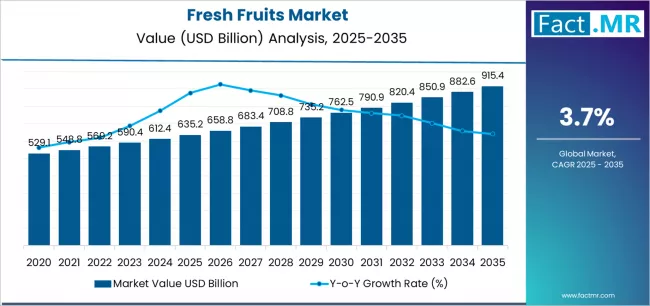
The global fresh fruits market is undergoing a structural shift toward “functional snacking” and traceable supply chains, projected to grow from a valuation of USD 645.5 billion in 2026 to approximately USD 1.1 trillion by 2036. This represents a steady compound annual growth rate (CAGR) of 5.5% over the ten-year forecast period. The market is being propelled by the global “health-centric” dietary transition, advancements in cold-chain logistics that minimize post-harvest losses, and the rising middle-class population in emerging economies demanding premium, exotic varieties.
Get Access of Report Sample: https://www.factmr.com/connectus/sample?flag=S&rep_id=11655
Quick Stats:
- Market size 2026? USD 645.5 billion.
- Market size 2036? USD 1.1 trillion.
- CAGR? 5.5% (2026–2036).
- Leading Fruit Type? Bananas and Apples account for over 35% of the global volume share.
- Fastest Growing Segment? Berries (Blueberries, Raspberries) and Avocados due to their “superfood” status.
- Primary Distribution Channel? Supermarkets/Hypermarkets remain the dominant revenue source.
- Top Companies? Dole Food Company, Inc., Fresh Del Monte Produce Inc., Chiquita Brands International Sàrl, Total Produce plc (Dole plc), Mirak Group, and Sunkist Growers, Inc.
Market Momentum (YoY Path)
The fresh fruits market is evolving from a local commodity-based trade into a highly sophisticated global value chain. Valued at USD 645.5 billion in 2026, the market is expected to reach USD 758 billion by 2029 as e-commerce “quick-commerce” platforms in urban centers improve the last-mile delivery of perishables. As climate-resilient farming techniques and “smart packaging” extend the shelf life of tropical fruits, the valuation is projected to hit USD 915 billion by 2032, eventually reaching USD 1.1 trillion by 2036.
Why the Market is Growing
Growth is primarily fueled by the Increasing Consumer Focus on Natural Immunity and the Diversification of Exotic Fruit Availability. Post-pandemic, there has been a permanent shift toward whole-food diets rich in Vitamin C and antioxidants. Furthermore, Innovations in Controlled Atmosphere Storage (CAS) are a major catalyst; fruits can now be transported across oceans while maintaining “just-picked” freshness, allowing seasonal fruits to be available year-round. In Emerging Markets, the westernization of diets and the expansion of organized retail are significantly increasing the per capita consumption of non-native fruits like kiwis and dragon fruits.
Segment Spotlight
- Fruit Type: The Superfood Surge
While Citrus Fruits and Melons maintain massive steady volumes, Berries are witnessing the highest CAGR. Their high nutrient density and convenience for “on-the-go” snacking make them a favorite for health-conscious Gen Z and Millennial demographics. Avocados also continue to see strong demand, driven by the global “healthy fats” culinary trend.
- Nature: Conventional vs. Organic
Conventional fruits dominate the market by volume. However, the Organic segment is growing at a CAGR of 8.2%, particularly in North America and Western Europe, where consumers are increasingly willing to pay a premium for “pesticide-free” and “non-GMO” certifications.
- Regional Focus: Asia-Pacific’s Consumption Engine
Asia-Pacific currently holds the largest market share (approx. 42%), led by China and India, which are both massive producers and consumers. This region is also the primary driver of the “Exotic Fruit” trade, as rising disposable incomes lead to higher spending on imported premium fruits like cherries and durians.
Drivers, Opportunities, Trends, and Challenges
- Drivers: Rising awareness of veganism, expansion of the “fruit-processing” industry (juices, smoothies), and government-led “5-a-day” health campaigns.
- Opportunities: Direct-to-Consumer (DTC) Fruit Boxes. There is a massive opportunity for subscription-based “farm-to-table” models that bypass traditional retail markups and provide fresher produce.
- Trends: The rise of “Ugly Fruit” movements (selling misshapen produce to reduce waste) and the use of Edible Coatings (made from plant-based materials) to double the shelf life of fruits without plastic packaging.
- Challenges: Climate Change Impacts. Unpredictable weather patterns, droughts, and emerging pests are destabilizing harvest yields. Additionally, High Logistics Costs and the carbon footprint associated with air-freighted exotic fruits are under increasing scrutiny.
Country Growth Outlook (CAGR)
| Country | Projected CAGR (2026-2036) |
| China | 7.1% |
| India | 6.8% |
| USA | 4.9% |
| Brazil | 5.4% |
| Germany | 4.2% |
Competitive Landscape
The market is characterized by Heavy Consolidation in Logistics and Brand-Led Differentiation.
- Market Leadership: Giants like Dole and Fresh Del Monte dominate through ownership of their own shipping fleets and ripening centers, allowing them to control the quality of the “cold chain” from end to end.
- Sustainability Integration: Leading players are increasingly investing in Water-Efficient Irrigation and Regenerative Agriculture to secure long-term yields amidst water scarcity.
- Innovation Focus: Competition is shifting toward Varietal Innovation. Companies are developing proprietary “Trademarked” fruit varieties (e.g., Pink Lady apples or Zespri SunGold kiwis) that offer superior taste, color, or shelf life.
- Digital Transformation: Major distributors are adopting Blockchain-based Traceability, allowing consumers to scan a QR code on a piece of fruit to see exactly which farm it came from and when it was harvested.
Browse Full Report : https://www.factmr.com/report/fresh-fruits-market
About Fact.MR
Fact.MR is a global market research and consulting firm, trusted by Fortune 500 companies and emerging businesses for reliable insights and strategic intelligence. With a presence across the U.S., UK, India, and Dubai, we deliver data-driven research and tailored consulting solutions across 30+ industries and 1,000+ markets. Backed by deep expertise and advanced analytics, Fact.MR helps organizations uncover opportunities, reduce risks, and make informed decisions for sustainable growth.