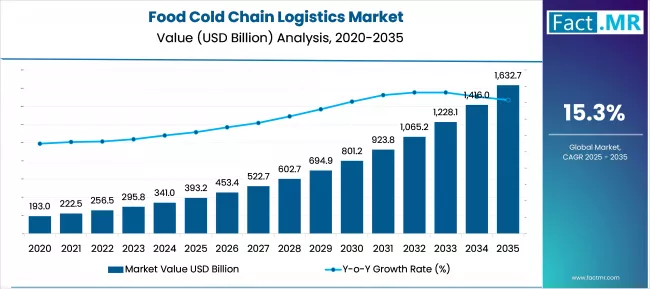
The global food cold chain logistics market is projected to grow from USD 455.2 billion in 2026 to approximately USD 1,023.7 billion by 2036. This massive expansion represents an absolute increase of USD 568.5 billion over the forecast period, with the market set to expand at a compound annual growth rate (CAGR) of 8.4% between 2026 and 2036. The market is being propelled by the globalization of food trade and a fundamental shift in consumer behavior toward fresh, perishable, and ready-to-eat temperature-sensitive products.
Quick Stats:
-
Market size 2026? USD 455.2 billion.
-
Market size 2036? USD 1,023.7 billion.
-
CAGR? 8.4% (2026–2036).
-
Leading service segment? Refrigerated Warehousing leads the market with a 52.0% share.
-
Leading food type? Meat, Fish, and Seafood dominate the logistics demand at 38.0% market share.
-
Key growth regions? Asia-Pacific (fastest growing), North America, and Europe.
-
Top companies? Americold Logistics, Lineage Logistics, Lineage, United States Cold Storage, Nichirei Logistics Group, Burris Logistics, and Tippmann Group.
Get Access of Report Sample: https://www.factmr.com/connectus/sample?flag=S&rep_id=11077
Market Momentum (YoY Path)
The food cold chain logistics market is on a robust year-over-year trajectory. Valued at USD 455.2 billion in 2026, the market is expected to reach USD 535.4 billion by 2028. As “farm-to-fork” transparency becomes a global standard, the valuation is projected to hit USD 698.2 billion in 2031 and USD 815.4 billion by 2033. By 2036, the market will surpass the USD 1 trillion mark, driven by a 2.2X expansion of the automated cold storage footprint in emerging economies.
Why the Market is Growing
Growth is primarily fueled by the “Freshness Revolution” and the explosion of Online Grocery Retail. Consumers are increasingly demanding year-round access to exotic fruits, premium meats, and temperature-sensitive dairy, necessitating a continuous, unbroken cold chain. Additionally, stricter international food safety regulations (such as FSMA in the USA and similar EU mandates) require precise temperature monitoring and documentation. This shift from “passive” storage to “active” smart logistics is making specialized cold chain services indispensable for reducing food waste, which currently claims nearly 30% of global production.
Segment Spotlight
1. Service Type: Refrigerated Warehousing
Refrigerated Warehousing holds the leading share at 52.0%. The demand is shifting toward automated storage and retrieval systems (AS/RS) that minimize human contact and heat gain. Furthermore, “multi-temperature” facilities that can accommodate frozen, chilled, and ambient products in one hub are becoming the new industry standard for e-commerce fulfillment centers.
2. Food Type: Meat, Fish, and Seafood
This segment accounts for 38.0% of the market. High protein consumption globally and the expansion of international seafood trade require sophisticated ultra-low temperature (ULT) logistics. Following closely is the Fruits and Vegetables segment, which is seeing a surge in demand for controlled atmosphere (CA) storage to slow down the ripening process during long-haul sea freight.
3. Regional Growth: Asia-Pacific Dominance
Asia-Pacific leads global demand, with India (10.2% CAGR) and China (9.1% CAGR) as the primary engines of growth. China’s massive investment in “Cold Chain Silk Road” infrastructure and India’s focus on reducing post-harvest losses through the development of rural cold hubs are significantly boosting regional capacity.
Drivers, Opportunities, Trends, and Challenges
Drivers: The rise of organized retail (supermarkets/hypermarkets) and the growth of the biopharmaceutical sector (sharing cold chain infrastructure) are major catalysts. Additionally, government subsidies for the construction of cold storage in developing nations are lowering the barrier to entry for local providers.
Opportunities: There is a significant opportunity in Green Cold Chain technology. With refrigeration being an energy-intensive process, providers adopting CO2 or ammonia-based natural refrigerants and solar-powered refrigerated trailers (reefers) are gaining a competitive edge by lowering operational costs and carbon footprints.
Trends: A major trend is the integration of Blockchain and IoT-based real-time tracking. Modern cold chains now use sensors that provide a continuous data log of temperature, humidity, and location. This “smart” tracking allows for “Dynamic Routing,” where shipments can be rerouted if a temperature excursion is detected, saving the cargo from spoilage.
Challenges: High initial capital expenditure (CAPEX) for specialized facilities and the rising cost of energy remain primary hurdles. Furthermore, the industry faces a critical shortage of specialized labor and the technical challenge of maintaining “unbroken” chains in regions with unreliable power grids.
Country Growth Outlook (CAGR)
| Country | CAGR (2026-2036) |
| India | 10.2% |
| China | 9.1% |
| Brazil | 7.8% |
| USA | 6.5% |
| Germany | 5.9% |
| South Korea | 5.2% |
Competitive Landscape
The market is moving toward consolidation, with global giants like Lineage Logistics and Americold pursuing aggressive acquisition strategies to build “end-to-end” networks. Innovation is focused on “last-mile” delivery solutions, specifically for urban areas. Competition is also intensifying in the software space, as logistics firms develop proprietary platforms to offer customers full visibility into their perishable supply chains.
Browse Full Report : https://www.factmr.com/report/food-cold-chain-logistics-market
About Fact.MR
Fact.MR is a global market research and consulting firm, trusted by Fortune 500 companies and emerging businesses for reliable insights and strategic intelligence. With a presence across the U.S., UK, India, and Dubai, we deliver data-driven research and tailored consulting solutions across 30+ industries and 1,000+ markets. Backed by deep expertise and advanced analytics, Fact.MR helps organizations uncover opportunities, reduce risks, and make informed decisions for sustainable growth.