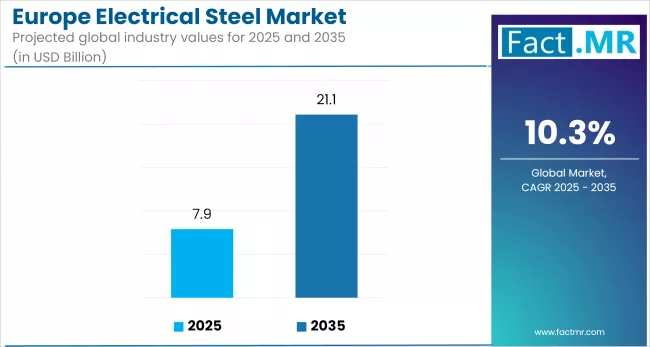
The European electrical steel sector is positioned for a major expansion, growing from an estimated market size of €12.3 billion in 2024 to a projected €18.9 billion by 2030 — representing a compound annual growth rate (CAGR) of 6.8%. The upward trend is driven by surging demand in electric vehicles (EVs), renewable energy infrastructure, and modernization of power grids.
Market Growth Accelerated by EVs, Renewables, and Grid Upgrades
-
EV surge: Europe experienced a 48% increase in EV registrations in 2024 compared with 2023, resulting in 3.1 million new EVs on the road. Each new EV requires 20–25 kg of high-grade non-grain-oriented (NGO) electrical steel for traction motors and 3–4 kg of grain-oriented (GO) steel for onboard transformers and electronics. EVs alone accounted for roughly €1.8 billion of electrical steel consumption in 2024.
-
Renewable energy expansion: Wind and solar electricity generation capacity rose by 22% and 18% respectively in 2024, driving GO steel procurement up by 30%, adding approximately €920 million to the total electrical steel demand.
-
Grid modernization: Over 45,000 km of high-voltage grid lines and 12,500 substations across Europe are scheduled for upgrades between 2025 and 2028, expected to generate an additional €2.3 billion in electrical steel demand.
Key Trends Unlocking Growth
1. Premium Steel Grades on the Rise
Manufacturers are transitioning from conventional M-19 to advanced high-permeability grades such as M-36 and M-50. In 2024, high-grade steels comprised 54% of total volume, up from 42% in 2022, driven by growing efficiency and performance requirements in EV motors and power transformers.
2. Domestic Production and Nearshoring
European mills increased domestic production capacity by 18% in 2024 to address supply chain bottlenecks. Investments exceeding €450 million expanded GO steel capacity in Belgium, Germany, and Poland, reducing lead times from 12 weeks to 6–8 weeks by 2026, cutting logistics costs by 12–15%.
3. Environmental Compliance and Low-Carbon Steel
Sustainability regulations have accelerated demand for low-carbon steel. Adoption of hydrogen-based reduction and electric-arc furnaces reduced carbon intensity by 35–40% in 2024, appealing to OEMs and utility companies seeking sustainable supply chains.
Market Forecast 2025–2030
| Year | Market Size (€B) | CAGR (%) | Key Drivers |
|---|---|---|---|
| 2025 | 13.2 | 7.5 | EV growth; initial grid upgrades |
| 2026 | 14.1 | 6.9 | Renewable capacity expansion |
| 2027 | 15.2 | 7.8 | Large-scale GO steel contracts |
| 2028 | 16.4 | 7.6 | Low-carbon steel adoption; EV demand |
| 2029 | 17.6 | 7.3 | Shift to high-permeability grades |
| 2030 | 18.9 | 7.0 | Mature EV market; second phase grid upgrades |
By 2030, electrical steel consumption for EVs alone is expected to exceed 2.2 million metric tons annually, compared with 1.4 million metric tons in 2024.
Industry Insights
“Switching to high-permeability steel is essential for EV efficiency and energy-cost reduction. We’ve retooled European mills to operate with hydrogen-ARC furnaces, committing to cleaner, high-performance steel supply.”
Electrical steel is also increasingly critical for renewable energy and grid infrastructure. Transformers using advanced steel grades achieved 20–25% better magnetic efficiency compared with older grades, while constituting 14% of total raw material costs in procurement.
Strategic Implications
The growing market and expansion of domestic production highlight Europe’s focus on industrial resilience and energy sovereignty. Low-carbon and high-efficiency steel grades are directly contributing to net-zero objectives. Each ton of advanced electrical steel can reduce annual electricity losses by approximately 1.2 MWh. Applied to projected consumption in 2030, this equates to 2.6 TWh of energy savings — enough to power 1.3 million households.
Browse Full Report : https://www.factmr.com/report/europe-electrical-steel-market
Next Steps for Stakeholders
-
Steel Producers: Expand capacity, invest in hydrogen-based furnaces, and maintain low-carbon compliance.
-
OEMs & Utilities: Secure long-term supply agreements and integrate high-permeability steel into EVs, transformers, and grid infrastructure.
-
Policymakers: Support domestic low-carbon steel production and circularity initiatives as strategic priorities.
About the European Electrical Steel Market Report
The 2025 European Electrical Steel Market Report provides comprehensive analysis of demand, supply, pricing trends, and future outlook for both GO and NGO electrical steel in Europe. The report leverages production, consumption, and market-volume data to deliver actionable insights for manufacturers, utilities, and policymakers.