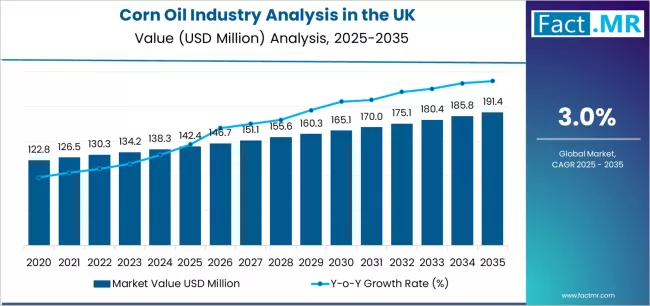
The United Kingdom corn oil market is navigating a period of steady growth driven by a shift toward high-smoke-point cooking oils and industrial sustainability, projected to expand from a valuation of USD 185 million in 2026 to approximately USD 312 million by 2036. This represents a compound annual growth rate (CAGR) of 5.4% over the ten-year forecast period. The market is being shaped by the recovery of the hospitality sector, the “non-GMO” preference in British retail, and the increasing use of technical-grade corn oil in the UK’s expanding biodiesel industry.
Get Access of Report Sample: https://www.factmr.com/connectus/sample?flag=S&rep_id=11590
Quick Stats:
- Market size 2026? USD 185 million.
- Market size 2036? USD 312 million.
- CAGR? 5.4% (2026–2036).
- Leading Grade? Edible/Refined Corn Oil accounts for over 65% of the market share.
- Dominant Application? Food Service and Food Processing are the primary revenue generators.
- Primary Source? Imported Crude Corn Oil (mainly from Europe and the Americas) for domestic refining.
- Top Companies? Archer Daniels Midland (ADM), Cargill Inc., Ingredion Incorporated, Associated British Foods (ABF), Bunge Limited, and KTC Edibles Ltd.
Market Momentum (YoY Path)
The UK corn oil market is evolving from a commodity staple into a specialized ingredient for both culinary and technical applications. Valued at USD 185 million in 2026, the market is expected to reach USD 218 million by 2029 as the “Clean Label” trend encourages food processors to use corn oil as a stable, neutral-flavored alternative to palm oil. As the UK government tightens mandates for renewable transport fuels, the demand for non-edible corn oil as a feedstock is projected to push the valuation to USD 265 million by 2032, eventually reaching USD 312 million by 2036.
Why the Market is Growing
Growth is primarily fueled by the High Versatility in Industrial Cooking and the Expansion of the Biofuel Sector. Corn oil is highly prized by British professional kitchens for its high smoke point (232°C), which makes it superior for deep-frying and high-heat sautéing compared to olive or sunflower oil. Furthermore, Post-Brexit Supply Chain Diversification is a major catalyst; UK buyers are increasingly sourcing corn oil from North and South America to mitigate the price volatility of European sunflower oil. In the Animal Feed sector, corn oil is becoming a preferred energy supplement for the UK’s high-value poultry and livestock industries.
Segment Spotlight
- Product Type: Refined vs. Crude
Refined Corn Oil leads the market in value, serving the premium retail and food service segments. Crude Corn Oil is witnessing a surge in volume demand, primarily as a raw material for the UK’s chemical and biodiesel refineries in regions like Teesside and the Humber.
- End-Use: Retail vs. Food Service
The Food Service segment (restaurants and catering) is the dominant consumer. However, the Retail segment is seeing a shift toward “Cold-Pressed” and “Organic” corn oil variants, which are marketed to health-conscious consumers for their high vitamin E and phytosterol content.
- Regional Focus: The Industrial North vs. The Consumer South
While consumption is highest in high-density urban areas like London and the South East, the logistics and refining hubs in the North of England and Scotland are critical for the distribution of industrial-grade corn oil used in manufacturing and energy.
Drivers, Opportunities, Trends, and Challenges
- Drivers: Rising demand for snack foods, the phase-out of partially hydrogenated oils in the UK, and the growth of the domestic margarine and spread industry.
- Opportunities: Bio-based Lubricants. There is a significant opportunity for corn oil to replace petroleum-based lubricants in the UK’s agricultural machinery sector, aligning with “Green Farming” subsidies.
- Trends: The rise of “Non-GMO” certified corn oil, the increasing popularity of Corn-Oil-based Salad Dressings, and the use of Recycled Cooking Oil collection programs to turn used corn oil into renewable energy.
- Challenges: Price Sensitivity. Corn oil often faces stiff competition from cheaper rapeseed oil, which is produced in large quantities domestically in the UK. Additionally, Import Tariffs and Logistics Costs post-Brexit remain a factor for crude oil sourced outside the EU.
Competitive Landscape
The UK competitive landscape is characterized by Global Trade Giants and Local Specialty Refiners.
- Market Leadership: ADM and Cargill dominate the supply chain, leveraging their global processing capacity to ensure a steady flow of oil into the UK market.
- Specialized Distribution: Companies like KTC Edibles and Associated British Foods focus on the “Ethnic Food” and “Professional Catering” sectors, where corn oil has a loyal and growing customer base.
- Sustainability Focus: Leading players are increasingly investing in Traceable Supply Chains, ensuring that the corn used for oil production is not associated with deforestation or intensive chemical use, satisfying the requirements of major UK supermarkets like Tesco and Sainsbury’s.
- Product Innovation: Competition is centering on Fortified Corn Oils (adding Vitamin D or Omega-3s) to differentiate products in a crowded “Healthy Oils” retail aisle.
Browse Full Report : https://www.factmr.com/report/united-kingdom-corn-oil-industry-analysis
About Fact.MR
Fact.MR is a global market research and consulting firm, trusted by Fortune 500 companies and emerging businesses for reliable insights and strategic intelligence. With a presence across the U.S., UK, India, and Dubai, we deliver data-driven research and tailored consulting solutions across 30+ industries and 1,000+ markets. Backed by deep expertise and advanced analytics, Fact.MR helps organizations uncover opportunities, reduce risks, and make informed decisions for sustainable growth.