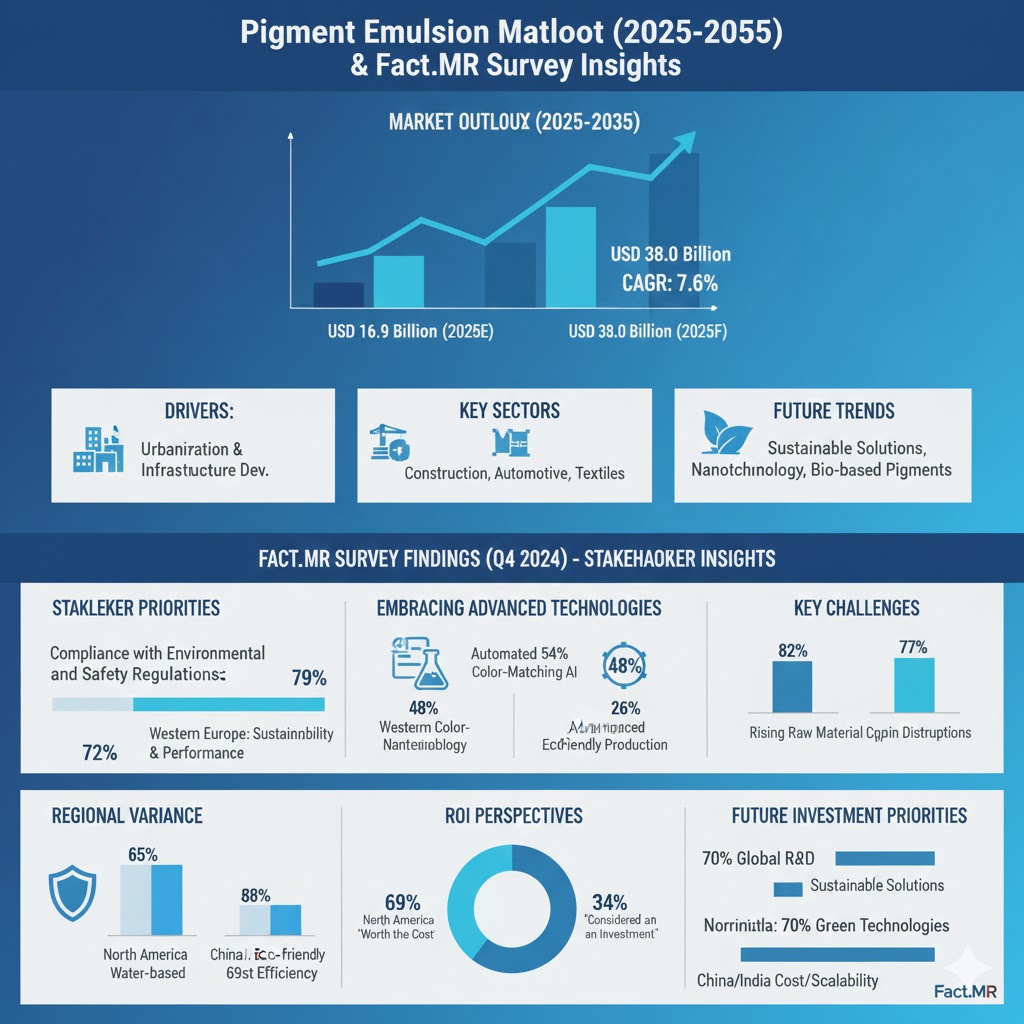
The global Pigment Emulsion Market was valued at approximately USD 16.9 billion in 2025 and is projected to reach USD 38.0 billion by 2036, growing at a CAGR of 7.6% over the forecast period. The market’s expansion is driven by increasing demand in paints & coatings (45% of total consumption in 2025), textiles (20%), automotive coatings (18%), and printing inks (17%).
Urbanization in Asia Pacific and infrastructure development globally are key drivers. In addition, the market benefits from the adoption of high-performance emulsions, including low-VOC, water-based, and nano-dispersed formulations, which account for 28% of new product launches in 2025.
2. Technology Evolution & Innovation Trends
A. Advanced Dispersion & Nanotechnology
-
Nano-dispersed pigment emulsions currently account for 12% of the market volume but are growing at a CAGR of 9.2%, outpacing conventional emulsions.
-
Benefits include improved UV stability, better chemical resistance, and optimized particle distribution.
B. Automation & AI Integration
-
15-20% of pigment manufacturers in North America and Europe have implemented AI-enabled color matching to reduce waste by 5-7% annually.
-
Automation in production has increased throughput by 10-12% on average, helping companies maintain consistent quality.
C. Sustainable & Eco-Friendly Solutions
-
Water-based and low-VOC emulsions accounted for 35% of total market volume in 2025, projected to reach 52% by 2036.
-
Regulatory mandates have accelerated adoption, with Europe and North America contributing 40% of global eco-friendly emulsion demand.
3. End-Use Demand Dynamics
| End-Use Segment | 2025 Market Share | Projected CAGR (2026-2036) |
|---|---|---|
| Paints & Coatings | 45% | 7.3% |
| Textiles | 20% | 8.0% |
| Automotive Coatings | 18% | 8.5% |
| Printing Inks | 17% | 7.0% |
-
Paints & Coatings: Driven by construction and industrial applications, the segment is expected to grow from USD 7.6 billion in 2025 to USD 16.1 billion by 2036.
-
Automotive Coatings: Demand for nano-dispersed and high-solid emulsions is projected to grow at 8.5% CAGR, reaching USD 10.0 billion by 2036.
-
Textiles & Printing Inks: Textile applications are growing due to eco-friendly and fast-drying emulsions, while printing inks are expanding with digital packaging trends.
4. Regional Demand Analysis
| Region | 2025 Market Share | 2036 Market Projection | CAGR |
|---|---|---|---|
| Asia Pacific | 45% | USD 18.5 B | 8.3% |
| North America | 22% | USD 8.6 B | 6.5% |
| Europe | 20% | USD 7.8 B | 6.8% |
| Latin America | 8% | USD 3.4 B | 7.2% |
| Middle East & Africa | 5% | USD 2.2 B | 7.0% |
-
Asia Pacific dominates the market due to industrial expansion, infrastructure projects, and textile production. China and India together contribute 65% of regional demand.
-
North America & Europe: Mature markets with strong adoption of eco-friendly emulsions; combined they hold 42% of global demand.
-
merging Markets: Latin America, Middle East, and Africa collectively account for 13% of the market but are growing steadily at ~7% CAGR.
5. Competitive Landscape
Key global players include:
-
DIC Corporation
-
Kiri Industries Limited
-
Sudarshan Chemical Industries
-
Pidilite Industries
-
Huebach GmbH
-
Camex Limited
Market Positioning Metrics:
-
Top 5 players control 60% of the global market.
-
R&D spend averages 5-6% of annual revenue, focusing on eco-friendly and high-performance emulsions.
-
Strategic focus includes mergers, acquisitions, and partnerships in Asia-Pacific and Europe to expand regional penetration.
6. Regulatory & Environmental Impact
-
VOC limits and bio-based regulations are driving water-based emulsions.
-
Adoption of low-VOC products is expected to grow from 35% in 2025 to 52% by 2036.
-
Companies are increasingly investing USD 100-150 million annually across R&D and compliance in mature markets.
7. Forecast Scenarios to 2036
Market Size Scenarios (USD Billion):
| Scenario | 2036 Projection | CAGR |
|---|---|---|
| Bullish | 41.5 | 8.3% |
| Base (Steady Growth) | 38.0 | 7.6% |
| Restrained | 33.0 | 6.5% |
-
Bullish scenario: Accelerated adoption of nano-technology and eco-friendly emulsions.
-
Restrained scenario: Raw material price volatility and geopolitical disruptions impact growth.
8. Key Challenges & Recommendations
Challenges:
-
Raw material price volatility (e.g., titanium dioxide, acrylics) can affect margins.
-
Compliance costs are rising in mature markets.
-
Shortage of skilled labor for advanced production technologies.
Recommendations:
-
Increase investment in eco-friendly formulations, projected to drive 52% of volume by 2036.
-
Expand automation & AI-driven production to improve efficiency by 10-12%.
-
Strengthen regional distribution networks, particularly in Asia Pacific and Latin America.
Browse Full Report : https://www.factmr.com/report/4409/pigment-emulsion-market
Conclusion
The global pigment emulsion market is poised to more than double from USD 16.9 billion in 2025 to USD 38 billion by 2036, led by paints & coatings, automotive, textiles, and printing ink segments. Asia Pacific will continue as the primary growth engine, while technological innovation and sustainability trends will define competitive advantage. Investment in nano-dispersed, water-based, and low-VOC emulsions is critical for future success.
Key metrics to watch:
-
CAGR 2026-2036: 7.6% (base scenario)
-
Asia Pacific share 2036: ~49%
-
Eco-friendly emulsions penetration: 52% of volume by 2036