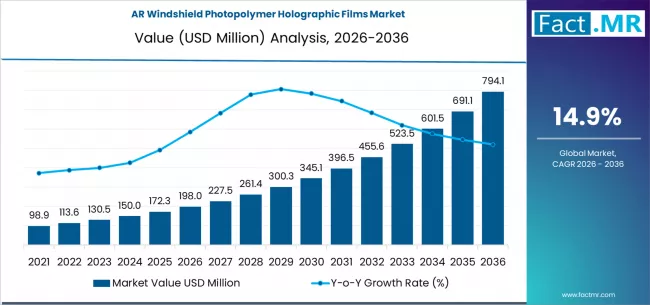
The automotive industry is undergoing a technological revolution, with augmented reality (AR) interfaces becoming an integral part of modern vehicle design. AR windshield photopolymer holographic films are at the forefront of this shift, enabling immersive head-up displays and windshield-integrated AR systems. These films project navigation, safety, and connectivity information directly onto the driver’s field of view, improving situational awareness and driving safety. As automotive manufacturers embrace advanced human-machine interfaces, the demand for holographic films continues to rise, driving innovation in materials, optics, and vehicle integration.
Market Overview
AR windshield photopolymer holographic films are specialized optical components that combine high transparency with precise diffractive properties. They are used to create vivid, high-contrast AR imagery while maintaining clear visibility of the road. These films support a variety of vehicle applications, from conventional head-up displays (HUDs) to fully immersive AR windshields. Their adoption is fueled by the automotive industry’s focus on safety, driver experience, and the integration of advanced driver-assistance systems (ADAS).
Manufacturers are continually improving film durability, optical clarity, and processability to ensure performance under extreme temperatures, UV exposure, and vibrations. As production techniques advance, including roll-to-roll embossing and laser writing, these films are becoming increasingly scalable and suitable for mass-market automotive applications.
Regional Insights
North America leads the adoption of AR windshield holographic films, driven by a dense ecosystem of automotive R&D centers, AR technology developers, and premium vehicle manufacturers. Europe, particularly Spain and Italy, is also witnessing strong growth due to the presence of luxury automotive brands and specialized glass suppliers. Asia-Pacific is emerging as a key market as automotive innovation and digital interface adoption accelerate. Regional growth reflects the combination of regulatory encouragement, premium automotive demand, and technological capability in developing AR-enabled vehicles.
Key Trends & Forecast
Several trends are shaping the AR windshield photopolymer holographic films market:
- Transition to Full-Windshield AR Systems: Beyond traditional HUDs, manufacturers are exploring AR integration across the entire windshield to provide drivers with a more immersive and safer experience.
- Multi-Layer and Hybrid Films: Films are increasingly being developed with additional functionalities, such as defogging, glare control, or dynamic dimming, to improve usability and comfort.
- Advanced Optical Materials: Photopolymer films are engineered to balance transparency and diffraction efficiency, allowing high-quality image projection without compromising visibility.
- AI-Driven Rendering: AR content is optimized for the curvature and optical properties of windshields using AI, ensuring accurate placement and clarity of virtual objects.
- Collaboration Between Automakers and Suppliers: Strategic partnerships are strengthening between film manufacturers, glass suppliers, and vehicle UX design teams to co-develop integrated solutions that meet high standards of safety and performance.
Applications & End-Use Outlook
Automotive head-up displays remain the primary application for photopolymer holographic films, offering drivers essential information such as speed, navigation cues, lane guidance, and safety warnings. As technology evolves, these films are increasingly applied in fully augmented windshields and passenger information systems. The integration of AR films enhances the driving experience, minimizes distraction, and supports semi-autonomous and autonomous vehicle functionalities.
Drivers and Restraints
The growing focus on driver safety, situational awareness, and intuitive interface design is a key driver for this market. Regulatory requirements encouraging advanced driver-assistance systems and minimizing road accidents also support adoption. Additionally, the rise of electric and premium vehicles has prompted manufacturers to integrate AR interfaces as a differentiating feature.
On the other hand, the market faces challenges including high production costs, technical complexity, and the need for precise system integration. Ensuring optical clarity, environmental durability, and alignment between projector systems and films requires sophisticated manufacturing and testing processes. Overcoming these challenges is essential to achieve large-scale adoption and cost-effective deployment.
Competitive Landscape
The AR windshield photopolymer holographic films market features a mix of specialized optical film manufacturers, automotive glass suppliers, and technology innovators. Leading players focus on R&D collaboration, customization, and production scale-up to meet the needs of both premium and mass-market vehicles. Innovation in material properties, manufacturing efficiency, and system integration is crucial to maintain a competitive edge.
Conclusion
AR windshield photopolymer holographic films are transforming the automotive industry by bridging advanced optics with immersive augmented reality. As vehicles become smarter and more connected, these films will play a critical role in enhancing driver safety, experience, and vehicle-human interaction. Continuous innovation, strategic collaboration, and regulatory support will be key to realizing the full potential of AR windshield technology, making it an essential component of the next generation of intelligent vehicles.
Browse Full Report – https://www.factmr.com/report/e-grocery-compostable-delivery-bags-market