As the automotive industry rapidly evolves with digital innovation, Augmented Reality (AR) Navigation Windshield Head-Up Displays (HUDs) are emerging as a game-changing technology. These systems project critical driving information directly onto the windshield, allowing drivers to stay focused on the road while accessing real-time navigation cues. The increasing demand for enhanced safety, convenience, and immersive driving experiences is propelling the growth of the AR navigation windshield HUD market worldwide.
Market Overview:
AR navigation windshield HUD technology integrates augmented reality with advanced display systems to overlay navigation directions, speed, hazard warnings, and other essential data onto the driver’s field of vision. Unlike traditional dashboard displays, AR HUDs provide contextual and intuitive visual guidance, improving situational awareness and reducing driver distraction.
Automakers are increasingly incorporating AR HUDs into premium and mid-range vehicles as part of advanced driver assistance systems (ADAS). The growing emphasis on vehicle safety regulations and the push toward autonomous and semi-autonomous driving are further accelerating the adoption of these systems. Continuous advancements in projection technology, sensors, and software algorithms are enhancing the accuracy and clarity of AR-based displays.
Regional Insights:
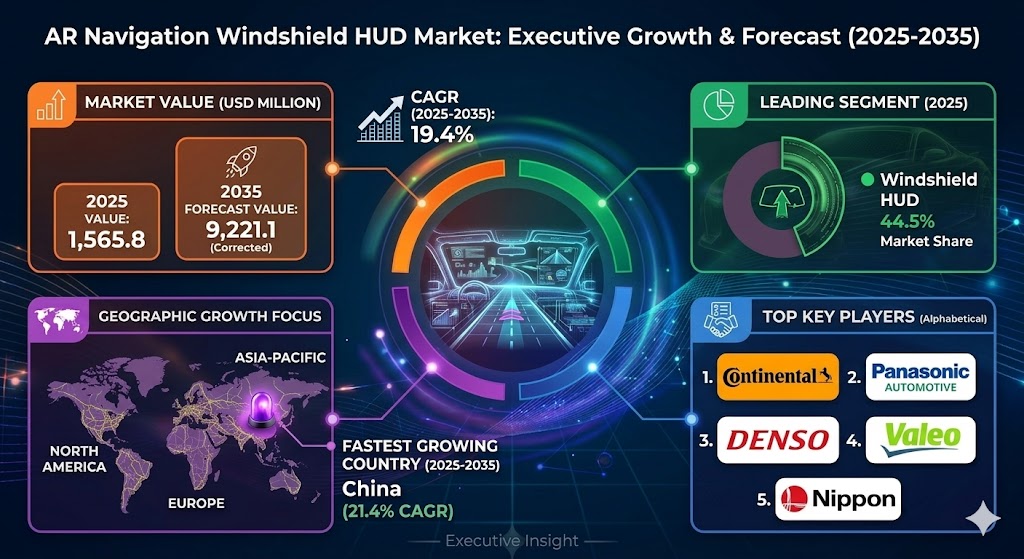
North America remains a key market due to strong adoption of advanced automotive technologies and the presence of leading automobile manufacturers and tech firms. The region’s focus on safety standards and innovation supports widespread integration of AR HUD systems.
Europe is also witnessing substantial growth, driven by strict vehicle safety regulations and increasing consumer demand for high-tech driving features. Automotive manufacturers in the region are heavily investing in research and development to enhance in-car user experiences.
Asia-Pacific is emerging as a high-growth region, fueled by rising automotive production, growing disposable income, and increasing demand for connected vehicles. Countries such as China, Japan, and South Korea are at the forefront of adopting AR technologies in the automotive sector, supported by rapid urbanization and smart mobility initiatives.
Key Trends & Forecast:
One of the most prominent trends in the AR navigation windshield HUD market is the integration of artificial intelligence and machine learning to deliver more personalized and adaptive driving assistance. These technologies enable systems to analyze driving patterns and provide context-aware navigation and alerts.
Another significant trend is the advancement in display technologies, including higher resolution projections, wider field of view, and improved brightness for better visibility under varying lighting conditions. Innovations in holographic and waveguide-based displays are further enhancing the user experience.
Automotive manufacturers are increasingly collaborating with technology providers to develop next-generation AR HUD systems. Partnerships between OEMs and software companies are leading to the creation of more sophisticated and seamless interfaces.
The market is also witnessing a shift toward electric and autonomous vehicles, where AR HUDs play a crucial role in delivering real-time information and enhancing driver confidence. As vehicles become more connected, AR navigation systems are expected to integrate with cloud-based platforms and smart city infrastructure.
Applications & End-Use Outlook:
AR navigation windshield HUD systems are primarily used in passenger vehicles, particularly in luxury and high-end models. However, their adoption is gradually expanding to mid-range vehicles as production costs decrease and technology becomes more accessible.
In addition to navigation, these systems are used for displaying critical driving information such as speed, lane departure warnings, collision alerts, and traffic updates. The ability to present this information directly in the driver’s line of sight significantly enhances safety and reduces cognitive load.
Commercial vehicles are also beginning to adopt AR HUD technology to improve fleet efficiency and driver safety. Logistics and transportation companies are recognizing the benefits of real-time navigation assistance and hazard detection in optimizing operations.
Furthermore, AR HUDs are playing an increasingly important role in the development of autonomous vehicles. They serve as a bridge between fully manual and automated driving by providing drivers with clear and intuitive insights into the vehicle’s actions and surroundings.
Conclusion:
The AR Navigation Windshield HUD market is poised for significant growth as the automotive industry continues to embrace digital transformation and advanced driver assistance technologies. With increasing emphasis on safety, user experience, and connectivity, AR HUD systems are becoming an integral part of modern vehicles.
Ongoing technological advancements, coupled with rising consumer demand for smarter and safer driving solutions, are expected to drive widespread adoption in the coming years. As automakers and technology providers continue to innovate, AR navigation windshield HUDs will redefine how drivers interact with their vehicles, paving the way for a more intuitive and immersive driving experience.
Browse Full Report – https://www.factmr.com/report/ar-navigation-windshield-hud-market