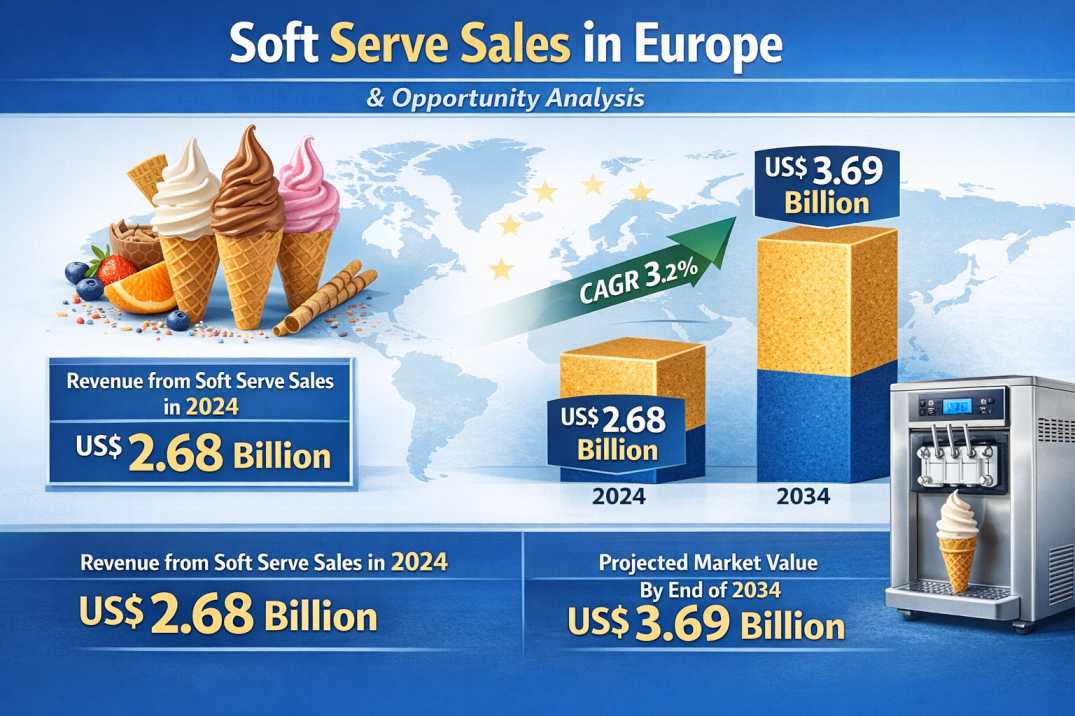
The Europe soft serve market is experiencing a premium makeover, projected to grow from a valuation of USD 1.2 billion in 2026 to approximately USD 1.9 billion by 2036. This represents a steady compound annual growth rate (CAGR) of 4.6% over the ten-year forecast period. The market is evolving from a seasonal beach-side treat to a year-round “experiential” dessert, driven by the proliferation of artisanal boutiques and the integration of soft serve into high-end foodservice menus.
Quick Stats:
- Market size 2026? USD 1.2 billion.
- Market size 2036? USD 1.9 billion.
- CAGR? 4.6% (2026–2036).
- Leading Country? Germany and France hold over 35% of the European market share.
- Dominant Product Type? Traditional Dairy-based mixes lead, while Vegan/Plant-based is the fastest-growing segment.
- Primary Sales Channel? Quick Service Restaurants (QSRs) and Dedicated Ice Cream Parlors.
- Top Companies? Unilever (Wall’s), Nestlé S.A., Taylor Company, Carpigiani Group, Nissei Co., Ltd., and Valio Ltd.
Get Access of Report Sample: https://www.factmr.com/connectus/sample?flag=S&rep_id=9874
Market Momentum (YoY Path)
The European soft serve market is transitioning toward “premiumization” and “health-conscious indulgence.” Valued at USD 1.2 billion in 2026, the market is expected to reach USD 1.4 billion by 2029 as the QSR sector expands its dessert menus with high-margin soft serve options. As technological advancements in dispensing machines allow for more complex textures and flavor swirl combinations, the valuation is projected to hit USD 1.6 billion by 2032, eventually reaching USD 1.9 billion by 2036. This represents an absolute dollar opportunity of USD 700 million over the decade.
Why the Market is Growing
Growth is primarily fueled by the Innovation in Flavor Profiles and the Expansion of the “Grab-and-Go” Culture. Unlike traditional scoop ice cream, soft serve offers a lower air-to-cream ratio and a smoother texture that appeals to younger demographics seeking an “Instagrammable” aesthetic. Furthermore, the Rising Demand for Healthier Alternatives has led to a surge in frozen yogurt and low-calorie probiotic soft serves. In the commercial sector, the High Profit Margins for operators—often exceeding 70%—make soft serve an attractive addition for bakeries, cinemas, and theme parks across the continent.
Segment Spotlight
- Product Category: Dairy vs. Plant-Based
While Dairy-based soft serve remains the volume leader, Plant-based (Oat, Almond, and Coconut) mixes are witnessing a CAGR of 6.2%. This is particularly prominent in the UK and Nordic countries, where the vegan movement is most established and consumers are willing to pay a premium for dairy alternatives.
- Machine Type: Self-Service vs. Staff-Operated
Staff-operated machines dominate high-end parlors. However, Self-service soft serve kiosks are the fastest-growing sub-segment in transit hubs (airports/train stations) and convenience stores, as they reduce labor costs and offer a novelty experience for the customer.
- Regional Focus: The Western European Stronghold
Germany is the largest market, followed closely by France and Italy. The “Italian Gelato” influence has shifted the market toward high-quality ingredients. Meanwhile, Eastern Europe (Poland and Romania) is projected to see the highest growth rate as Western QSR chains and “American-style” dessert diners expand into these territories.
Drivers, Opportunities, Trends, and Challenges
Drivers: Increasing tourism levels in Southern Europe, the popularity of soft serve as a base for elaborate “Freakshakes,” and the development of energy-efficient, easy-to-clean dispensing technology.
Opportunities: There is a significant opportunity in Seasonal and Localized Flavors. Manufacturers are moving beyond vanilla and chocolate to offer regional European specialties like Lavender (France), Sea Salt (UK), and Pistachio (Italy), targeting the “gastronomy-tourist” segment.
Trends: A major trend is the Hybrid Dessert. Soft serve is increasingly being paired with warm elements like waffles, churros, or “chimney cakes” (Kürtőskalács), driving sales during the colder autumn and winter months. Another trend is the Sustainable Sourcing of milk and cocoa, with brands highlighting “Grass-fed” or “Fairtrade” credentials on their menus.
Challenges: The market faces hurdles from Stricter Sugar Regulations and High Equipment Maintenance Costs. Several European countries have introduced sugar taxes or mandatory “traffic light” labeling, forcing brands to reformulate. Additionally, the complex cleaning requirements (heat-treatment cycles) of soft serve machines can be a barrier for smaller independent retailers.
Country Growth Outlook (CAGR)
| Country | Projected CAGR (2026-2036) |
| Poland | 5.8% |
| UK | 5.1% |
| Germany | 4.3% |
| France | 4.2% |
| Italy | 4.0% |
Competitive Landscape
The market is split between Global FMCG Giants providing the liquid/powder mixes and Specialized Machine Manufacturers. Companies like Unilever are focusing on “turnkey solutions” for retailers, providing both the mix and the branding. Meanwhile, machine leaders like Carpigiani are innovating with “IoT-enabled” dispensers that alert operators when a mix is low or when a technical fault is detected, minimizing downtime.
Browse Full Report : https://www.factmr.com/report/soft-serve-sales-in-europe-and-opportunity-analysis
About Fact.MR
Fact.MR is a global market research and consulting firm, trusted by Fortune 500 companies and emerging businesses for reliable insights and strategic intelligence. With a presence across the U.S., UK, India, and Dubai, we deliver data-driven research and tailored consulting solutions across 30+ industries and 1,000+ markets. Backed by deep expertise and advanced analytics, Fact.MR helps organizations uncover opportunities, reduce risks, and make informed decisions for sustainable growth.