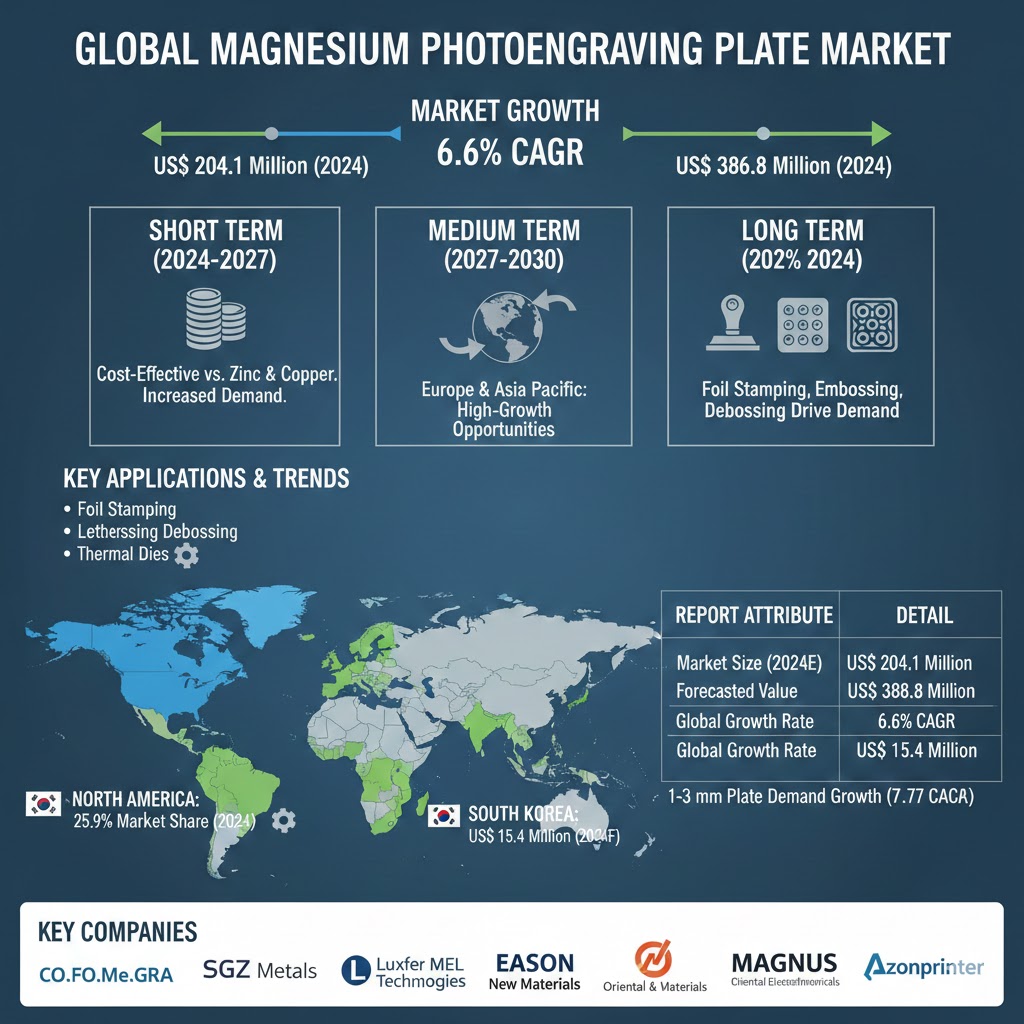
The global magnesium photoengraving plate market is on a trajectory of sustained growth, driven by increasing demand from luxury packaging, premium labeling, and short-run customized printing applications. Current projections indicate that the market, valued at approximately US$204 million in 2024, is expected to reach US$386 million by 2034, reflecting a compound annual growth rate (CAGR) of 6.6%. Extending this trend, the market is anticipated to surpass US$430 million by 2036, demonstrating the resilience of magnesium-based engraving solutions amid evolving printing technologies.
Magnesium photoengraving plates, favored for their lightweight construction, high durability, and precision engraving capabilities, are replacing traditional copper and zinc plates in many premium applications. These plates support embossing, debossing, and foil stamping, enabling brands to achieve high-definition, tactile finishes that enhance consumer perception and drive product differentiation.
Market Segmentation and Portfolio Priorities
Analysis indicates that magnesium photoengraving plates can be segmented by thickness, manufacturing process, and application type, each with distinct growth characteristics:
1. Plate Thickness Segmentation
-
3–5 mm plates dominate the market, accounting for nearly 42% of global volume in 2024, and are projected to generate US$135 million in revenue by 2034.
-
Thicker plates (>5 mm) are primarily used in heavy-duty industrial applications, while thinner plates (<3 mm) are increasingly adopted in short-run, high-precision decorative printing.
2. Manufacturing Technology Segmentation
-
CNC-manufactured plates constitute approximately 58% of production volume, driven by demand for fine line resolution and consistent quality.
-
Digitally engraved plates are projected to grow at a CAGR of 7.2% through 2036, reflecting the increasing adoption of automation and digital workflows in high-end packaging.
3. Application Segmentation
-
Luxury cosmetics and personal care packaging represent the largest application, accounting for roughly 36% of total demand in 2024, with a projected CAGR of 6.8%.
-
Alcoholic beverages, chocolates, and premium foods collectively represent 28% of demand, benefiting from rising global consumption and premiumization trends.
-
Industrial and commercial labeling accounts for the remainder, with steady growth supported by regulatory labeling and brand authenticity requirements.
Regional Insights
Regional dynamics indicate varying adoption patterns and growth potential:
-
North America: Market valued at US$62 million in 2024, projected to grow at a 6.8% CAGR through 2036. Strong adoption is driven by premium packaging and well-established printing infrastructure.
-
Europe: Holds approximately 30% of global demand, with high penetration in luxury and pharmaceutical packaging. Growth is moderate at 5.9% CAGR, reflecting a mature market.
-
Asia-Pacific: Rapidly expanding region, with a CAGR of 7.5%, accounting for 28% of global demand by 2034. Growth is fueled by emerging markets in China, India, and Southeast Asia, rising disposable incomes, and demand for visually differentiated packaging.
-
Middle East & Africa and Latin America: Combined share is approximately 12%, with growth rates exceeding 6% CAGR, led by luxury consumer goods and regional packaging innovations.
Adoption Trends
Several quantifiable trends are shaping the adoption of magnesium photoengraving plates:
-
Premium Packaging Demand: Over 64% of total market revenue in 2024 is driven by luxury and premium packaging applications. The proportion is expected to increase to 70% by 2036, highlighting the strong link between premium branding and plate adoption.
-
Short-Run Printing and Customization: The proportion of short-run applications (<10,000 units) is projected to grow from 22% in 2024 to 35% by 2036, emphasizing the need for rapid plate production and quick turnaround times.
-
Digital & CNC Adoption: CNC and digital engraving now account for 58% of production, projected to rise to 73% by 2036, driven by precision, repeatability, and reduced human error.
-
Regional Diversification: Demand outside North America and Europe is expected to grow 2.5x faster than in developed markets, indicating the significance of emerging economies for future revenue growth.
Forecast and Demand Outlook (2024–2036)
The market’s quantitative outlook suggests:
-
2024 Market Value: US$204 million
-
2030 Market Value: US$310 million
-
2034 Market Value: US$386 million
-
2036 Market Value: >US$430 million
This trajectory implies sustained investment opportunities, particularly in mid-range plate thicknesses (3–5 mm), CNC-based solutions, and sector-specific customizations. Volume demand is projected to increase 4.8% annually in units, reflecting efficiency improvements and growing adoption in premium applications.
Strategic Implications for Manufacturers
Data-driven insights point to three critical areas for strategic focus:
-
Product Optimization: Manufacturers should prioritize the 3–5 mm thickness range, projected to maintain a 42% volume share, while innovating in specialized thin plates for short-run printing.
-
Technology Investment: CNC and digitally engraved plate production is expected to comprise 73% of the market by 2036, making automation and digital integration essential for competitiveness.
-
Application-Specific Solutions: Targeted solutions for luxury cosmetics, alcoholic beverages, and high-end foods will drive 60–70% of future revenue, emphasizing customization and co-development with brand owners.
Browse Full Report : https://www.factmr.com/report/magnesium-photoengraving-plate-market
Conclusion
The magnesium photoengraving plate market is set for robust expansion through 2036, underpinned by premium packaging demand, adoption of CNC and digital engraving technologies, and regional growth in Asia-Pacific and emerging luxury markets. With market value projected to surpass US$430 million, manufacturers that align their portfolios with optimized thickness segments, high-precision production, and sector-focused applications will capture the largest share of growth.
Magnesium photoengraving plates are no longer peripheral tools—they are strategic enablers of brand differentiation, and their adoption will continue to accelerate as packaging and printing industries evolve in complexity, speed, and design sophistication.