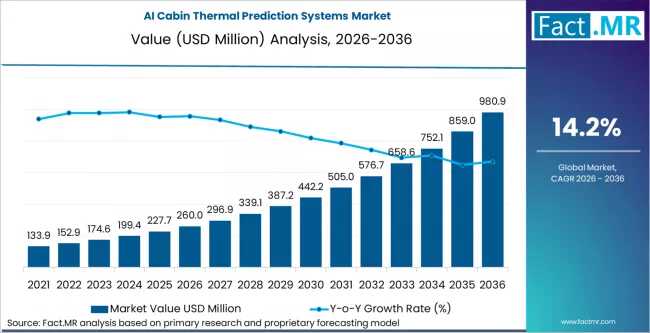
AI Cabin Thermal Prediction Systems Market to Reach USD 980 Million by 2036, Growing at 14.2% CAGR. The global AI cabin thermal prediction systems market is poised for significant expansion, with a projected valuation of USD 260 million in 2026. According to the latest analysis by Fact.MR, the market is expected to climb to USD 980 million by 2036, driven by a structural shift toward data-driven, scalable thermal management solutions across automotive, aviation, and mass transit platforms.
Direct Answers: Key Market Insights
-
Market Size (2026): USD 260 million
-
Market Size (2036): USD 980 million
-
CAGR (2026–2036): 14.2%
-
Leading Software Function: Thermal load prediction leads the market with a 39% share, supported by repeatable integration across vehicle platforms and predictable licensing demand.
-
Leading Data Input: Cabin sensors represent the largest segment, accounting for a 42% share due to the reliance on high-volume, standardized data streams.
-
Leading Deployment Mode: Includes On-board Embedded, Cloud-connected, and Hybrid systems.
-
Key Growth Regions: China (16.8% CAGR) and Brazil (16.5% CAGR) are the fastest-growing markets.
-
Top Companies: Bosch, Valeo, Continental, HARMAN, NVIDIA, CARIAD, dSPACE, MathWorks, Siemens, and Aptiv.
Market Momentum (YoY Path)
The AI cabin thermal prediction systems market is on a robust upward trajectory. Starting at a value of USD 260 million in 2026, the market is anticipated to show consistent year-over-year gains. By 2028, adoption in the EV sector will further bolster valuation, continuing through 2030 and 2031 as IoT connectivity expands. By 2033, the market is expected to see large-scale integration in mass transit, ultimately reaching its forecast peak of USD 980 million in 2036.
Why the Market is Growing
Growth is primarily fueled by the increasing adoption of AI-enabled climate control in passenger vehicles and aircraft. Predictive thermal management significantly enhances energy efficiency—a critical factor for Electric Vehicle (EV) range—and improves the overall passenger experience. Manufacturers are leveraging these systems to optimize HVAC cycles and reduce energy consumption, while regulatory mandates for emissions reduction provide additional tailwinds for market expansion.
Segment Spotlight
Software Function: Thermal Load Prediction
Holding a dominant 39% share, thermal load prediction is the leading function. Its prominence is driven by structural market factors, including workflow repeatability and the ability for OEMs to integrate it across various vehicle lines. This segment benefits from predictable implementation cycles and efficient data management workflows.
Data Input: Cabin Sensors
Cabin sensors account for 42% of the market, reflecting a heavy reliance on standardized data acquisition. Suppliers in this segment benefit from recurring orders and high-volume integration into automotive production lines. These sensors enable scalable software integration and consistent system performance across diverse mobility platforms.
Buyer Type: OEMs and Tier-1 Suppliers
Original Equipment Manufacturers (OEMs) and Tier-1 HVAC suppliers are the primary drivers of adoption. These entities prioritize computational precision and operational scalability to meet consumer expectations for comfort and regulatory requirements for energy conservation.
Drivers, Opportunities, Trends, Challenges
Drivers: The rapid electrification of transport and a growing emphasis on passenger comfort are the primary catalysts. Predictive HVAC systems are becoming essential for optimizing battery performance and cabin climate in real-time.
Opportunities: Advancements in machine learning and IoT connectivity present significant opportunities for suppliers to expand system capabilities. Emerging markets like India and Brazil offer high-growth potential as they modernize their automotive manufacturing bases.
Trends: There is a noticeable shift toward integrated prediction architectures. Leading players are moving away from standalone algorithms to focus on validated data models and multi-zone thermal optimization, particularly in the premium vehicle segment.
Challenges: Regulatory compliance and the high cost of safety certifications can act as barriers to entry, particularly for smaller suppliers. Additionally, regional variability in quality standards can delay the approval and rollout of new AI systems.
Country Growth Outlook (CAGR 2026–2036)
| Country | CAGR (2026–2036) |
| China | 16.8% |
| Brazil | 16.5% |
| USA | 13.4% |
| South Korea | 13.3% |
| Germany | 13.2% |
| UK | 13.1% |
| Japan | 12.2% |
Browse Full report : https://www.factmr.com/report/ai-cabin-thermal-prediction-systems-market
Competitive Landscape
The market is defined by a shift toward integrated prediction architectures where data fidelity and OEM alignment are paramount. Bosch and Continental lead through deep systems integration, while Valeo and HARMAN focus on modular software flexibility. NVIDIA and CARIAD provide the high-performance AI stacks necessary for real-time accuracy. Other key contributors like dSPACE, MathWorks, and Siemens provide critical simulation and validation toolchains that accelerate development cycles.
– Contact Us –
11140 Rockville Pike, Suite 400, Rockville,
MD 20852, United States
Tel: +1 (628) 251-1583 | sales@factmr.com
About Fact.MR
Fact.MR is a global market research and consulting firm, trusted by Fortune 500 companies and emerging businesses for reliable insights and strategic intelligence. With a presence across the U.S., UK, India, and Dubai, we deliver data-driven research and tailored consulting solutions across 30+ industries and 1,000+ markets. Backed by deep expertise and advanced analytics, Fact.MR helps organizations uncover opportunities, reduce risks, and make informed decisions for sustainable growth.