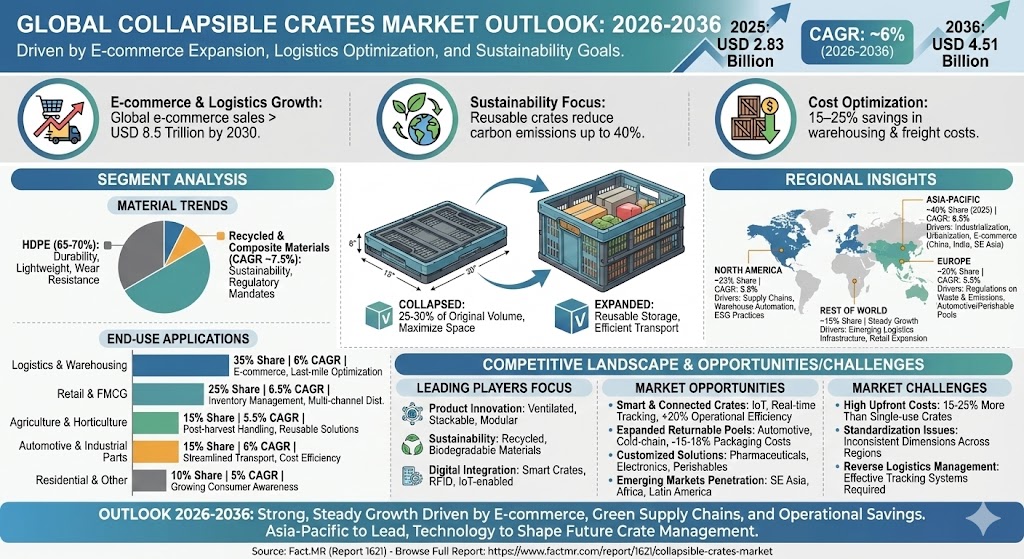
The global collapsible crates market is poised for strong growth over the next decade, driven by e-commerce expansion, logistics optimization, and rising demand for sustainable packaging solutions. Market analysis forecasts that the industry will expand from an estimated USD 2.83 billion in 2025 to USD 4.51 billion by 2036, reflecting a CAGR of approximately 6% during the 2026-2036 period. This growth trajectory is underpinned by increasing adoption in retail, industrial, agricultural, and automotive sectors.
Market Overview & Dynamics
Collapsible crates are foldable, reusable storage containers that maximize space efficiency, reduce transport costs, and support circular economy initiatives. Their ability to collapse to nearly 25–30% of their original volume when not in use allows companies to optimize warehouse space and minimize empty return trips, generating substantial cost savings.
Key market drivers include:
-
E-commerce & logistics growth: Global e-commerce sales are projected to surpass USD 8.5 trillion by 2030, fueling demand for high-efficiency packaging solutions such as collapsible crates.
-
Sustainability focus: Increasing environmental regulations and corporate ESG initiatives are driving adoption of reusable crates over single-use packaging. Businesses report up to 40% reduction in carbon emissions per crate when using collapsible, returnable designs.
-
Cost optimization: Companies report 15–25% savings in warehousing and freight costs by integrating collapsible crates into their supply chains.
Segment Analysis
Material Trends
-
High-Density Polyethylene (HDPE): Accounts for 65–70% of the market due to its durability, lightweight characteristics, and resistance to wear.
-
Recycled and composite materials: Gaining traction, expected to grow at a CAGR of 7.5% over 2026-2036, driven by sustainability and regulatory mandates.
End-Use Applications
| Segment | Market Share 2025 | Projected CAGR (2026–2036) | Key Drivers |
|---|---|---|---|
| Logistics & warehousing | 35% | 6% | E-commerce, last-mile delivery optimization |
| Retail & FMCG | 25% | 6.5% | Inventory management, multi-channel distribution |
| Agriculture & horticulture | 15% | 5.5% | Improved post-harvest handling, reusable solutions |
| Automotive & industrial parts | 15% | 6% | Streamlined component transport, cost efficiency |
| Residential & other | 10% | 5% | Growing consumer awareness of storage solutions |
This segmentation indicates that logistics and retail sectors dominate market consumption, while agriculture and industrial use are steadily expanding.
Regional Insights
Asia-Pacific
-
Dominates the market with ~40% share by value in 2025.
-
High growth is driven by industrialization, urbanization, and large-scale e-commerce adoption in China, India, and Southeast Asia.
-
Expected CAGR: 6.5% over 2026-2036.
North America
-
Accounts for ~25% of the global market.
-
Growth supported by sophisticated supply chains, warehouse automation, and ESG-driven packaging practices.
-
Expected CAGR: 5.8%.
Europe
-
Market share: ~20%, driven by stringent regulations on packaging waste and carbon emissions.
-
Expected CAGR: 5.5%, with particular growth in returnable packaging pools for automotive and perishable goods.
Rest of World
-
Accounts for ~15% of the market, showing slower but steady growth due to emerging logistics infrastructure and retail expansion.
Competitive Landscape
The collapsible crates market is moderately fragmented, with a mix of global leaders and regional manufacturers. Leading players focus on:
-
Product innovation: Ventilated crates, stackable designs, and modular systems tailored to specific industries.
-
Sustainability: Use of recycled and biodegradable materials to comply with environmental standards.
-
Digital integration: Smart crates with RFID tracking and IoT-enabled lifecycle management.
The market concentration shows top 5 players controlling roughly 50–55% of total revenue, leaving substantial opportunities for new entrants with innovative solutions.
Market Opportunities
-
Smart and connected crates: IoT integration allows real-time tracking, utilization monitoring, and predictive maintenance, increasing operational efficiency by up to 20%.
-
Expanded returnable packaging pools: Collaborative sharing of crates in automotive, retail, and cold-chain logistics could reduce packaging costs by 15–18%.
-
Customized solutions: Tailored crates for pharmaceuticals, electronics, and perishables are driving high-margin growth opportunities.
-
Emerging markets penetration: Southeast Asia, Africa, and Latin America present new adoption opportunities due to growing retail, logistics, and agricultural infrastructure.
Challenges
-
High upfront costs: Durable collapsible crates cost 15–25% more than standard single-use crates, posing adoption barriers for smaller companies.
-
Standardization issues: Inconsistent crate dimensions across regions create interoperability challenges.
-
Reverse logistics management: Effective tracking systems are required to manage returns efficiently.
Browse Full Report : https://www.factmr.com/report/1621/collapsible-crates-market
Outlook 2026-2036
The global collapsible crates market is expected to continue strong, steady growth over the next decade, driven by:
-
Increasing global e-commerce sales.
-
Adoption of green supply chains and circular economy initiatives.
-
Operational cost savings in warehousing and logistics.
By 2036, the market is projected to reach USD 4.51 billion, with Asia-Pacific emerging as the largest regional contributor and technology-driven solutions shaping the future of crate management. Businesses adopting smart, reusable, and industry-specific collapsible crates will gain a competitive advantage in cost efficiency, sustainability compliance, and supply chain resilience.