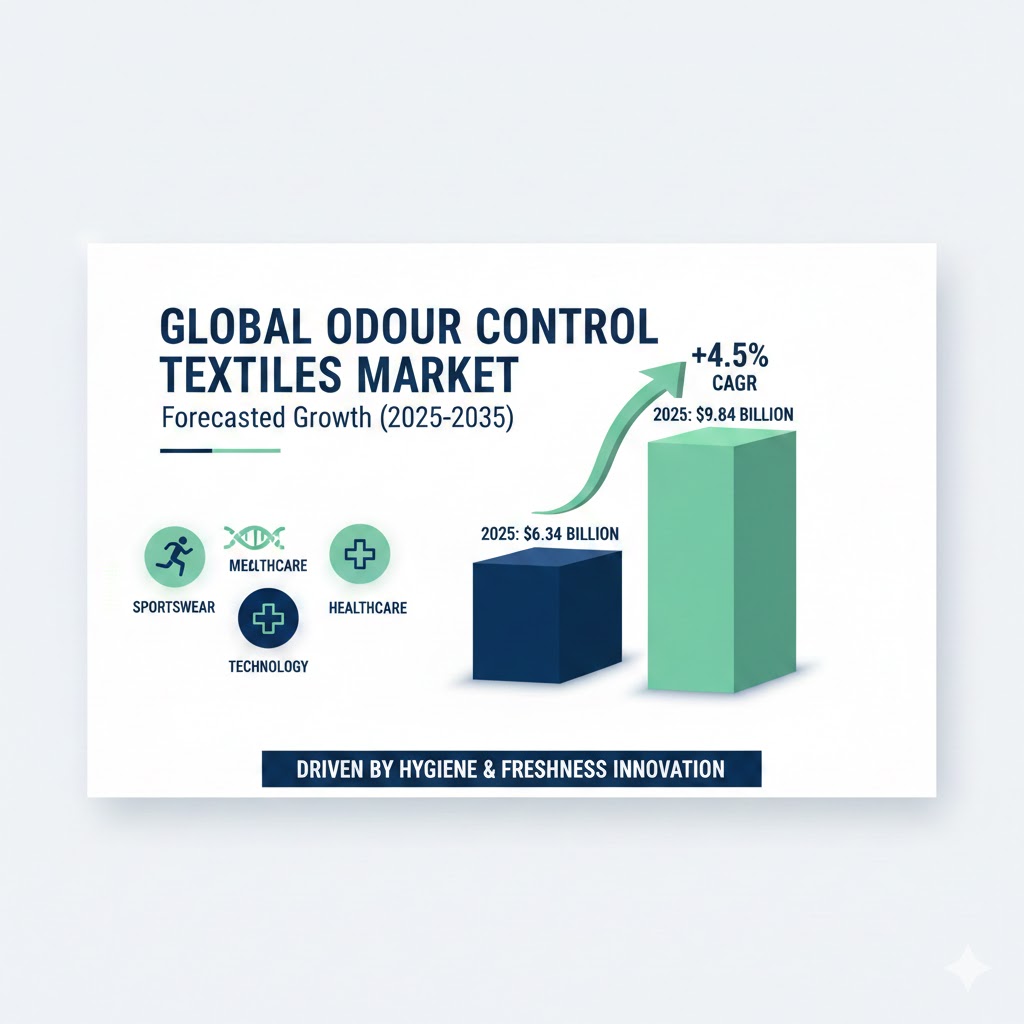
Odour Control Textiles Market to Reach USD 9.84 Billion by 2035 at 4.5% CAGR. The global odour control textiles market is projected to grow from USD 6.34 billion in 2025 to USD 9.84 billion by 2035, expanding at a compound annual growth rate (CAGR) of 4.5%. This steady climb is fueled by an intensified consumer focus on personal hygiene and the rapid integration of advanced nanotechnology within the sportswear and healthcare sectors.
Odour Control Textiles : Market Intelligence at a Glance
-
Market size 2025? USD 6.34 billion
-
Market size 2035? USD 9.84 billion
-
CAGR? 4.5% (2025–2035)
-
Leading product segment and share? Apparel & Footwear (5.8% CAGR)
-
Leading application and share? Nanotechnology (6.1% CAGR)
-
Leading sector and share? Industrial (5.4% CAGR)
-
Key growth regions? Asia Pacific (fastest growing), North America, Europe
-
Top companies? Heiq Materials AG, Sciessent LLC, Trevira GmbH, Dyntex GmbH, THOMPSON TEE, SANITIZED AG, Polygiene AB, ODEGON, Microban.
Market Momentum (YoY Path)
The progression of the Odour Control Textiles Market reflects a consistent upward trajectory. Starting at an estimated USD 6.34 billion in 2025, the market is expected to maintain its 4.5% CAGR momentum through the decade. By 2028, the valuation will see steady gains, followed by a robust middle-period expansion in 2030 and 2031. As technological maturity peaks in 2033, the market will approach its projected peak, ultimately reaching USD 9.84 billion by 2035.
Why the Market is Growing
The surge in demand for the Odour Control Textiles Market is primarily attributed to rising hygiene consciousness in a post-pandemic world. Consumers increasingly seek freshness and comfort in active, urban lifestyles, particularly in warmer climates. Furthermore, technological breakthroughs in nanotechnology and smart textiles have allowed for more effective, durable, and sustainable odour-neutralizing properties, meeting the green demands of modern shoppers.
Segment Spotlight
1) Product Type: Apparel & Footwear
The Apparel & Footwear segment is the most lucrative, growing at a 5.8% CAGR. As a mature area of the smart textile industry, it leverages features like movement sensing and temperature adjustment. From high-performance sportswear to gait-analysis footwear for the elderly, this segment leads in commercialization and user uptake.
2) Application Type: Nanotechnology
Expanding at a 6.1% CAGR, Nanotechnology is the highly remunerative service segment. Using silver and zinc oxide nanoparticles, manufacturers can inhibit bacterial growth at a microscopic level without sacrificing fabric breathability. These treatments are highly durable, surviving multiple wash cycles in hygiene-sensitive environments.
3) Sector: Industrial
The Industrial sector is projected to grow at a 5.4% CAGR. Demand is driven by strict occupational health and safety standards in food processing, waste management, and chemical handling. Odour-control technologies in industrial uniforms reduce laundering frequency and enhance worker comfort in high-heat environments.
Drivers, Opportunities, Trends, and Challenges
Drivers: The primary engine of growth is the athleisure movement and a wellness-focused culture. Post-pandemic hygiene sensitivity has made odour-resistant fabrics a standard requirement for active lifestyles, while the medical sector adopts these textiles for hospital bedding and patient clothing to maintain sterile environments.
Opportunities: Strategic opportunities lie at the intersection of innovation and sustainability. There is a high potential for clean-label options, such as bio-based and silver-free antimicrobial treatments. Partnerships between nanotechnology firms and global fashion brands offer a pathway to lock in long-term contracts and dominate retail categories.
Trends: A major trend is the shift toward smart textiles that respond to body heat or moisture. Manufacturers are moving away from traditional chemical coatings toward fiber-level integration. Additionally, there is a rising focus on ESG-compliant innovation, with investors prioritizing companies that utilize closed-loop chemistry and microplastic-free agents.
Challenges: The premium cost of production remains a significant barrier, as advanced technologies like microencapsulation drive up retail prices. Furthermore, limited consumer awareness in developing countries poses a hurdle; shoppers in these regions often prioritize low costs and durability over technical performance attributes like odour resistance.
Country Growth Outlook (2025–2035)
| Country | Projected CAGR |
| India | Fastest Growing |
| China | 5.0% |
| South Korea | 4.6% |
| USA | 4.2% |
| UK | 4.0% |
| Japan | 4.0% |
| Germany | 3.9% |
| France | 3.8% |
| Australia & NZ | 3.7% |
| Italy | 3.6% |
Browse Full report : https://www.factmr.com/report/849/odour-control-textiles-market
Competitive Landscape
The Odour Control Textiles Market is dominated by specialized players focusing on proprietary technologies. Heiq Materials AG leads with an 18-20% share, followed by Sciessent LLC at 14-16% and Trevira GmbH at 12-14%. Other significant contributors include Dyntex GmbH (8-10%) and THOMPSON TEE (2-3%). These companies maintain their edge through strategic licensing, OEKO-TEX® certifications, and the development of bio-based alternatives to traditional metal-based antimicrobials.