Warehousing and logistics operations are undergoing a rapid digital transformation as businesses strive to improve efficiency, accuracy, and responsiveness. At the center of this evolution are dynamic warehouse AI-powered autonomous mobile robots (AMRs). These intelligent systems are redefining how goods are stored, picked, transported, and managed within warehouses. By combining artificial intelligence with autonomous mobility, AI-powered AMRs enable warehouses to adapt dynamically to changing workloads, layouts, and demand patterns, making them a cornerstone of modern intralogistics strategies.
Market Overview
Dynamic warehouse AI-powered AMRs are advanced robotic systems designed to navigate warehouse environments autonomously while making real-time decisions. Unlike traditional automated guided vehicles that rely on fixed paths, AMRs leverage AI algorithms, sensors, and machine vision to move freely and safely alongside human workers.
The market is shaped by growing demand for flexible automation solutions capable of handling high-mix, high-volume operations. These robots integrate seamlessly with warehouse management systems and order fulfillment platforms, enabling real-time optimization of workflows. As supply chains become more complex and customer expectations for speed and accuracy rise, dynamic AMRs are increasingly viewed as essential infrastructure rather than optional enhancements.
Key Growth Drivers
One of the main drivers of the dynamic warehouse AI-powered AMRs market is the surge in e-commerce and omnichannel retail operations. Warehouses must process a growing number of small, time-sensitive orders, requiring automation solutions that can scale quickly and adapt to fluctuating demand.
Labor shortages and rising operational costs are also accelerating adoption. AI-powered AMRs help address workforce challenges by reducing reliance on manual material handling, improving worker productivity, and enhancing workplace safety.
Additionally, the need for real-time operational visibility and data-driven decision-making is pushing warehouses toward intelligent robotic systems. AMRs generate valuable data on movement patterns, task efficiency, and bottlenecks, enabling continuous process improvement.
Regional Insights
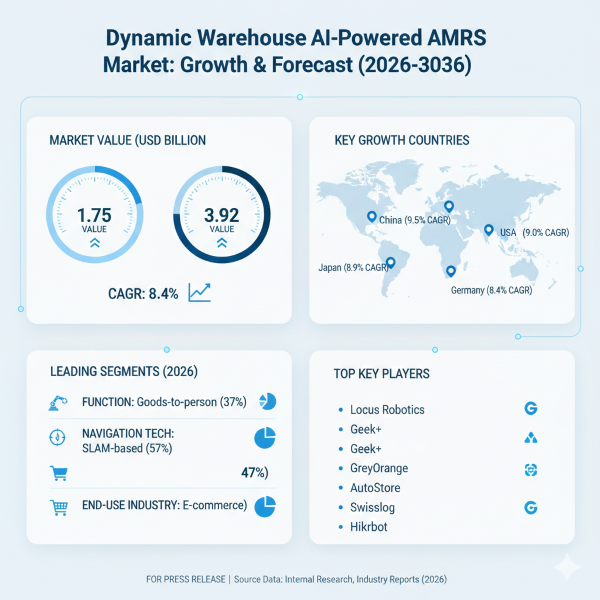
North America is a leading market for dynamic warehouse AI-powered AMRs, supported by advanced logistics infrastructure and early adoption of automation technologies. The presence of major e-commerce players and third-party logistics providers has driven widespread deployment of intelligent robotic systems.
Europe follows closely, driven by strong focus on operational efficiency, sustainability, and worker safety. Regulatory support for automation and energy-efficient warehouse operations is encouraging investment in AI-powered AMRs across the region.
Asia-Pacific is emerging as a high-growth region, fueled by rapid industrialization, expanding manufacturing hubs, and growing e-commerce activity. Companies in the region are increasingly investing in smart warehouse solutions to remain competitive in fast-moving markets.
Key Trends and Market Evolution
A significant trend shaping the market is the evolution toward fully dynamic and self-optimizing warehouses. AI-powered AMRs are increasingly capable of adapting routes, prioritizing tasks, and collaborating with other robots and human workers in real time.
Another notable trend is the integration of machine learning and advanced perception technologies. Improved vision systems and sensor fusion allow AMRs to operate safely in complex, constantly changing environments without disrupting existing warehouse layouts.
Interoperability is also gaining importance. Warehouse operators are seeking vendor-agnostic solutions that can integrate with diverse software platforms and coexist with other automation technologies, enhancing long-term flexibility.
Applications and End-Use Outlook
Dynamic warehouse AI-powered AMRs are widely used in e-commerce fulfillment centers, where speed, accuracy, and scalability are critical. These robots streamline order picking, sorting, and transport, helping meet fast delivery expectations.
Manufacturing facilities also represent a key end-use segment. AMRs support just-in-time production by efficiently transporting materials and components between workstations, reducing downtime and inventory holding costs.
Third-party logistics providers are increasingly adopting AI-powered AMRs to handle diverse client requirements and seasonal demand spikes. The flexibility of these systems makes them well suited for multi-tenant warehouse environments.
Competitive Landscape
The market features a mix of established robotics companies, automation specialists, and emerging AI-focused startups. Competition is driven by technological differentiation, system reliability, and ease of integration.
Vendors are investing heavily in research and development to enhance autonomy, navigation accuracy, and fleet management capabilities. Strategic partnerships with software providers and logistics operators are helping accelerate product innovation and market adoption.
Service offerings, including system integration, maintenance, and analytics support, are becoming key differentiators as customers seek end-to-end automation solutions.
Conclusion
The dynamic warehouse AI-powered AMRs market is reshaping the future of logistics by enabling agile, intelligent, and scalable warehouse operations. As supply chains continue to evolve and customer expectations rise, the role of AI-powered autonomous robots is becoming increasingly critical. These systems not only enhance operational efficiency but also provide the flexibility needed to navigate uncertainty and growth.
Browse Full Report – https://www.factmr.com/report/dynamic-warehouse-ai-powered-amrs-market