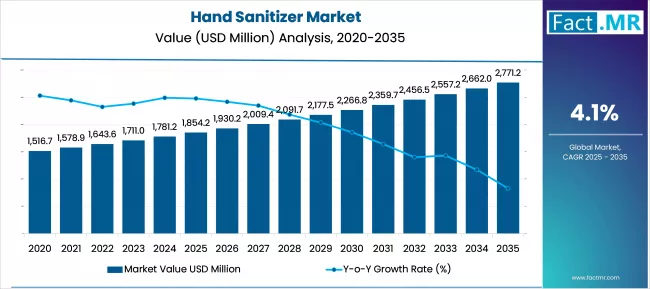
The global hand sanitizer market is transitioning from a crisis-driven surge to steady, sustainable growth, reflecting its lasting role within personal care and healthcare. The market is projected to grow from USD 1,854.2 million in 2025 to USD 2,771.2 million by 2035, achieving a CAGR of 4.1% over the decade.
This growth underscores the increasing recognition of hand sanitizers as essential hygiene products across households, healthcare facilities, workplaces, schools, and public spaces. Consumer behavior has shifted from temporary pandemic-driven demand to long-term, routine usage, emphasizing product innovation, sustainability, and institutional adoption.
Market Performance and Long-Term Growth Trends
Although demand surged during the COVID-19 pandemic, the hand sanitizer market has stabilized and is poised for sustainable growth. Key drivers include:
-
Heightened Hygiene Awareness: Consumers now consider hand sanitizers essential for daily hygiene, driving consistent demand across demographics.
-
Institutional Integration: Hospitals, schools, offices, retail spaces, and transport hubs are increasingly incorporating hand sanitizers into hygiene protocols, resulting in steady bulk purchases.
-
Diversified Product Formats: Gel-based sanitizers dominate due to convenience, but sprays, foams, and wipes are gaining traction, catering to specific preferences and environments.
-
Formulation Preferences: Alcohol-based products continue to lead due to proven antimicrobial efficacy, while demand for botanical and skin-friendly formulations is rising.
Strategic Insights for R&D
R&D investment is critical for maintaining a competitive edge and addressing evolving consumer expectations. Key areas for innovation include:
1. Advanced Formulations for Skin Care
Although alcohol remains the standard for sanitization, formulations that reduce dryness and incorporate moisturizers or botanical extracts are increasingly preferred, particularly in premium segments. Dual-action sanitizers that combine effective germ protection with skin benefits are an emerging trend.
2. Sustainable Product Development
Environmental considerations are reshaping product design. Refillable systems, recyclable packaging, and concentrated formulations align with consumer preferences and regulatory expectations. Investing in sustainable chemistry and eco-friendly delivery systems differentiates brands and supports long-term compliance.
3. Smart Dispenser Technologies
Institutions increasingly value dispensers with telemetry, usage tracking, and automated refill alerts. R&D can integrate hygiene solutions with IoT capabilities, enabling data-driven maintenance and operational efficiency in high-traffic settings.
Expansion Strategy and Market Development
Market growth requires targeted strategies based on regional demand patterns and consumer behavior:
North America: Premium & Institutional Focus
The U.S. and Canada are characterized by high hygiene awareness and strong institutional procurement. Growth is shifting from volume to value, with emphasis on premium, dermatologically tested, or eco-certified products.
Asia-Pacific: Rapid Adoption
Countries like China, Japan, and others in Asia-Pacific are witnessing fast growth due to urbanization, digital commerce adoption, and public health awareness. E-commerce platforms enable direct-to-consumer sales, subscription models, and personalized offerings.
Latin America, Middle East & Africa: Emerging Markets
Emerging regions show dual market dynamics: premium imported products cater to affluent urban consumers, while cost-effective products drive volume among broader populations. Public health initiatives are improving hygiene awareness and accessibility.
Distribution Channel Dynamics
Distribution strategies are evolving in response to consumer preferences:
-
Supermarkets & Pharmacies: Traditional retail remains essential, especially for brands with broad visibility and trust.
-
E-commerce Growth: Online channels attract younger, digitally-savvy consumers, enabling subscription services, customized bundles, and targeted marketing.
-
Institutional Sales: Bulk purchases, long-term supply contracts, and integrated dispensers ensure steady revenue streams for manufacturers.
Challenges and Risk Factors
Despite positive projections, several challenges require careful navigation:
-
Raw Material Volatility: Dependence on ethanol and specialty chemicals exposes manufacturers to price fluctuations and supply disruptions, impacting margins.
-
Regulatory Complexity: Hand sanitizer formulations and labeling vary across regions, requiring compliance with evolving regulations.
-
Competitive Saturation: Low barriers to entry have led to crowded markets. Differentiation through innovation, brand loyalty, and efficient distribution is essential.
Browse Full Report : https://www.factmr.com/report/4705/hand-sanitizer-market
Competitive Landscape
Global leaders include Reckitt Benckiser, GOJO Industries, Procter & Gamble, Unilever, Henkel, 3M, Vi-Jon, Godrej Consumer Products, and Beiersdorf. These companies are investing in capacity expansion, innovative formulations, and smart dispenser technology to maintain market leadership.
Conclusion
The global hand sanitizer market’s outlook to 2036 reflects a combination of stable demand, product innovation, and regional opportunities. As sanitizers become integrated into everyday hygiene routines, companies that prioritize R&D, sustainability, and adaptive market strategies will be best positioned to capture long-term growth.