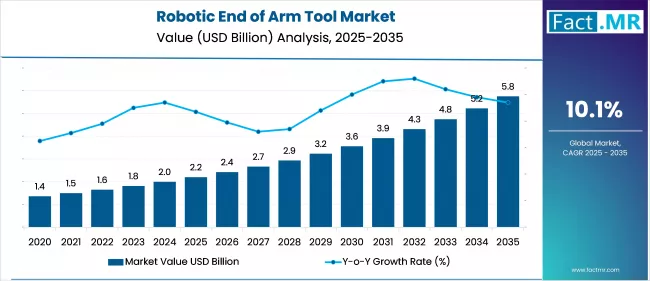
The rapid adoption of industrial automation across manufacturing sectors is transforming how products are assembled, handled, and packaged. At the core of this transformation lies robotic end of arm tooling (EOAT)—the interface between a robot and the task it performs. As industries strive for higher productivity, precision, and operational flexibility, the robotic end of arm tool market is gaining strong momentum. Insights from Fact.MR indicate that EOAT solutions are becoming indispensable components in modern robotic systems, enabling robots to perform complex, customized, and high-speed operations across diverse industrial environments.
Market Overview
Robotic end of arm tools refer to the devices attached to the wrist of an industrial robot that interact directly with workpieces. These tools include grippers, vacuum cups, welding guns, dispensing tools, cutting tools, and sensing devices, each designed for specific tasks. EOAT systems are engineered to maximize efficiency, accuracy, and repeatability while minimizing cycle times and human intervention.
The market is evolving from simple mechanical grippers to smart, sensor-enabled, and application-specific tooling solutions. Manufacturers increasingly demand modular and customizable EOAT designs that can be easily reconfigured to support multiple product variants and shorter production runs. This shift reflects broader trends toward flexible manufacturing and Industry 4.0 adoption.
Key Growth Drivers
One of the primary drivers of the robotic end of arm tool market is the growing emphasis on automation to address labor shortages and rising operational costs. EOAT systems enable manufacturers to automate repetitive, hazardous, or precision-intensive tasks, improving workplace safety and production consistency.
Another major driver is the increasing complexity of manufacturing processes, particularly in industries such as automotive, electronics, and pharmaceuticals. As products become more intricate and quality standards more stringent, advanced EOAT solutions equipped with force sensors, vision systems, and adaptive gripping mechanisms are gaining traction.
The rise of collaborative robots (cobots) is also fueling demand for specialized end of arm tools. Cobots require lightweight, safe, and highly responsive EOAT designs to operate effectively alongside human workers, opening new opportunities for tooling innovation.
Regional Insights
From a regional standpoint, Asia-Pacific represents a leading market for robotic end of arm tools, supported by strong manufacturing activity in countries such as China, Japan, South Korea, and India. Rapid industrialization, expanding electronics production, and increasing investments in factory automation are driving EOAT adoption across the region.
North America follows closely, with high demand driven by advanced manufacturing facilities, early adoption of robotics, and a strong focus on productivity optimization. The presence of leading automation technology providers further supports market growth.
Europe remains a key contributor, particularly in automotive and industrial machinery manufacturing. Stringent quality standards, emphasis on precision engineering, and growing use of collaborative robots are accelerating EOAT deployment across European industries.
Key Trends and Forecast
One of the most prominent trends in the robotic EOAT market is the integration of smart technologies. End of arm tools are increasingly embedded with sensors, vision systems, and IoT connectivity, enabling real-time feedback, adaptive control, and predictive maintenance.
Another significant trend is the growing demand for modular and quick-change tooling systems. These solutions allow manufacturers to switch tools rapidly without downtime, supporting high-mix, low-volume production models and improving overall equipment effectiveness.
The market is also witnessing increased adoption of soft robotic grippers, particularly for handling delicate or irregularly shaped objects. These tools are gaining popularity in food processing, logistics, and consumer goods industries due to their flexibility and gentle handling capabilities.
Applications and End-Use Outlook
Robotic end of arm tools are widely used across multiple industries. In the automotive sector, EOAT systems support welding, assembly, material handling, and painting operations, ensuring consistency and high throughput.
In electronics and semiconductor manufacturing, EOAT solutions enable precise handling of small, sensitive components, reducing damage and improving yield rates. Advanced vacuum and micro-gripping tools are particularly critical in these applications.
The food and beverage industry is increasingly adopting EOAT systems for picking, sorting, packaging, and palletizing tasks. Hygienic design standards and soft gripping technologies play a key role in this segment.
Other important end-use industries include pharmaceuticals, logistics and warehousing, metal fabrication, and consumer goods manufacturing, where EOAT systems enhance operational efficiency and process reliability.
Competitive Landscape
The robotic end of arm tool market is characterized by a mix of global automation leaders and specialized tooling manufacturers. Companies are focusing on product innovation, customization capabilities, and compatibility with multiple robot platforms to strengthen their market presence.
Strategic partnerships between EOAT suppliers, robot manufacturers, and system integrators are becoming increasingly common. According to insights from Fact.MR, suppliers that offer application-specific, intelligent, and easily integrable EOAT solutions are well-positioned to gain a competitive advantage.
Conclusion
The robotic end of arm tool market is a critical enabler of next-generation industrial automation. As manufacturers seek greater flexibility, precision, and efficiency, EOAT solutions are evolving to meet complex operational demands across industries. The integration of smart technologies, modular designs, and application-specific tooling will continue to shape the market’s future. Leveraging in-depth industry analysis from trusted sources such as Fact.MR can help stakeholders understand emerging trends, identify growth opportunities, and make informed decisions in this dynamic automation landscape.
Browse Full Report – https://www.factmr.com/report/503/robotic-end-of-arm-tooling-market