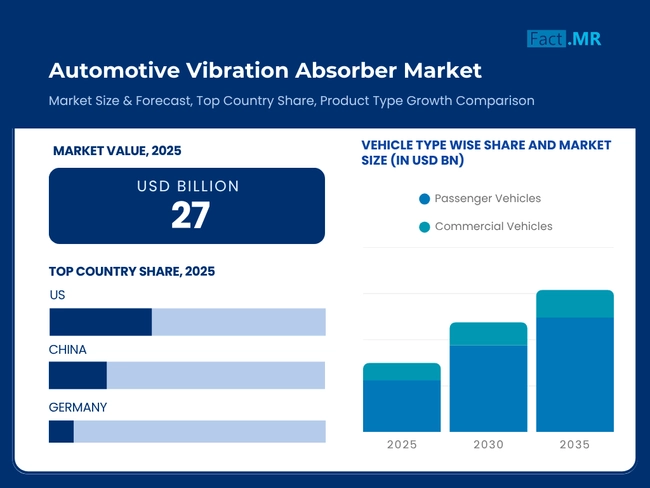
As the automotive industry continues to evolve toward higher performance, improved comfort, and quieter mobility, controlling noise, vibration, and harshness (NVH) has become a top priority for manufacturers. Automotive vibration absorbers play a crucial role in minimizing unwanted vibrations generated by engines, drivetrains, suspensions, and road conditions. With rising consumer expectations for smooth driving experiences and the growing adoption of electric and hybrid vehicles, the automotive vibration absorber market is gaining steady traction. According to insights from Fact.MR, advancements in vehicle design and material technologies are significantly influencing the demand for effective vibration control solutions.
Market Overview
Automotive vibration absorbers are components designed to reduce oscillations and dampen vibrations within vehicle systems. These absorbers are commonly integrated into engine mounts, exhaust systems, chassis structures, driveline components, and suspension systems. By mitigating vibration transmission, they enhance ride comfort, reduce component wear, and improve overall vehicle reliability.
The market encompasses various absorber types, including rubber-based dampers, hydraulic absorbers, tuned mass dampers, and elastomeric solutions. Automakers increasingly focus on optimizing vibration absorber designs to meet evolving performance standards while maintaining cost efficiency and durability. As vehicles become lighter and more complex, vibration absorbers are being engineered to deliver higher efficiency within compact form factors.
Key Growth Drivers
One of the primary drivers of the automotive vibration absorber market is the increasing emphasis on passenger comfort and vehicle refinement. Consumers now expect quieter cabins and smoother rides, even in entry-level vehicles, prompting manufacturers to invest in advanced NVH reduction technologies.
The rise of electric vehicles (EVs) is another major growth driver. While EVs eliminate engine noise, they amplify other vibration sources such as electric motors, gear whine, and road noise. This shift has increased the importance of vibration absorbers specifically designed for electric powertrains and lightweight vehicle architectures.
Additionally, stringent regulatory standards related to vehicle safety, durability, and emissions indirectly support market growth. Effective vibration management helps extend component life, reduce maintenance requirements, and ensure compliance with quality and performance regulations across global markets.
Regional Insights
From a regional perspective, Asia-Pacific holds a dominant position in the automotive vibration absorber market, supported by high vehicle production volumes and a strong presence of automotive OEMs in countries such as China, Japan, India, and South Korea. Rapid urbanization, growing middle-class populations, and increasing demand for passenger vehicles are driving the adoption of advanced vibration control components in the region.
Europe represents a significant market due to its focus on premium vehicles, advanced engineering standards, and early adoption of electric and hybrid vehicles. European automakers place strong emphasis on NVH optimization, contributing to consistent demand for high-performance vibration absorbers.
North America also plays a key role, driven by strong demand for SUVs and pickup trucks, where vibration control is critical for ride comfort and durability. The region’s focus on innovation and vehicle performance further supports market development.
Key Trends & Forecast
A prominent trend shaping the automotive vibration absorber market is the development of lightweight and high-performance materials. Manufacturers are increasingly using advanced elastomers, composites, and hybrid materials to improve damping efficiency while reducing overall vehicle weight.
Another key trend is the customization of vibration absorbers for specific vehicle platforms. Instead of one-size-fits-all solutions, OEMs are adopting tuned absorbers designed for particular frequencies and operating conditions, enhancing NVH performance across different driving scenarios.
The integration of simulation and digital modeling technologies is also transforming product development. Advanced CAE tools allow manufacturers to predict vibration behavior early in the design phase, leading to more precise and efficient absorber solutions.
Applications & End-Use Outlook
Automotive vibration absorbers are used across a wide range of applications. In engine and powertrain systems, they help minimize vibrations generated by combustion processes, rotating components, and gear interactions. These applications are critical for both conventional and electrified vehicles.
In chassis and suspension systems, vibration absorbers improve ride stability and handling by reducing road-induced vibrations. This is particularly important in vehicles designed for long-distance travel and uneven road conditions.
The exhaust system is another key application area, where vibration absorbers help reduce noise, prevent structural fatigue, and enhance overall system longevity.
End-use segments include passenger cars, light commercial vehicles, and heavy commercial vehicles, with passenger cars accounting for a significant share due to high production volumes and increasing comfort expectations.
Competitive Landscape
The automotive vibration absorber market features a mix of global component suppliers and specialized NVH solution providers. Companies are focusing on research and development, material innovation, and close collaboration with automotive OEMs to deliver optimized vibration control systems.
Strategic partnerships, long-term supply agreements, and investments in advanced testing facilities are common competitive strategies. As highlighted by Fact.MR, suppliers that can offer durable, lightweight, and application-specific vibration absorbers are likely to strengthen their position in the evolving automotive ecosystem.
Conclusion
The automotive vibration absorber market plays a vital role in shaping vehicle comfort, performance, and durability. As the industry transitions toward electric mobility, lightweight construction, and enhanced driving experiences, the importance of effective vibration management continues to grow. Technological advancements, material innovation, and increasing customization are expected to define the market’s future trajectory. Leveraging detailed insights from trusted industry sources such as Fact.MR can help manufacturers, suppliers, and stakeholders navigate emerging trends and capitalize on long-term growth opportunities.
Browse Full Report – https://www.factmr.com/report/507/automotive-vibration-absorber-market