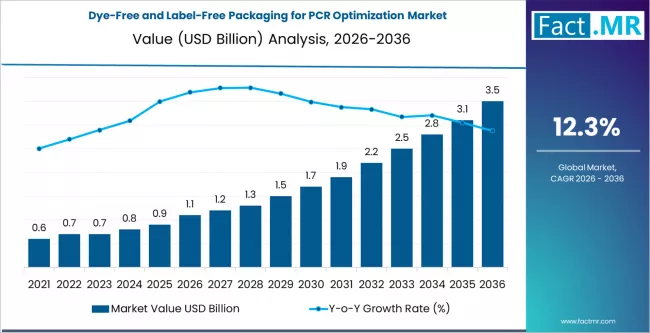
A fundamental shift in sustainable packaging design is underway as global industries move toward “”clean”” material streams. According to a new market study by Fact.MR, the global Dye-Free and Label-Free Packaging for PCR Optimization Market is projected to grow from a valuation of USD 1.1 billion in 2026 to USD 3.5 billion by 2036, expanding at a robust compound annual growth rate (CAGR) of 12.3%.
This growth is driven by a critical need to optimize Post-Consumer Recycled (PCR) content. By eliminating added colorants and adhesive-backed labels, manufacturers are successfully reducing contamination in recycling streams, ensuring that recycled plastics maintain the high material integrity required for high-speed filling lines and circular reuse.
Solving the Recycling Contamination Crisis
Traditional packaging often relies on heavy pigments and complex labels that act as contaminants during the mechanical recycling process. These additives lower the quality of the resulting PCR, often relegating it to “”downcycled”” applications rather than food-grade or high-performance packaging.
To address this, brand owners and packaging converters are increasingly adopting dye-free and label-free designs. By utilizing technologies such as mold-in embossing, laser marking, and digital marking, companies can maintain brand identity and provide necessary product information without the use of secondary materials that complicate sorting and recycling.
Key Market Insights and Data-Backed Trends
- Material Dominance: Natural PE, PP, and PET currently lead the market with a 57% share. These materials offer the essential structural versatility and material clarity needed for diverse applications while remaining highly compatible with advanced PCR optimization.
- Segment Leadership: Food and beverage packaging remains the primary driver, accounting for 45% of the market share. Unpigmented containers, specifically, are expected to lead the packaging segment with a 50% share of total demand.
- Technology Evolution: The industry is moving toward high-speed embossing and simplified decoration methods that eliminate the need for traditional adhesives and inks, further streamlining the sorting process at recycling facilities.
Regional Outlook: Asia Pacific and India Lead Growth
While North America and Europe remain significant hubs for regulatory-driven adoption, the Asia Pacific region is emerging as the fastest-growing market.
- India: Projected to grow at a 15% CAGR through 2036, India’s market is buoyed by government initiatives aimed at reducing plastic waste and a rapidly expanding domestic manufacturing sector.
- United States: The U.S. market is forecast to grow at a 12% CAGR, fueled by increasing corporate sustainability commitments and pressure to meet stringent PCR content requirements in consumer goods.
Market Implications for Industry Leaders
“”The shift toward dye-free and label-free solutions is no longer just an environmental preference; it is a technical necessity for the viability of the circular economy,”” states the Fact.MR report. Leading players such as ALPLA are already pioneering these designs to meet the dual demands of brand aesthetics and material recyclability.
As the industry moves toward 2036, the adoption of clear, natural packaging is expected to become the gold standard for FMCG, household care, and beverage sectors. This transition allows for a “”closed-loop”” system where packaging can be recycled back into its original form multiple times without the degradation of color or quality.
Browse Full Report :
https://www.factmr.com/report/dye-free-and-label-free-packaging-for-pcr-optimization-market
About Fact.MR
Fact.MR is a leading provider of market intelligence and competitive research, offering granular insights into the chemical, material, and consumer goods sectors. With a focus on emerging sustainability trends, Fact.MR provides the data-driven clarity required for strategic decision-making in a rapidly evolving global economy.