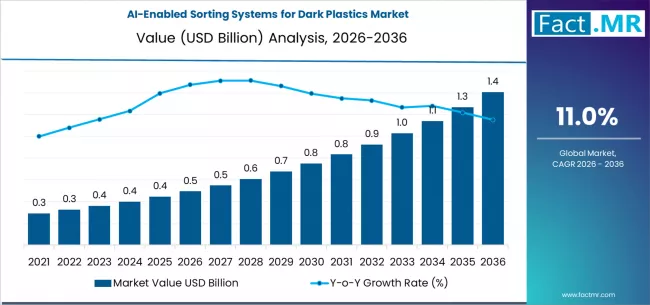
The global AI-Enabled Sorting Systems for Dark Plastics Market is poised for significant expansion through 2036 as demand for advanced recycling solutions rises in response to environmental regulations, corporate sustainability targets, and mounting pressure to improve circular economy performance. Dark plastics — which are traditionally difficult to identify and sort using conventional optical systems — represent a persistent challenge in recycling streams. AI-enabled sorting systems use artificial intelligence, machine vision, and advanced sensor fusion to accurately detect, classify, and separate dark plastic materials at high throughput, enabling higher recovery rates, better material quality, and improved economic viability for recycling operations.
As global plastic consumption continues to grow, especially in packaging, consumer goods, and industrial applications, recycling infrastructure must evolve to handle increasingly complex waste streams. AI-driven sorting systems for dark plastics empower materials recovery facilities (MRFs), plastics recyclers, and waste management companies to capture value from materials that were once difficult to reclaim, supporting broader objectives of waste reduction, resource efficiency, and greenhouse gas mitigation.
Market Outlook (2026–2036)
-
Market Value in 2026: Estimated at USD 0.65 Billion
-
Market Value in 2036: Projected at USD 2.1 Billion
-
Forecast CAGR (2026–2036): Approximately 12.5%
-
Leading Technology Segment: Machine Vision with Deep Learning Algorithms
-
Primary End Users: Materials Recovery Facilities, Plastics Recyclers, Waste Management Companies
-
Key Growth Drivers: Regulatory pressure, sustainability commitments, advancements in AI and sensor technologies
The anticipated growth reflects the increasing adoption of intelligent sorting solutions that can reliably process dark plastics — including black packaging, automotive components, and industrial materials — without manual intervention or costly pre-sorting labor.
To access the complete data tables and in-depth insights, request a Discount On The Report here: https://www.factmr.com/connectus/sample?flag=S&rep_id=13484
Market Overview
Dark plastics have long presented a sorting challenge because traditional near-infrared (NIR) sensors often fail to detect them due to their light-absorbing properties. This limitation leads to lower recovery rates, increased contamination of recycled streams, and reduced material value. AI-enabled sorting systems overcome this by integrating machine vision cameras, hyperspectral imaging, deep learning classifiers, and real-time data analytics to distinguish dark plastics from other waste fractions with high accuracy.
By training neural networks on large datasets of labeled materials, these systems “learn” the visual and spectral signatures of dark plastics and can adapt to variations in shape, color, and surface conditions. Combined with robotics and high-speed actuators, AI sorting platforms can automatically divert identified dark plastics into designated streams, facilitating cleaner material flows and higher-value recyclates.
Key Market Drivers
1. Regulatory and Policy Pressure on Plastic Waste
Government mandates on plastic recycling targets, extended producer responsibility (EPR) frameworks, and restrictions on landfilling are encouraging investments in advanced sorting technologies that enhance recovery rates — especially for materials like dark plastics that were previously difficult to recycle.
2. Growing Corporate Sustainability Commitments
Brand owners and multinational corporations are adopting ambitious sustainability goals, including targets for recycled content and zero waste. Advanced sorting solutions enable supply chains to access higher-quality recycled plastics, including dark fractions, supporting circular product design.
3. Technological Advancements in AI and Imaging
Continuous improvements in artificial intelligence, machine learning, and imaging sensors are enhancing the accuracy and speed of sorting solutions, reducing operational costs, and increasing reliability even in mixed and contaminated waste streams.
4. Expansion of Recycling Infrastructure
Investment in new recycling capacity, modernization of existing materials recovery facilities, and increased use of automated technologies are creating fertile conditions for the adoption of AI-enabled sorting systems that can handle complex material streams.
Market Segmentation Insights
By Technology Type:
-
Machine Vision with Deep Learning Classification
-
Hyperspectral Imaging Systems
-
3D Imaging and Structured Light Sorting
-
Sensor Fusion Platforms (Combining Vision, NIR, and X-ray)
-
Robotics and Actuated Diverter Integration
By Application:
-
Post-Consumer Packaging Recycling
-
Post-Industrial Plastics Sorting
-
Automotive and Durable Goods Recycling
-
Electronic Waste (E-Waste) Plastics Separation
-
Other Specialized Waste Streams
By End User:
-
Materials Recovery Facilities (MRFs)
-
Plastics Recyclers and Compounders
-
Waste Management and Collection Companies
-
Industrial Sorting Service Providers
-
Municipal and Regional Recycling Programs
Regional Demand Dynamics
North America is expected to hold a significant share of the market due to advanced recycling regulations, strong emphasis on sustainability, and proactive deployment of smart waste management technologies. Investments in digital infrastructure and innovation centers further support adoption of AI-enabled sorting solutions.
Europe also represents a major regional market supported by comprehensive circular economy policies, ambitious recycling targets, and well-developed waste collection systems. Mandates for high recycling thresholds and recycled content are accelerating interest in technologies that can improve dark plastic recovery.
Asia Pacific is projected to exhibit rapid growth as urbanization accelerates, recycling infrastructure expands, and governments implement policies to address plastic pollution. Growth in industrial output and packaging consumption drives the need for advanced sorting capabilities in emerging economies.
Emerging demand is also visible in Latin America and Middle East & Africa, where investments in waste management modernization and sustainability initiatives are creating opportunities for intelligent sorting technologies.
Competitive Landscape
The market for AI-enabled sorting systems for dark plastics is moderately competitive, with participation from robotics integrators, sensor manufacturers, software developers, and recycling technology firms. Leading solutions focus on ease of integration with existing conveyor systems, high sorting accuracy, adaptive learning capabilities, and scalability for diverse waste processing environments.
Companies are enhancing their offerings with cloud-based analytics, remote diagnostics, and modular hardware to support rapid deployment and ongoing performance optimization. Strategic partnerships with waste management firms, recycling associations, and research institutions are also important for validating performance and accelerating commercial adoption.
Future Outlook
The AI-Enabled Sorting Systems for Dark Plastics Market is expected to maintain robust growth through 2036 as recycling ecosystems evolve, sustainability priorities deepen, and demand for high-quality recycled materials grows. Continued advancements in AI algorithms, sensor technologies, and robotics will further improve sorting accuracy, reduce operating costs, and unlock new applications across diverse materials streams.
With the global focus on reducing plastic waste and enhancing material circularity, AI-driven sorting solutions will play an increasingly central role in transforming how dark plastics are recovered, processed, and reintegrated into manufacturing supply chains.
Browse Full Report: https://www.factmr.com/report/ai-enabled-sorting-systems-for-dark-plastics-market