The global automated office smart shading systems market is entering a decisive growth phase, driven by energy economics, regulatory pressure, and the rapid convergence of building automation, IoT, and artificial intelligence. Once considered a premium architectural add-on, smart shading is now emerging as a core infrastructure component for next-generation commercial buildings and retrofit strategies worldwide.
Market Size and Growth Outlook
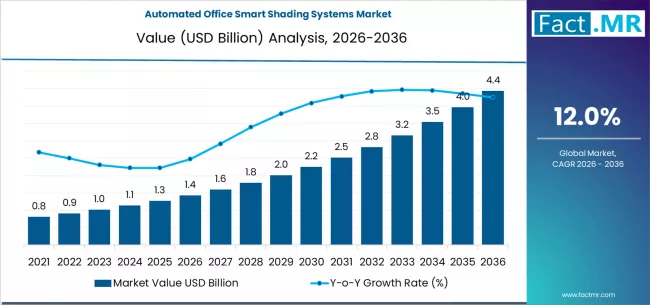
The automated shading systems market was valued at approximately USD 18.4 billion in 2023 and is projected to grow at over 10% CAGR through 2032, reflecting accelerating adoption across commercial and institutional buildings. Within this, office-focused smart shading solutions represent one of the fastest-growing subsegments, supported by workplace decarbonization mandates and rising energy costs.
The automated office smart shading systems market is expected to maintain double-digit growth into the mid-2030s, with some smart shades categories forecast to expand at CAGRs exceeding 20% as AI-driven and sensor-based systems scale globally. India, Southeast Asia, and the Middle East are expected to outperform global averages, fueled by rapid urbanization and commercial real estate development, with India alone posting nearly 14% CAGR in office smart shading adoption.
Key Market Drivers
-
Energy Efficiency and Cost Reduction
Energy performance remains the primary catalyst. Automated office shading systems dynamically regulate daylight and solar heat gain, reducing HVAC and lighting demand. Studies show that automated window shading can cut building energy consumption by up to 25%, with payback periods of three to five years in large office towers. In an era of volatile energy prices, these savings directly translate into improved operating margins for property owners and tenants.
-
Net-Zero and Green Building Regulations
Governments and city authorities are embedding stricter energy-efficiency and carbon-reduction requirements into building codes. Automated shading is increasingly recognized as a low-cost, high-impact lever to meet net-zero carbon building targets, particularly when integrated with smart HVAC and lighting controls. Green building certifications such as LEED, BREEAM, and WELL further reinforce adoption by rewarding intelligent daylight and glare management.
-
Technological Convergence: IoT, AI, and Sensors
Advances in sensors, AI algorithms, and cloud-based building management platforms are transforming smart shading from rule-based automation into predictive, self-optimizing systems. Modern solutions analyze weather forecasts, solar angles, occupancy patterns, and real-time energy data to optimize comfort and efficiency autonomously. Declining motor and sensor costs are lowering barriers to adoption, particularly in retrofit projects.
-
Workplace Experience and Productivity
Post-pandemic office design places renewed emphasis on employee well-being and productivity. Smart shading reduces glare, improves thermal comfort, and maximizes natural daylight—factors linked to higher cognitive performance and employee satisfaction. As organizations compete for talent, intelligent environmental controls are becoming a strategic differentiator rather than a discretionary expense.
Disruption Signals Shaping the Industry
Several disruption signals indicate that the competitive landscape is evolving rapidly:
-
Retrofit-Led Demand Surge: Much of future growth will come from upgrading existing office stock. Targeted investments in smart systems can reduce energy use by 30% or more without structural rebuilds, delivering rapid ROI and carbon savings.
-
Platformization and Ecosystem Integration: Smart shading vendors are increasingly integrating with broader building operating systems, digital twins, and workplace analytics platforms. This favors players with strong software capabilities and open APIs over hardware-only manufacturers.
-
Shift from Manual Controls to Autonomous Optimization: As AI-driven automated system optimization replaces static schedules, shading becomes part of a continuously learning building ecosystem, raising switching costs and redefining customer expectations.
-
Regional Divergence: Emerging markets are leapfrogging legacy solutions, adopting fully connected systems from the outset, while mature markets focus on compliance-driven retrofits and performance upgrades.
Industry Scenarios: 2025–2035
Looking ahead, three plausible scenarios frame the future of the automated office smart shading systems market:
-
Baseline Scenario – “Smart Standard”
Smart shading becomes a standard specification in Class A office buildings globally. Growth remains strong at high single-digit to low double-digit CAGRs, driven by regulation, energy economics, and tenant demand. -
Accelerated Scenario – “Autonomous Buildings”
AI-native building platforms achieve widespread adoption, positioning smart shading as a critical node in autonomous energy management. Market growth accelerates beyond current forecasts, with premium software-enabled solutions commanding higher margins. -
Constrained Scenario – “Fragmented Adoption”
Supply chain volatility, integration challenges, or slow regulatory enforcement temper growth in some regions. Adoption remains uneven, favoring markets with strong policy alignment and energy pricing signals.
Browse Full Report : https://www.factmr.com/report/automated-office-smart-shading-systems-market
Strategic Implications
For manufacturers, technology providers, and investors, the message is clear: value is shifting from standalone products to integrated, data-driven solutions. Competitive advantage will depend on software intelligence, interoperability, and the ability to quantify energy and carbon savings for customers.
As commercial real estate recalibrates for sustainability, resilience, and occupant experience, automated office smart shading systems are poised to move from the periphery to the core of building strategy. The next decade will define not just how buildings look—but how intelligently they respond to the world around them.