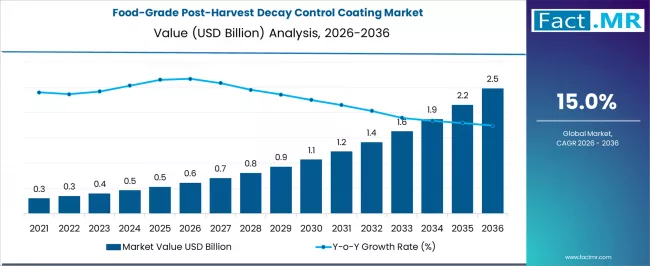
Post-harvest losses remain a major challenge for the global food supply chain, particularly for fresh fruits and vegetables that are highly perishable. As consumer demand for fresh, high-quality produce continues to rise, the food industry is increasingly focused on solutions that can preserve freshness, reduce waste, and maintain food safety. Food-grade post-harvest decay control coatings have emerged as an effective and sustainable approach to addressing these challenges.
These coatings form a protective layer on produce surfaces, slowing down microbial growth, reducing moisture loss, and extending shelf life without compromising food safety. As sustainability, food security, and clean-label practices gain prominence, the food-grade post-harvest decay control coating market is gaining strong traction across global agricultural and food distribution systems.
Market Overview
The food-grade post-harvest decay control coating market includes edible and non-edible coatings formulated from food-safe materials that help protect fresh produce from spoilage during storage, transportation, and retail display. These coatings are designed to regulate gas exchange, reduce oxidation, and inhibit the growth of decay-causing microorganisms.
Commonly used formulations include natural polymers, lipids, proteins, and plant-based compounds that align with food safety regulations and consumer expectations. Many coatings are compatible with organic produce requirements, making them particularly attractive for premium and export-oriented markets.
Unlike conventional chemical preservatives, food-grade decay control coatings emphasize minimal residue, safety, and environmental responsibility. Their growing adoption reflects a broader shift toward sustainable post-harvest management practices that prioritize both product quality and regulatory compliance.
Regional Insights
Adoption of food-grade post-harvest decay control coatings varies across regions based on agricultural output, cold-chain infrastructure, and food safety regulations. Regions with well-developed fresh produce supply chains and stringent food safety standards are leading the use of advanced coating technologies.
In emerging agricultural economies, adoption is increasing as governments and industry stakeholders seek to reduce post-harvest losses and improve access to domestic and export markets. Investments in storage facilities, logistics, and post-harvest technologies are supporting the wider use of decay control coatings.
Export-driven regions are particularly focused on these solutions, as extended shelf life and reduced spoilage are essential for maintaining quality during long-distance transportation. This trend is strengthening global demand for reliable and food-safe coating solutions.
Key Trends & Market Outlook
One of the most significant trends shaping the market is the growing preference for natural and plant-based coating formulations. Consumers are increasingly aware of food ingredients and processing methods, driving demand for coatings derived from renewable and biodegradable sources.
Another key trend is the integration of post-harvest coatings with modern supply-chain management practices. Coatings are being used alongside controlled-atmosphere storage, cold-chain logistics, and smart packaging technologies to enhance overall produce preservation.
Innovation in antimicrobial and antifungal coatings is also influencing market development. Research efforts are focused on improving coating performance while maintaining compliance with food safety and regulatory standards.
Additionally, sustainability considerations are driving the adoption of coatings that reduce food waste and support circular economy principles. By extending the usable life of fresh produce, these solutions contribute to more efficient resource utilization across the food system.
Applications & End-Use Outlook
Food-grade post-harvest decay control coatings are widely used across a variety of fresh produce categories, including fruits, vegetables, and specialty crops. High-value fruits benefit from coatings that maintain visual appeal, texture, and flavor throughout storage and distribution.
Vegetable producers and distributors use these coatings to reduce moisture loss and delay spoilage, ensuring consistent quality for retail and foodservice applications. Specialty crops, including organic and export-grade produce, represent a growing application area due to strict quality and safety requirements.
End users include farmers, post-harvest service providers, packaging companies, exporters, wholesalers, and retailers. Food processors and fresh-cut produce manufacturers are also adopting decay control coatings to improve product stability and reduce losses during handling.
Competitive Landscape and Strategic Developments
The market features a mix of agricultural technology companies, food ingredient suppliers, post-harvest solution providers, and research-driven startups. Competitive differentiation is driven by coating effectiveness, regulatory compliance, ease of application, and compatibility with various produce types.
Companies are investing in research and development to enhance coating performance, improve biodegradability, and expand application versatility. Strategic collaborations with growers, exporters, and logistics providers are helping solution providers tailor offerings to specific supply-chain needs.
Certifications, safety approvals, and alignment with international food standards play a critical role in market positioning and customer trust. Suppliers that offer transparent documentation and technical support are gaining a competitive advantage.
Conclusion
The food-grade post-harvest decay control coating market plays a vital role in improving food quality, reducing waste, and supporting sustainable agricultural practices. By protecting fresh produce throughout the supply chain, these coatings help ensure that food reaches consumers in optimal condition while meeting safety and environmental expectations.
As global food systems continue to prioritize efficiency, sustainability, and food security, demand for advanced post-harvest decay control solutions is expected to strengthen. Comprehensive market insights, such as those provided by Fact.MR, can help stakeholders understand evolving trends, regional dynamics, and strategic opportunities within this essential segment of the food and agriculture industry.
Browse Full Report – https://www.factmr.com/report/food-grade-post-harvest-decay-control-coating-market