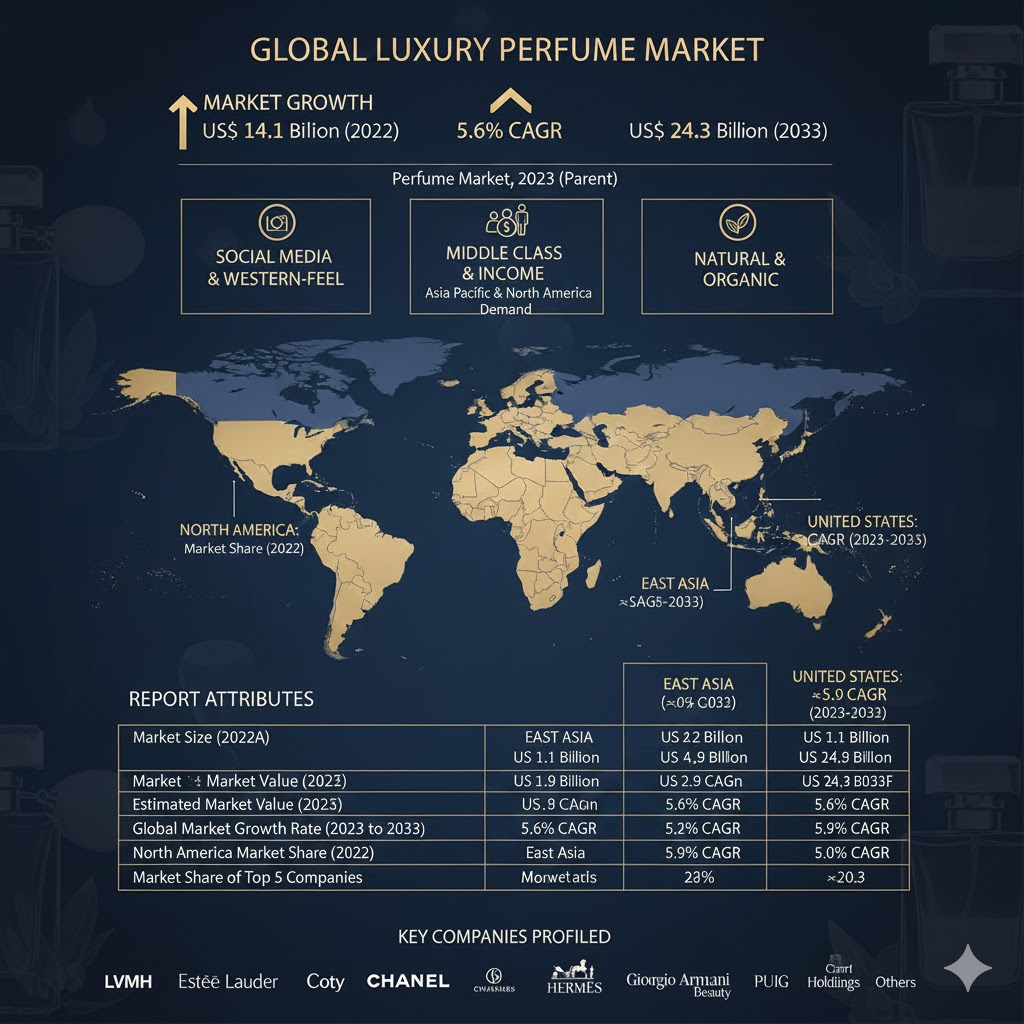
The global luxury perfume market is projected to grow from approximately USD 63 billion in 2023 to USD 99 billion by 2033, reflecting a compound annual growth rate (CAGR) of 4.7%. Luxury perfumes are outperforming mass-market fragrances due to higher margins, repeat purchases, and the emotional connection consumers have with scent.
Premium fragrances are increasingly resilient in uncertain economic conditions, as consumers treat them as affordable indulgences. Their repeatable purchase cycles and aspirational branding ensure sustained demand even when larger luxury categories slow.
Market Outlook: Key Segments and Regional Drivers
-
Concentration by Product Type:
-
Eau de Parfum dominates with 55% market share, followed by Eau de Toilette at 35%, and niche/exclusive offerings at 10%.
-
Limited editions and bespoke fragrances are experiencing annual growth of 7–9%, outperforming standard product lines.
-
-
Regional Trends:
-
North America accounts for 32% of the global luxury perfume market, driven by strong brand loyalty and high per-capita spending.
-
Europe represents 28%, led by France, Italy, and Germany, emphasizing heritage brands and artisanal products.
-
Asia-Pacific is the fastest-growing region at 6.2% CAGR, with China, India, and Southeast Asia driving both prestige and niche fragrance adoption.
-
Middle East and Latin America show steady growth of 4–5% CAGR, with demand concentrated on both Western luxury brands and regional artisanal perfumes.
-
Key Growth Drivers
1. Premiumisation and Niche Expansion
-
Niche fragrances now represent 10% of total luxury perfume revenue, up from 6% five years ago.
-
High-concentration perfumes (Extrait de Parfum) have grown 8% annually, driven by limited editions and personalized scent experiences.
2. Lifestyle and Emotional Well-Being
-
Multi-fragrance ownership is rising; 62% of luxury consumers now own more than three perfumes for different occasions.
-
Usage frequency is increasing, with average weekly wear rising from 2.8 to 3.5 days per week over the last decade.
3. Emerging Market Momentum
-
Asia-Pacific luxury perfume revenue is expected to increase from USD 15 billion in 2023 to USD 27 billion by 2033.
-
Urban middle and upper classes are contributing to annual sales growth of 6–7% in China, India, and Southeast Asia.
Disruption Signals
Digital Influence and Social Commerce
-
Social media now drives up to 40% of new product adoption in the luxury perfume space among Gen Z and Millennials.
-
Online sales of luxury perfumes are projected to reach USD 15 billion by 2030, up from USD 5 billion in 2023.
Sustainability and Ingredient Transparency
-
68% of consumers under 35 consider sustainable sourcing and refillable packaging essential when purchasing luxury perfumes.
-
Brands adopting eco-friendly initiatives report average sales uplift of 5–7%, demonstrating direct ROI on sustainability efforts.
Formulation Innovation
-
Use of high-quality synthetic and lab-grown aroma molecules is projected to grow 9% annually, ensuring scent consistency, scalability, and reduced environmental impact.
-
Limited natural resources and increasing raw material costs are expected to make these innovations critical for premium fragrance profitability.
Competitive Landscape
-
Top-tier global conglomerates hold 60% of the luxury fragrance market by revenue, leveraging scale, marketing power, and R&D capabilities.
-
Independent niche houses capture 10–15% but are growing faster than legacy brands due to exclusivity, personalization, and cultural relevance.
-
Acquisition activity is intensifying as conglomerates target high-growth niche brands with annual M&A spend estimated at USD 500 million–USD 700 million in the fragrance segment.
Future Industry Scenarios
Scenario 1: Premium Acceleration
-
CAGR of 5.5–6% with niche and artisanal fragrances driving the fastest growth.
-
Adoption of AI-driven personalization and experiential retail strengthens brand loyalty.
Scenario 2: Fragmented Growth
-
Overall market CAGR of 4–4.5% with value captured unevenly.
-
Independent niche brands outperform larger players but require high marketing and innovation budgets.
Scenario 3: Value-Conscious Luxury
-
CAGR slows to 3–3.5% due to economic caution.
-
Refillable formats and smaller bottles gain adoption, with mid-priced luxury fragrances capturing market share from higher-end exclusives.
Browse Full Report : https://www.factmr.com/report/luxury-perfume-market
Strategic Implications
Luxury perfume brands that succeed in the next decade will combine:
-
Scale with authenticity – leveraging distribution while preserving exclusivity.
-
Innovation with sustainability – integrating eco-friendly sourcing, packaging, and lab-grown formulations.
-
Heritage with digital agility – balancing brand storytelling with social commerce and online engagement.
Brands aligning these factors will capitalize on a market where fragrance is no longer just a product, but a personal, emotional, and aspirational statement.