The automotive front-end module (FEM) market is witnessing significant growth as vehicle manufacturers increasingly focus on improving safety, aesthetics, and performance. Front-end modules, which include components such as bumper systems, radiator supports, headlamp assemblies, grille systems, and impact-absorbing structures, are critical in protecting both vehicle occupants and pedestrians during collisions. Beyond safety, FEMs play a vital role in vehicle aerodynamics, cooling efficiency, and overall design appeal. The rising emphasis on advanced safety regulations, crashworthiness, and lightweight materials is driving the adoption of sophisticated front-end modules in modern vehicles. This article explores the automotive front-end module market in depth, highlighting key drivers, technological trends, regional dynamics, and future growth opportunities.
Market Overview:
Automotive front-end modules are engineered assemblies designed to integrate multiple vehicle components at the front of the vehicle. They serve a dual purpose: enhancing occupant and pedestrian safety while supporting the vehicle’s structural integrity and functionality. FEMs are crucial for energy absorption in front-end collisions, reducing repair costs, and improving vehicle aerodynamics. They also accommodate advanced sensors and electronic components, particularly in modern vehicles equipped with ADAS (Advanced Driver Assistance Systems) and autonomous driving technologies.
The market has evolved with the growing adoption of modular designs, which allow manufacturers to assemble front-end components efficiently while maintaining high-quality standards. FEMs are now increasingly lightweight and made from materials such as aluminum, high-strength steel, and composite plastics to improve fuel efficiency without compromising safety.
Key Growth Drivers:
The primary drivers for the automotive front-end module market include stringent safety regulations, growing vehicle production, and the increasing adoption of electric and autonomous vehicles. Governments worldwide are enforcing crash safety standards that compel automakers to implement advanced front-end designs capable of reducing the impact of collisions on both occupants and pedestrians.
Another significant driver is the rise of electric vehicles (EVs), which require redesigned front-end structures to accommodate battery cooling systems, sensors, and electric propulsion components. As EVs lack a traditional engine at the front, FEMs must integrate new functionalities while maintaining crashworthiness.
Consumer preference for aesthetically appealing vehicles also supports market growth, as front-end modules directly influence vehicle design, styling, and brand identity. Manufacturers are increasingly investing in lightweight, durable, and aerodynamic FEMs to meet consumer demands for performance, efficiency, and safety.
Regional Insights:
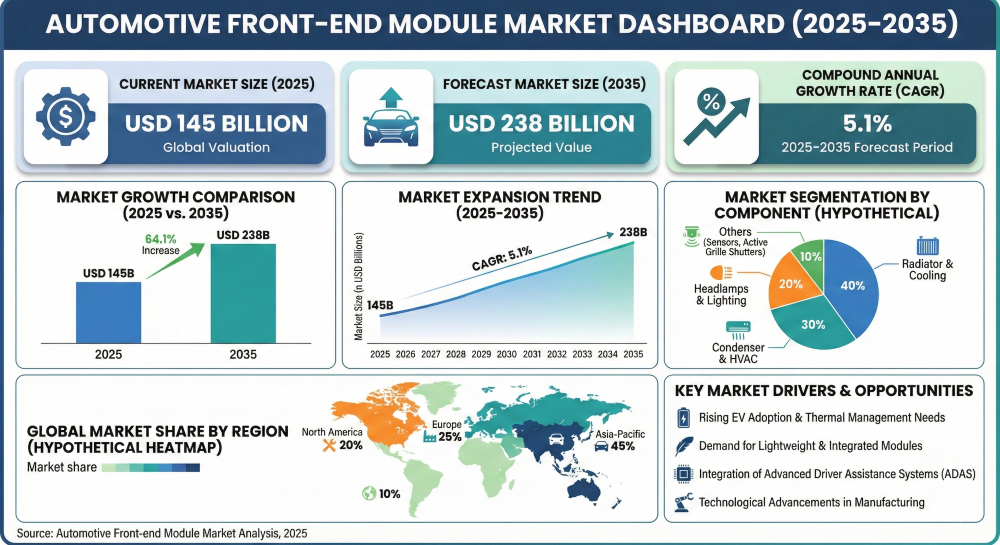
North America is a key market for automotive front-end modules, driven by the presence of leading automotive manufacturers, advanced safety regulations, and high adoption rates of premium and electric vehicles. The United States, in particular, is a hub for innovation in FEM technologies due to strong research and development capabilities and stringent crash-test mandates.
Europe also represents a major market, with countries like Germany, France, and Italy emphasizing vehicle safety, lightweight design, and fuel efficiency. The region is witnessing growth in electric and hybrid vehicles, which are influencing front-end module designs to accommodate advanced propulsion and sensor technologies.
Asia-Pacific is emerging as the fastest-growing market, propelled by rapid vehicle production in China, India, and Japan. Rising consumer demand, urbanization, and increasing vehicle safety awareness are driving investments in high-quality front-end modules. Emerging markets in Southeast Asia also present opportunities for growth as automotive manufacturing expands.
Technological Trends:
The automotive front-end module market is evolving with significant technological advancements. Lightweight materials such as aluminum alloys, reinforced plastics, and composite materials are increasingly used to reduce vehicle weight and improve fuel efficiency. These materials also provide high strength-to-weight ratios, ensuring safety standards are met.
Integration of sensors and electronics is another critical trend. Front-end modules now often house radar, lidar, and camera systems for ADAS features, including collision avoidance, adaptive cruise control, and pedestrian detection. Modular design approaches are enabling manufacturers to streamline production, reduce costs, and customize FEMs for different vehicle models efficiently.
Challenges:
Despite its growth, the automotive front-end module market faces challenges. High manufacturing costs of advanced materials and modular designs may limit adoption in cost-sensitive segments. The integration of electronic sensors and complex assemblies requires sophisticated engineering and testing, which can increase production timelines. Additionally, regulatory differences across regions may create challenges for global manufacturers in standardizing designs.
Conclusion:
The automotive front-end module market is poised for steady growth as vehicle safety, aesthetics, and technological integration remain critical priorities for manufacturers. Advanced materials, modular designs, and sensor integration are transforming FEMs into multifunctional components that enhance vehicle performance, safety, and efficiency. While challenges such as cost pressures and regulatory compliance exist, opportunities in electric vehicles, autonomous driving, and emerging markets offer significant potential for growth.
As the automotive industry continues to evolve, front-end modules will remain a crucial area of innovation, ensuring vehicles meet the dual demands of safety and design excellence. Manufacturers, suppliers, and stakeholders investing in advanced FEM technologies are well-positioned to capitalize on the market’s expansion and contribute to the development of safer, more efficient, and aesthetically appealing vehicles.
Browse Full Report – https://www.factmr.com/report/29/automotive-front-end-module-market