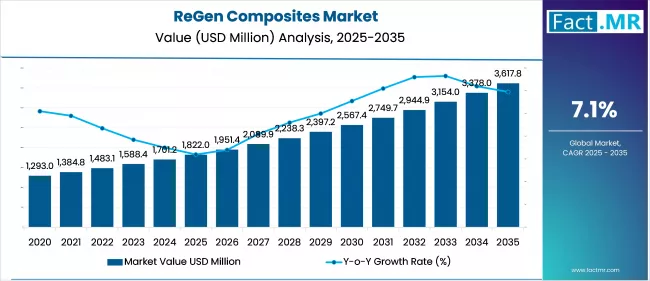
The ReGen composites market is projected to witness robust growth over the coming decade as industries worldwide intensify efforts to adopt sustainable materials, reduce carbon footprints, and improve performance in structural applications. In 2026, the market is estimated at USD 4.5 billion, and it is expected to reach USD 12.8 billion by 2036, representing an absolute increase of USD 8.3 billion over the forecast period. This growth corresponds to a compound annual growth rate (CAGR) of approximately 10.9% between 2026 and 2036, driven by rising demand for recyclable composite materials in automotive, aerospace, wind energy, infrastructure, and consumer goods sectors.
ReGen composites (short for recycled and regenerated composites) consist of advanced materials derived from reclaimed fibers, reprocessed resins, and circular feedstocks that deliver high strength-to-weight ratios while supporting environmental sustainability objectives. These materials enable manufacturers to reduce reliance on virgin raw materials, improve end-of-life recyclability, and achieve performance metrics comparable to traditional composite systems.
Quick Market Snapshot (2026–2036)
-
Market Value (2026): USD 4.5 Billion
-
Market Forecast Value (2036): USD 12.8 Billion
-
Forecast CAGR: ~10.9%
-
Leading Fiber Types: Recycled carbon fiber, recycled glass fiber
-
Major End-Use Industries: Automotive, aerospace, wind energy, construction
-
Key Growth Regions: North America, Europe, Asia Pacific
-
Primary Drivers: Lightweighting targets, circular economy initiatives, regulatory sustainability mandates
To access the complete data tables and in-depth insights, request a Discount On The Report here: https://www.factmr.com/connectus/sample?flag=S&rep_id=10846
Market Overview
ReGen composites encompass a broad category of engineered materials that integrate recycled or regenerated reinforcement fibers (such as carbon and glass fibers) with thermoplastic or thermoset polymer matrices that have been reclaimed or reprocessed. These composites deliver competitive mechanical properties while significantly reducing environmental impact relative to conventional composites based on virgin fibers and resins.
The rising global focus on sustainability, coupled with increasing regulatory pressure to reduce greenhouse gas emissions and divert waste from landfills, has stimulated innovations in recycling technologies and material recovery processes. ReGen composites support circular material flows by reusing valuable fiber content and enabling lightweight design solutions that lower energy consumption during product use.
Key Demand Drivers
Automotive Lightweighting and Emissions Reduction
Automotive manufacturers are rapidly adopting ReGen composites to meet stringent fuel efficiency and emissions standards. Lightweight materials reduce vehicle mass, improve energy efficiency, and support electric vehicle range extension. Recycled fiber composites provide a sustainable alternative to metals and virgin composites in body panels, interior components, and structural elements without compromising performance.
Sustainability and Circular Economy Goals
Corporate sustainability commitments and circular economy strategies are prompting companies across industries to integrate recycled content into product designs. ReGen composites offer quantifiable environmental benefits, including reduced embodied carbon, lower reliance on virgin feedstocks, and improved end-of-life recyclability. These benefits align with global ESG (environmental, social, and governance) objectives and consumer demand for eco-friendly products.
Renewable Energy Sector Expansion
The wind energy industry is a key adopter of advanced composites for turbine blades due to their high strength and fatigue resistance. As the sector expands, sustainability considerations are encouraging the use of recycled fiber composites in blade manufacturing and aftermarket components. ReGen materials support lifecycle performance while addressing concerns about end-of-life blade disposal.
Infrastructure and Construction Needs
ReGen composites are increasingly used in infrastructure applications, such as bridge retrofitting, architectural components, and lightweight load-bearing structures. Their corrosion resistance and durability make them attractive in harsh environments, and recycled composites further enhance sustainability credentials for green building projects.
Market Segmentation Insights
By Fiber Type
-
Recycled Carbon Fiber: Dominant segment due to high performance and strong demand in automotive and aerospace sectors. Recycled carbon fiber composites offer excellent stiffness and strength characteristics while reducing environmental impact.
-
Recycled Glass Fiber: Widely adopted for cost-effective composite solutions in construction, consumer goods, and industrial applications.
-
Other Recycled Reinforcements: Includes natural fiber composites and hybrid blends tailored for specific applications.
By Matrix Material
-
Thermoplastic ReGen Composites: Growing segment due to recyclability, rapid processing, and ease of reshaping. Thermoplastic matrices enable closed-loop recycling and are increasingly used in automotive and consumer goods.
-
Thermoset ReGen Composites: Continue to hold significant market share given established performance in structural applications, with recycling approaches focused on fiber recovery and resin reprocessing.
By End-Use Industry
-
Automotive: Largest demand center as lightweighting and sustainability targets push adoption of recycled composites in exterior panels, interior trim, and structural parts.
-
Aerospace: Strong growth driven by demand for high-performance, lightweight materials with sustainability considerations.
-
Wind Energy: Expansion of renewable energy infrastructure underpins demand for recycled composite materials.
-
Construction & Infrastructure: Use in retrofits, reinforcements, and design elements where durability and sustainability are valued.
-
Consumer Goods & Industrial: Includes electronics housings, sports equipment, and industrial components benefiting from recyclable composite materials.
Regional Demand Dynamics
North America
North America holds a significant share of the ReGen composites market, supported by advanced manufacturing capabilities, strong automotive and aerospace sectors, and proactive sustainability policies. Corporate commitments to reduce carbon footprints and innovative recycling initiatives are driving adoption across key industries.
Europe
Europe exhibits strong growth, driven by stringent environmental regulations and widespread adoption of circular economy principles. ReGen composites are integrated into automotive programs, renewable energy projects, and green infrastructure developments. Investments in recycling technologies and material certification frameworks further accelerate market expansion.
Asia Pacific
Asia Pacific is expected to register rapid growth through 2036, prompted by expanding automotive production, increasing renewable energy capacity, and rising infrastructure investment. Countries in the region are also strengthening recycling infrastructure and implementing sustainability mandates, supporting broader adoption of advanced recycled composite materials.
Other Regions
Latin America, the Middle East, and Africa are emerging markets where industrial modernisation and sustainability initiatives are gradually driving interest in ReGen composites. Increasing awareness of environmental impact and participation in global supply chains are contributing to gradual market penetration.
Competitive Landscape
The ReGen composites market is moderately competitive, featuring participation from global composite resin producers, recycling technology firms, material manufacturers, and specialty engineering enterprises. Key strategies among market players include expansion of recycled fiber processing capacities, development of high-performance ReGen resin systems, licensing of proprietary recycling technologies, and collaboration with OEMs in automotive, aerospace, and industrial sectors.
Innovation is centred on improving recycled fiber quality, enhancing composite performance, reducing processing costs, and expanding application versatility. Companies are also engaging in partnerships with end users and recyclers to establish closed-loop supply chains that ensure consistent feedstock quality and traceability.
Future Outlook
The ReGen composites market is expected to maintain strong growth through 2036 as sustainability mandates, lightweighting needs, and recycling innovations converge to reshape material preferences across industries. Continued advancements in mechanical and chemical recycling processes, coupled with increasing regulatory support for circular materials, will expand the feasibility and adoption of recycled composite solutions.
As global value chains evolve toward reduced environmental impact and improved resource efficiency, ReGen composites will play a key role in delivering high-performance, eco-responsible materials that meet both technical requirements and sustainability expectations.
Browse Full Report: https://www.factmr.com/report/regen-composites-market