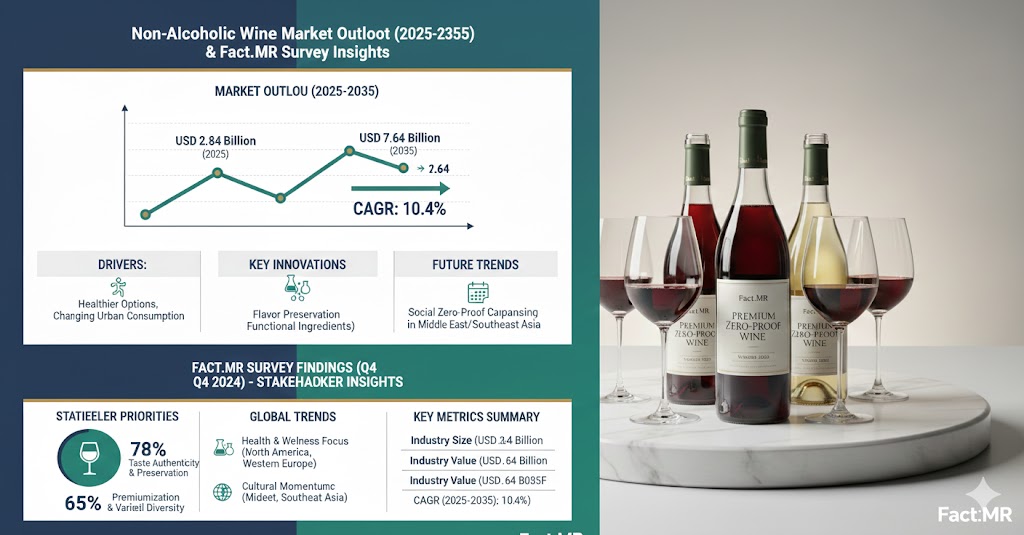
The global non-alcoholic wine market is poised for rapid expansion, driven by increasing health consciousness, lifestyle moderation, and advances in production technology. In 2025, the market is estimated at USD 2.84 billion and is projected to reach USD 7.64 billion by 2035, reflecting a CAGR of 10.4% over the forecast period.
Consumer Trends Fueling Growth
The surge in demand is primarily driven by shifting consumer attitudes. Around 62% of millennials and 55% of Gen Z report reducing alcohol consumption due to health, wellness, and social reasons. Urban populations in North America and Western Europe increasingly prefer non-alcoholic wines that maintain the sensory and social experience of traditional wine without the associated health risks.
Health-conscious consumers are not only seeking zero-alcohol alternatives but also products with functional benefits, such as lower calories, organic ingredients, and botanical infusions. Surveys indicate that 48% of non-alcoholic wine buyers are motivated by calorie reduction, while 35% prioritize alcohol-free labels for lifestyle reasons.
Market Segmentation by Product Type
The non-alcoholic wine market is segmented into still wines, sparkling wines, and flavored wines:
-
Sparkling non-alcoholic wines dominate with 42% market share, reflecting a preference for celebratory and premium experiences. Annual growth in this segment is projected at 11.5% CAGR through 2035.
-
Still non-alcoholic wines account for 38% of the market, growing at 9.2% CAGR, appealing to consumers seeking daily consumption options.
-
Flavored non-alcoholic wines hold 20% market share, with a higher growth trajectory of 12.3% CAGR due to innovative flavor combinations attracting younger demographics.
Alcohol Concentration Trends
Non-alcoholic wines are classified by residual alcohol content:
-
0.0% ABV (completely alcohol-free) represents 68% of sales, reflecting rising consumer demand for total alcohol avoidance.
-
Up to 0.5% ABV captures 32% of the market, catering to traditional wine consumers who prefer minimal alcohol content while maintaining taste profiles.
Packaging Insights
Packaging is another significant driver of adoption:
-
Glass bottles account for 59% of sales, primarily in premium and gifting segments.
-
Cans and Tetra Pak formats are growing at 13.2% CAGR, appealing to on-the-go consumption, sustainability-conscious consumers, and younger demographics.
Distribution Channels
Non-alcoholic wine is increasingly available through multiple channels:
-
On-trade (restaurants, bars, hotels) holds 46% of sales, supported by premium dining experiences and social drinking occasions.
-
Off-trade (supermarkets, specialty stores) captures 38%, benefiting from increasing retail penetration.
-
Online sales are the fastest-growing channel, with 16% market share and a CAGR of 15.8%, driven by convenience, personalized offerings, and subscription models.
Regional Growth Outlook
The market exhibits strong regional variations:
-
North America: Market size is USD 1.1 billion in 2025, growing at 5.2% CAGR. Consumers show strong preference for sparkling wines, online channels, and premium products.
-
Europe: Valued at USD 950 million in 2025, with a CAGR of 6.0%, led by Germany, the UK, and France. Sustainability and premiumization are key drivers.
-
Asia-Pacific: Currently USD 450 million, expected to grow at 7.1% CAGR. India and China are major contributors, with rising urban incomes and health awareness influencing purchase decisions.
-
Rest of the World: Markets in the Middle East, Africa, and Latin America are smaller but growing at 8–9% CAGR, aided by cultural preference for non-alcoholic alternatives and expanding retail networks.
Technological Advancements Driving Quality
The growth of the non-alcoholic wine market is supported by advanced production techniques:
-
Vacuum distillation and reverse osmosis maintain flavor and aroma while removing alcohol.
-
Fermentation control and flavor stabilization ensure that the final product mimics the sensory profile of conventional wine.
-
Innovations in botanicals and adaptogens allow producers to differentiate products with health-oriented features.
These advancements have increased repeat purchase rates, with approximately 41% of consumers reporting satisfaction levels equivalent to conventional wines.
Market Challenges
Despite strong growth, challenges remain:
-
Regulatory variations across countries create hurdles for labeling and marketing.
-
Cost pressures from premium ingredients and sustainable packaging impact profit margins.
-
Consumer education is critical, as 28% of potential buyers are hesitant due to perceptions of taste differences from traditional wine.
Competitive Landscape
The market is highly competitive, with established wine brands and emerging boutique producers investing in:
-
R&D for flavor and alcohol-free innovation
-
Digital marketing and e-commerce presence
-
Premiumization and sustainable practices
Forecasts suggest that companies investing in brand differentiation, functional benefits, and digital reach are likely to capture higher market share over the next decade.
Browse Full Report : https://www.factmr.com/report/4532/non-alcoholic-wine-market
Conclusion
The non-alcoholic wine market is set for unprecedented growth over the next decade, driven by evolving consumer behavior, technological innovation, and a global shift toward healthier lifestyles. By 2035, the market is projected to surpass USD 7.6 billion, with sparkling wines, zero-alcohol formats, and online channels leading the charge. With strong growth across North America, Europe, and Asia-Pacific, the segment is well-positioned to transform social drinking and redefine modern beverage consumption.