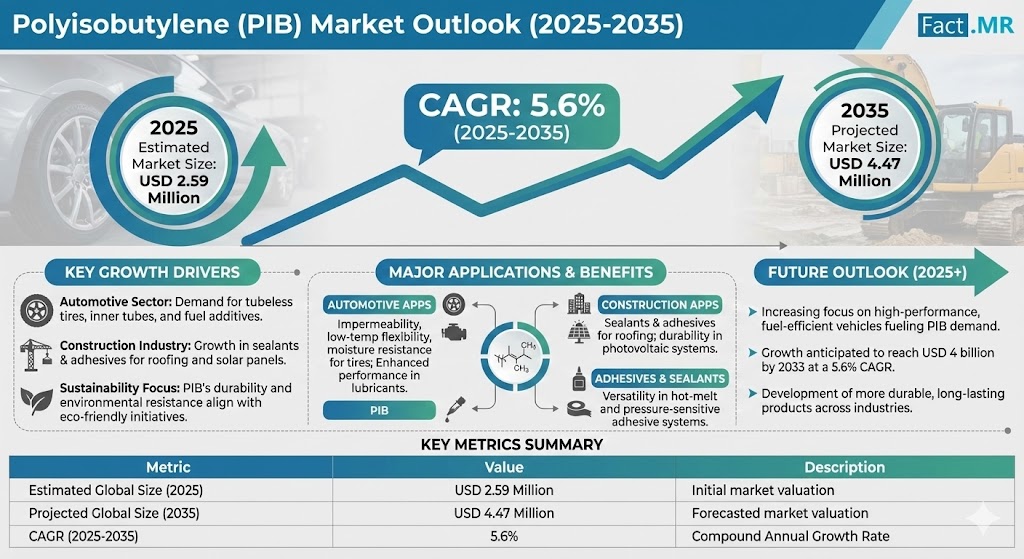
The global polyisobutylene (PIB) market is projected to grow from USD 4.2 billion in 2026 to approximately USD 6.8 billion by 2036, reflecting a CAGR of 4.5% over the forecast period. This growth is driven by increasing demand in automotive, lubricant additives, construction, and adhesive industries, along with rising industrialization in emerging economies. PIB’s properties—excellent gas impermeability, moisture resistance, chemical stability, and high elasticity—make it a critical polymer in diverse applications.
Regional Market Insights
-
Asia-Pacific is the largest and fastest-growing region, expected to account for over 45% of global PIB demand by 2036. China and India alone will contribute to nearly 30% of total consumption, propelled by automotive tire production, lubricant additive manufacturing, and industrial sealant usage.
-
North America is projected to maintain a steady CAGR of 3.8%, driven by lubricant additives and performance polymer demand in the automotive and industrial sectors.
-
Europe will see moderate growth of 3.5% CAGR, influenced by stricter sustainability regulations and demand for eco-friendly PIB grades.
Market Segmentation
By Molecular Weight
-
High molecular weight PIB is forecast to capture approximately 60% of market share by 2036 due to its superior mechanical and barrier properties, especially in tires, seals, and industrial applications.
-
Low and medium molecular weight PIB will account for the remaining 40%, used primarily in lubricant additives, adhesives, and specialty chemical applications.
By Product Type
-
Conventional PIB will hold the largest share at around 55%, owing to its cost-effectiveness and broad utility in adhesives, sealants, and industrial manufacturing.
-
Highly reactive PIB (HR-PIB) is expected to witness the fastest growth at 6.2% CAGR, driven by demand in advanced fuel additives, performance polymers, and high-tech composites.
By End-Use Industry
-
Automotive: The largest application segment, estimated to account for 35% of total market volume by 2036. Growth is fueled by demand for fuel-efficient tires, EV-compatible materials, lubricants, and sealing compounds.
-
Lubricants & Fuel Additives: Projected to reach USD 2.1 billion by 2036, growing at 5% CAGR, with PIB enhancing viscosity and thermal stability in engine oils.
-
Construction & Adhesives: Expected to grow steadily at 4% CAGR, as demand for PIB-based sealants, adhesives, and insulation materials increases.
-
Packaging & Specialty Applications: Niche segment projected to reach USD 0.7 billion by 2036, leveraging PIB’s barrier properties in pharmaceuticals, medical devices, and flexible packaging.
Market Drivers
-
Automotive Industry Expansion: Growth of tire production and EV adoption is expected to increase high molecular weight PIB consumption by ~40% over the decade.
-
Lubricant Additive Demand: Increasing engine efficiency standards and industrial equipment maintenance will drive PIB-based additive consumption at 5–6% CAGR.
-
Construction & Adhesive Use: Rising infrastructure development, especially in Asia-Pacific and the Middle East, will boost PIB-based sealants and adhesives demand.
-
Sustainability Trends: Eco-friendly and recyclable PIB variants are expected to see CAGR of 6.0%, reflecting regulatory pressures and consumer preferences for sustainable materials.
Key Opportunities
-
High-Performance Automotive Materials: R&D into EV-compatible, lightweight, and fuel-efficient tire and seal materials.
-
Specialty Lubricants & Industrial Applications: Development of high-performance HR-PIB for next-generation lubricants and industrial chemicals.
-
Sustainable & Bio-Based PIB: Investment in recyclable, eco-friendly PIB formulations to align with global regulatory trends.
-
Global Partnerships & M&A: Strategic alliances with OEMs, industrial chemical manufacturers, and infrastructure developers to accelerate adoption and market share.
Browse Full Report : https://www.factmr.com/report/5160/polyisobutene-market
Market Constraints
-
Raw Material Price Volatility: Isobutylene price fluctuations may affect production costs and margins.
-
Regulatory Challenges: Compliance with chemical safety and environmental laws can increase reformulation costs.
-
Competition from Alternative Polymers: Rising adoption of bio-based or alternative polymers may limit PIB penetration in select industries.
Forecast Summary (2026–2036)
| Segment | 2026 (USD Billion) | 2036 (USD Billion) | CAGR (%) |
|---|---|---|---|
| Global PIB Market | 4.2 | 6.8 | 4.5 |
| High Molecular Weight PIB | 2.4 | 4.1 | 4.9 |
| Low/Medium Molecular Weight PIB | 1.8 | 2.7 | 4.0 |
| Automotive | 1.3 | 2.4 | 5.0 |
| Lubricants & Fuel Additives | 1.3 | 2.1 | 5.0 |
| Construction & Adhesives | 0.9 | 1.3 | 4.0 |
| Packaging & Specialty | 0.7 | 0.7 | 3.0 |
Conclusion
The polyisobutylene market is on track for sustained growth through 2036, with strong demand in automotive, lubricants, construction, and specialty applications driving value creation. High molecular weight PIB and HR-PIB are expected to offer the highest growth opportunities, while Asia-Pacific will continue to dominate regional consumption. Market leaders who focus on innovation, sustainability, and strategic partnerships are likely to gain competitive advantages in the coming decade.
With a clear data-driven roadmap, businesses can make informed investment, R&D, and production decisions, ensuring they capture the full potential of the evolving PIB market.