The global market for environmentally safe road marking paint additives is undergoing a structural transformation as sustainability shifts from a regulatory requirement to a core competitive differentiator. By 2036, this segment is expected to play a pivotal role in the broader road marking ecosystem, reshaping product formulations, procurement strategies, and innovation roadmaps across infrastructure value chains.
Market Size and Growth Outlook to 2036
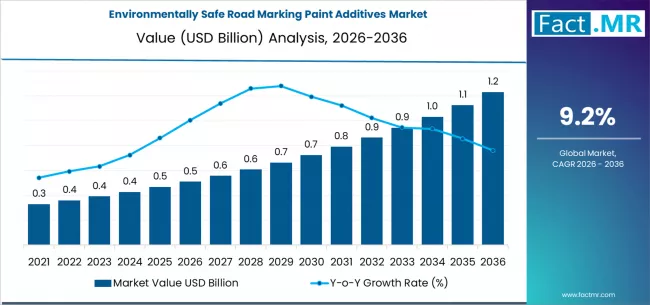
The environmentally safe road marking paint additives market is projected to expand from USD 556.4 million in 2026 to USD 1,341.6 million by 2036, representing a robust CAGR of 9.2% over the forecast period. This growth rate significantly outpaces the broader road marking paints and coatings market, which is growing at approximately 4–6% CAGR, underscoring the accelerating shift toward eco-friendly additive technologies.
From a value-chain perspective, additives account for a relatively small proportion of total paint formulation costs, yet they exert a disproportionate influence on performance parameters such as durability, reflectivity retention, drying time, and environmental compliance. As a result, municipalities and contractors increasingly prioritize additive innovation when upgrading road marking systems.
Sustainability as a Structural Growth Driver
Environmental regulation is the single most powerful catalyst transforming this market. Governments across North America, Europe, and parts of Asia-Pacific are tightening restrictions on volatile organic compounds (VOCs), heavy metals, and solvent-based chemistries used in infrastructure coatings. Regulatory frameworks have accelerated the adoption of low-VOC and zero-VOC additive systems.
Beyond compliance, sustainability is now closely linked to lifecycle cost reduction. Studies on road marking durability show that paint selection and additive composition are the dominant factors influencing service life, reducing the frequency of repainting and associated emissions. As public infrastructure budgets increasingly integrate carbon accounting, environmentally safe additives are gaining preference due to their lower total environmental footprint.
Innovation Trends Shaping the Market
Innovation in environmentally safe road marking paint additives is concentrated in four key areas:
-
Waterborne and Bio-Based Additives
Waterborne road marking paints currently account for approximately 34% of additive demand, making them the leading segment by formulation type. Additives compatible with water-based systems—such as bio-derived dispersants, non-toxic rheology modifiers, and biodegradable plasticizers—are gaining rapid adoption. Bio-based polymers and resins, often derived from renewable feedstocks, are increasingly replacing petroleum-based alternatives without compromising performance. -
Enhanced Durability and Reflectivity Retention
Innovation is shifting from basic compliance to performance optimization. Advanced additives now improve glass bead adhesion, UV resistance, and abrasion tolerance, extending marking life in high-traffic environments. Highways and expressways already represent about 32% of total demand, reflecting the premium placed on long-lasting, low-maintenance solutions in critical transport corridors. -
Cold-Applied and Low-Energy Technologies
Cold-applied plastics (CAP), water-based acrylics, and low-temperature curing systems are emerging as alternatives to energy-intensive thermoplastics. These technologies reduce application emissions and energy consumption while enabling faster reopening of traffic lanes—an increasingly important operational metric for urban authorities. -
Digitalization and Smart Manufacturing
Additive manufacturers are integrating digital tools into R&D and production, enabling real-time quality control and predictive performance modeling. This improves formulation consistency while shortening innovation cycles, giving early adopters a competitive edge in meeting evolving regulatory and customer requirements.
Regional Dynamics and Demand Hotspots
While Europe and North America remain regulatory-driven markets, Asia-Pacific—particularly India—is emerging as a high-growth region due to massive road infrastructure investments combined with rising environmental awareness. In parallel, Germany’s environmentally safe road marking additives market is forecast to grow at around 7.6% CAGR, driven by strict sustainability standards and advanced municipal procurement policies.
These regional dynamics indicate a gradual convergence of environmental standards, reducing fragmentation and enabling global suppliers to scale standardized eco-friendly additive platforms.
Competitive Positioning and Industry Structure
The competitive landscape is moderately consolidated, with multinational chemical and coatings companies such as 3M, BASF SE, Dow Inc., PPG Industries, and Sherwin-Williams leveraging scale, R&D depth, and regulatory expertise to maintain leadership positions. Competitive differentiation increasingly depends on:
-
Ability to deliver multi-functional additives that combine environmental safety with enhanced performance
-
Speed of compliance with evolving regulations across multiple jurisdictions
-
Strategic partnerships with road marking paint manufacturers and infrastructure contractors
Smaller specialty chemical firms, however, are gaining traction by focusing on niche bio-based formulations and region-specific regulatory solutions, suggesting a hybrid competitive structure through 2036.
Browse Full Report : https://www.factmr.com/report/environmentally-safe-road-marking-paint-additives-market
Market Transformation Toward 2036
By 2036, environmentally safe road marking paint additives will transition from a “premium option” to a baseline requirement in most developed and emerging markets. With the market expected to more than double in value over the next decade, growth will be driven not only by volume expansion but also by value-added innovation, where sustainability, durability, and digital enablement converge.
As infrastructure stakeholders prioritize long-term performance, carbon reduction, and public safety, environmentally safe additives will increasingly define competitive success in the road marking industry—positioning this market as a critical enabler of sustainable mobility worldwide.